Clear Sky Science · en
Multilevel evaluation of Prunus cerasifera Ehrh. rootstock candidates on nutritional and biochemical networks in ‘Hacıhaliloğlu’ apricot
Why the right roots matter for your fruit
Apricot growers in hot, dry regions increasingly struggle to keep trees healthy while using less water and fertilizer. This study shows that what happens below ground – in the hidden partnership between roots and shoots – can make the difference between trees that thrive and trees that merely survive. By testing how different plum root systems influence a popular Turkish apricot variety, the researchers reveal how a well-chosen rootstock can quietly manage minerals, hormones, and stress defenses to build tougher, more productive orchards.
Grafting: building a better tree
Most commercial apricot trees are actually biological hybrids: a fruiting top (the scion) attached to a genetically different root system (the rootstock). This grafting technique lets growers pair desirable fruit traits with roots that handle poor soils, drought, or heat. Yet, rootstocks are often chosen mainly on tradition or simple growth traits. In this work, scientists focused on ‘Hacihaliloglu’, a culturally and economically important apricot in Türkiye, and grafted it onto 13 locally selected Prunus cerasifera (cherry plum) rootstock candidates plus a standard commercial type. They then looked far beyond tree height or trunk thickness, probing leaf minerals, stress damage, protective enzymes, hormones, and sugars to see which underground partners truly supported a resilient tree.
Strong roots, well-fed leaves
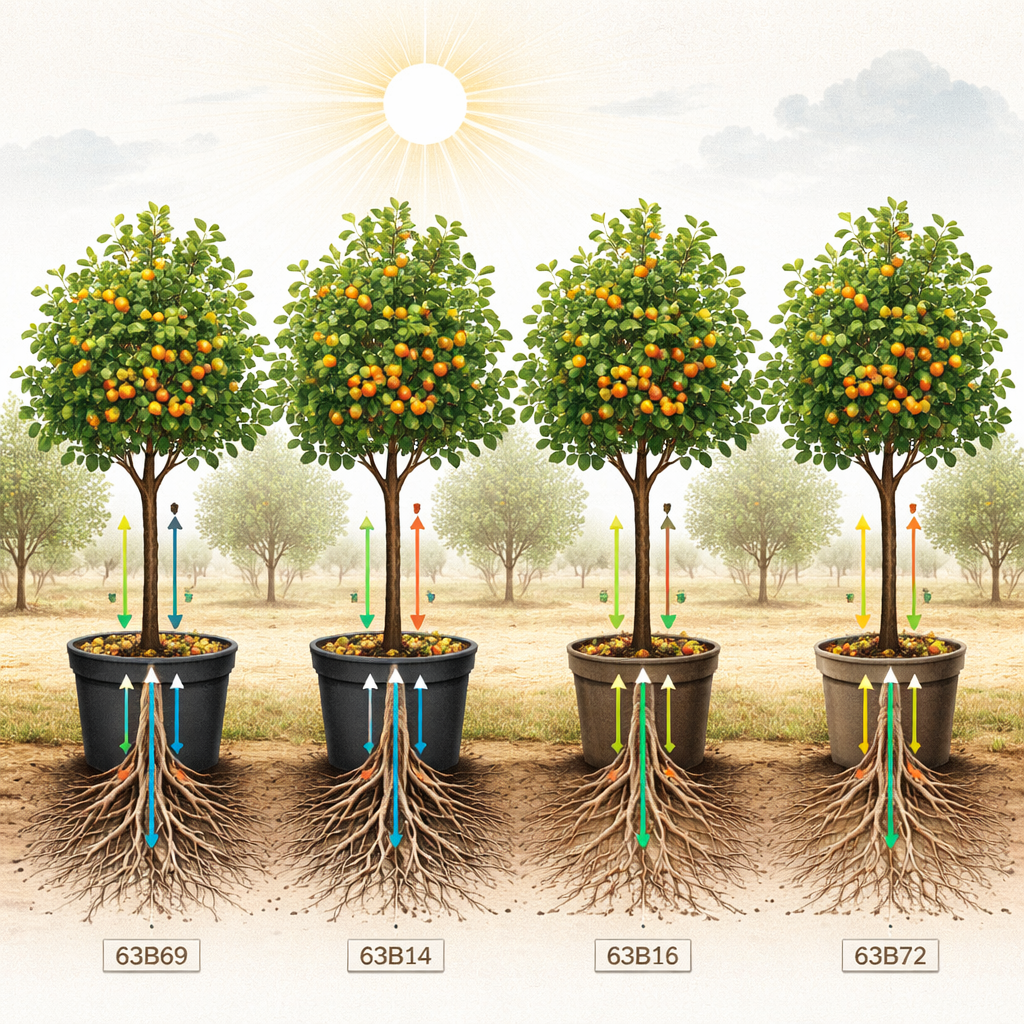
The first finding was nutritional: not all rootstocks were equally good at feeding the scion. Some, especially the genotype called 63B69 and, to a slightly lesser extent, 63B14 and 63B16, moved more nitrogen, phosphorus, potassium, calcium, magnesium, iron, and zinc into the leaves. Trees on these roots had richer mineral profiles than those on weaker candidates such as 63B72. When ‘Hacihaliloglu’ was grafted onto 63B69, leaf nutrient levels often exceeded even those of the ungrafted 63B69 plants, suggesting that the union of these two partners creates an especially efficient pipeline for water and minerals. Because minerals underpin photosynthesis, enzyme function, and growth, this superior uptake sets the stage for better performance under tough conditions.
Defending against invisible stress
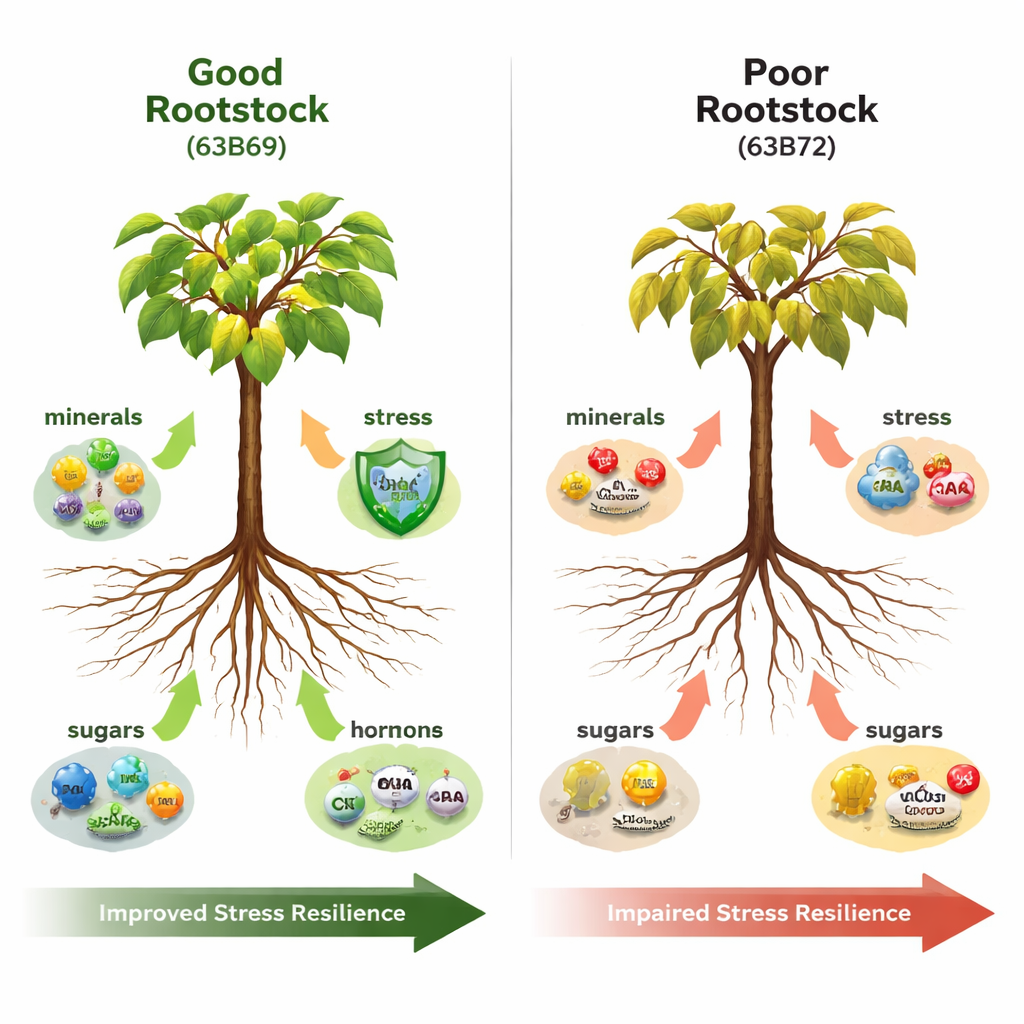
Heat and drought stress quietly damage plant cells by generating reactive oxygen molecules that attack membranes and proteins. The team tracked this hidden battle using chemical markers of damage (hydrogen peroxide and malondialdehyde) and the activity of antioxidant enzymes that neutralize these threats. Once again, 63B69 and its grafted combination H/63B69 stood out. They showed lower levels of oxidative damage and stronger activity of key protective enzymes such as catalase and superoxide dismutase. These trees also accumulated more proline, a small molecule that helps cells retain water and stabilize proteins during stress. In contrast, combinations involving 63B72 carried more damage markers and less proline, indicating that their tissues were under greater strain and less able to cope.
Hormones and sugars: the tree’s internal messaging system
Plants rely on a suite of hormones to balance growth and survival. The study found that favorable rootstocks tended to give ‘Hacihaliloglu’ leaves higher levels of growth-promoting hormones such as auxin, gibberellins, and cytokinins, while keeping the stress hormone abscisic acid in check. Poorer rootstocks showed the opposite pattern, with persistently high stress signals. Sugars told a similar story. Trees on strong rootstocks maintained higher sucrose and fructose – key fuels and signaling molecules – while those on weak roots accumulated more glucose, a pattern linked to less efficient sugar use and potential graft problems. Multivariate analyses showed that grafting reorganized all these factors into a tighter, more integrated network: in the best combinations, minerals, antioxidants, hormones, and sugars worked in concert rather than in isolation.
What this means for future orchards
To a non-specialist grower, the bottom line is clear: rootstock choice is not a minor technical detail, but a decisive factor in whether apricot trees can withstand heat and drought while using nutrients efficiently. The study highlights three local plum genotypes – 63B69, 63B14, and 63B16 – as particularly promising partners for ‘Hacihaliloglu’, consistently delivering better nutrition, stronger stress defenses, and more balanced internal chemistry than weaker candidates. As climate change brings more extreme conditions, using such well-characterized rootstocks could help stabilize yields and reduce inputs. In effect, choosing the right roots equips apricot trees with a built-in life-support system, quietly coordinating water, minerals, and biochemistry to keep the canopy green and productive.
Citation: Bolat, İ., Korkmaz, K., Turan, M. et al. Multilevel evaluation of Prunus cerasifera Ehrh. rootstock candidates on nutritional and biochemical networks in ‘Hacıhaliloğlu’ apricot. Sci Rep 16, 5850 (2026). https://doi.org/10.1038/s41598-026-36460-y
Keywords: apricot rootstocks, grafting, drought stress, plant hormones, antioxidant defenses