Clear Sky Science · en
Evaluation of drip and flood irrigated treatments under varying heat stress on winter wheat: a four-seasons experimental study
Why watering wheat wisely matters
As the world gets hotter and drier in many regions, farmers face a tough puzzle: how to grow more food using less water. Wheat, a staple for billions of people, is especially vulnerable to heatwaves and erratic rainfall. This study follows winter wheat over four growing seasons in northern India to test whether smarter irrigation—especially drip systems guided by soil moisture—can protect harvests and save water even when the weather turns extreme.
A four-year test in a changing climate
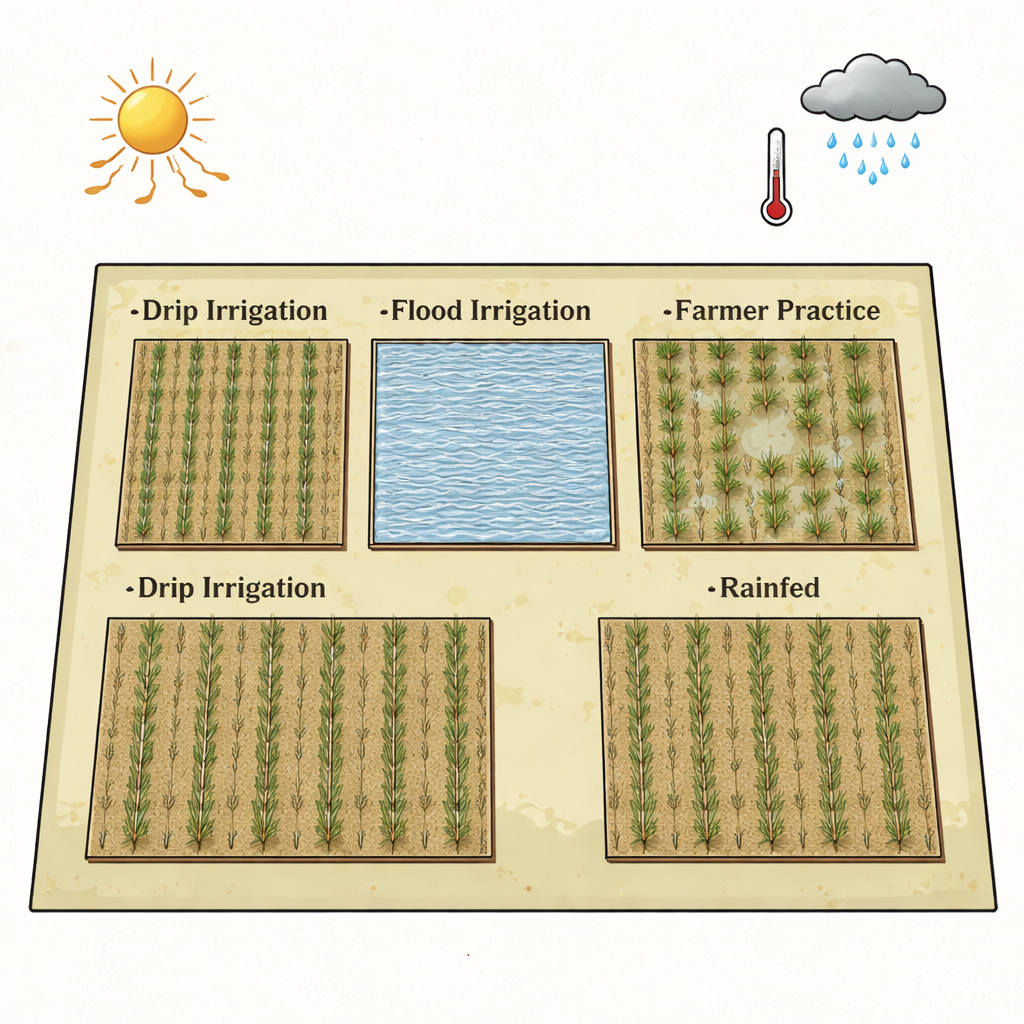
Researchers set up field experiments on sandy loam soils at a university farm in Uttar Pradesh, a humid subtropical region. Over four winters from 2021 to 2025, they grew the same heat-tolerant wheat variety under five watering strategies: two drip-irrigated plots triggered at different soil dryness levels, one carefully scheduled flood-irrigated plot, a “farmer’s practice” plot watered by local rules of thumb, and a mostly rainfed plot given only one early lifesaving irrigation. The seasons naturally delivered very different weather: one with a severe heatwave, one relatively cool and wet, one hotter and dry after flowering, and one punctuated by a damaging hailstorm. This variation created a real-world test bed for how watering methods cope with climate swings.
Heat, rain, and timing of stress
To understand how weather hurt or helped the crop, the team tracked daily temperature and rainfall and translated them into simple heat-stress scores: how many hot days occurred after the wheat heads emerged, how intense the heat was, and how many degrees above a 30 °C threshold the crop experienced. Season 1 had the harshest conditions, with a March heatwave striking during grain filling and almost no rain at that stage. Season 2 was the gentlest, with fewer hot days and well-timed showers during grain filling. Seasons 3 and 4 sat in between: both were warm and relatively dry, but season 4 also saw a hailstorm right as grains began to develop, cutting yields across the board.
Who wins the yield and water race?
Across all four years, one pattern stood out: drip irrigation scheduled at 50% soil moisture depletion consistently produced the highest grain yields and the best use of water. On average, this treatment boosted yield by about 40% compared with the farmer-style flooding, while using less irrigation water. Fully irrigated drip and carefully managed flood irrigation also outperformed the conventional method, but not by as much. In contrast, the rainfed plot and the farmer’s practice plot proved most vulnerable when heat or hail struck, suffering the sharpest drops in yield as heat-stress scores rose. By calculating how many kilograms of wheat were produced per unit of irrigation water and per unit of total water used by the crop, the study showed that scientifically scheduled drip at 50% depletion delivered the highest “water productivity,” followed by fully irrigated drip, then improved flood irrigation, with farmer practice last.
What happens to the water you can’t see
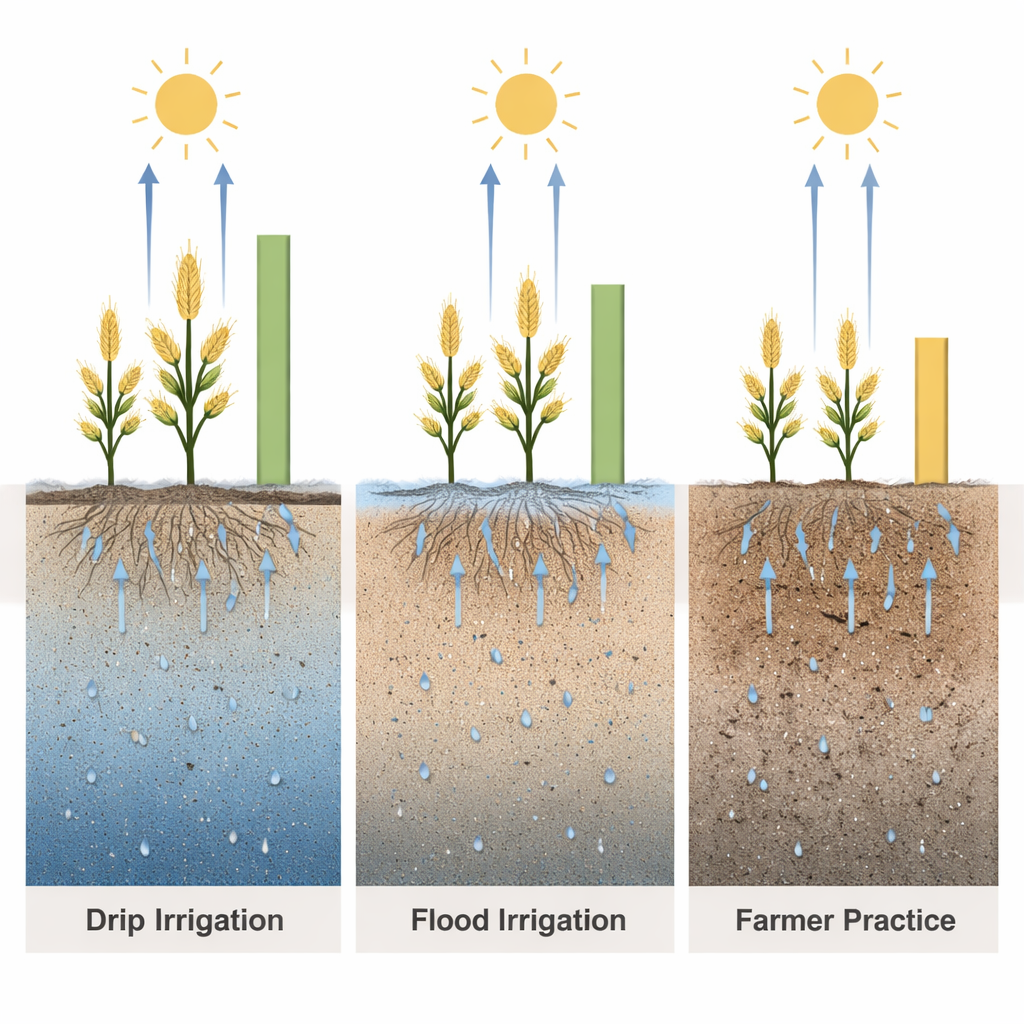
Beyond yield, the researchers examined where the water actually went. They used a field water-balance approach to estimate how much water was stored in the soil, taken up and evaporated by the crop, or lost by seeping below the root zone. In the farmer-practice plots, deep percolation losses were strikingly high—on average more than 80% greater than in the best-performing drip treatment. This meant a large share of the water added by traditional flooding never benefited the plants. In the drip plots, by contrast, water was applied more frequently in smaller amounts, keeping roots supplied without saturating the soil and limiting these hidden losses. Even under heatwaves, this steadier supply helped wheat avoid severe stress during critical growth stages.
Take-home lessons for future harvests
For non-specialists, the message is straightforward: how and when we apply water can matter as much as how much we apply. In this study, drip irrigation guided by soil moisture sensors—especially at the 50% dryness threshold—raised wheat yields, squeezed more grain from every drop, and cushioned the crop against heatwaves and hail compared with conventional farmer watering. While drip systems require higher upfront investment and careful maintenance, similar ideas can be adapted to existing flood systems by using soil moisture measurements to schedule smaller, better-timed irrigations. As climate change makes hot spells and erratic storms more common, such scientifically informed watering strategies offer a practical path to growing more wheat with less water, helping to secure food supplies in water-stressed regions.
Citation: Giri, G., Upreti, H. & Singhal, G.D. Evaluation of drip and flood irrigated treatments under varying heat stress on winter wheat: a four-seasons experimental study. Sci Rep 16, 5798 (2026). https://doi.org/10.1038/s41598-026-36458-6
Keywords: winter wheat, drip irrigation, heat stress, water productivity, climate-resilient farming