Clear Sky Science · en
Semantic-aware fault diagnosis of heavy-duty railway maintenance machinery and its potential in multisensor fusion systems
Keeping Rail Repairs on Track
Behind every smooth train journey is a fleet of heavy-duty machines that inspect, lift, tamp, and realign the tracks. When these complex vehicles fail, delays and safety risks can follow. This paper explores a new way to diagnose faults in such machinery by teaching computers not only to read numerical sensor data, like vibration or temperature, but also to "understand" the words that mechanics write in maintenance logs. By narrowing the gap between numbers and language, the work points toward smarter, more reliable railway maintenance.
Why Machines Still Need Human Words
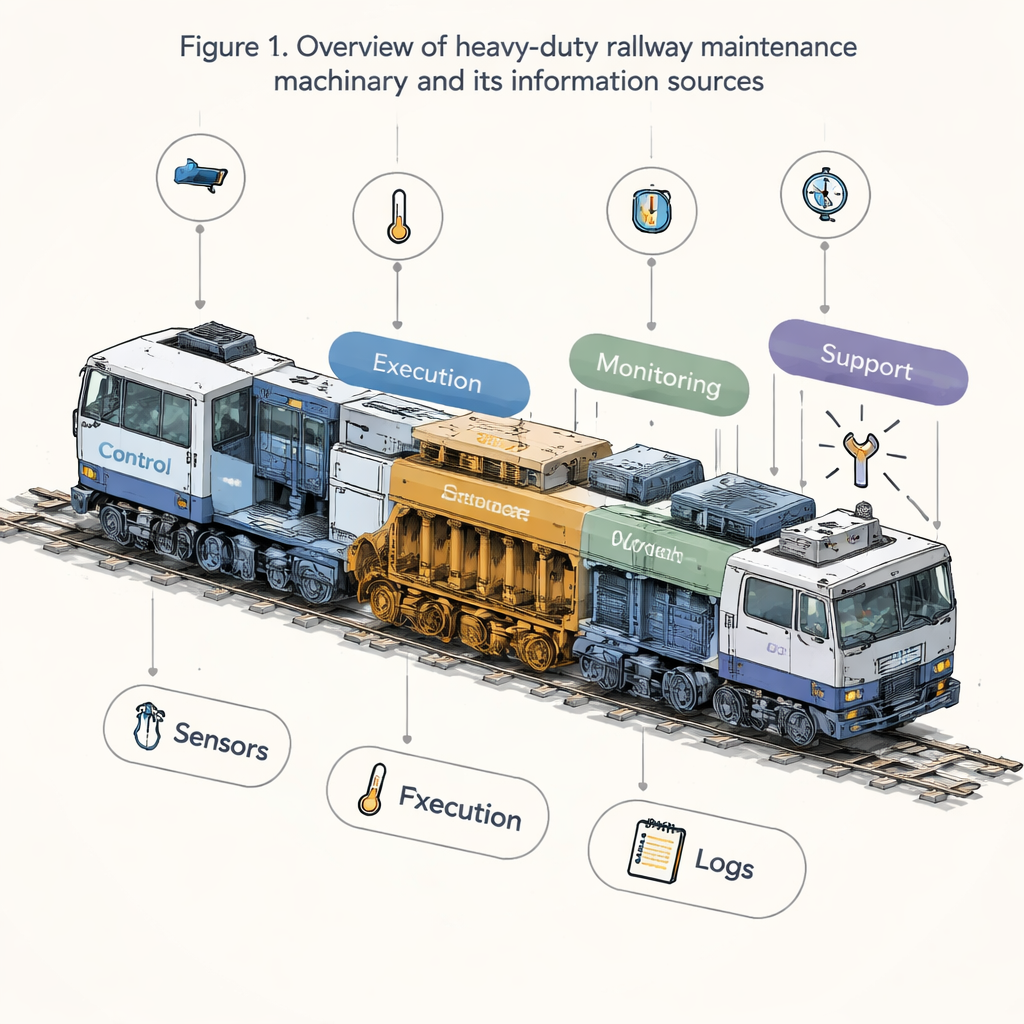
Modern track maintenance machines bristle with sensors that monitor current, pressure, speed, and much more. By combining these readings, engineers can form a detailed picture of a machine’s physical state. Yet, this picture misses something important: meaning. A spike in vibration might hint at a worn bearing or a loose bolt, but the sensor itself cannot tell which. In practice, frontline staff fill this gap by recording symptoms such as "abnormal noise" or "sluggish operation" and noting causes and fixes in written logs. These descriptions capture years of experience, but they are unstructured and hard for computers to use, so most diagnostic systems ignore them.
Turning Text Into a New Kind of Sensor
The authors propose treating maintenance logs as a kind of "virtual semantic sensor"—a software module that converts sentences into standardized signals, much like a temperature probe outputs degrees. Their target machines are large, multi-system track maintenance vehicles, including central control units, power and braking systems, motion systems, and auxiliary support units. For each fault record, they collect short texts describing where the fault occurred, what was observed, why it happened, and how it was fixed. These texts, though brief and sometimes ambiguous, contain crucial clues that complement the signals from physical sensors.
How the Virtual Semantic Sensor Works
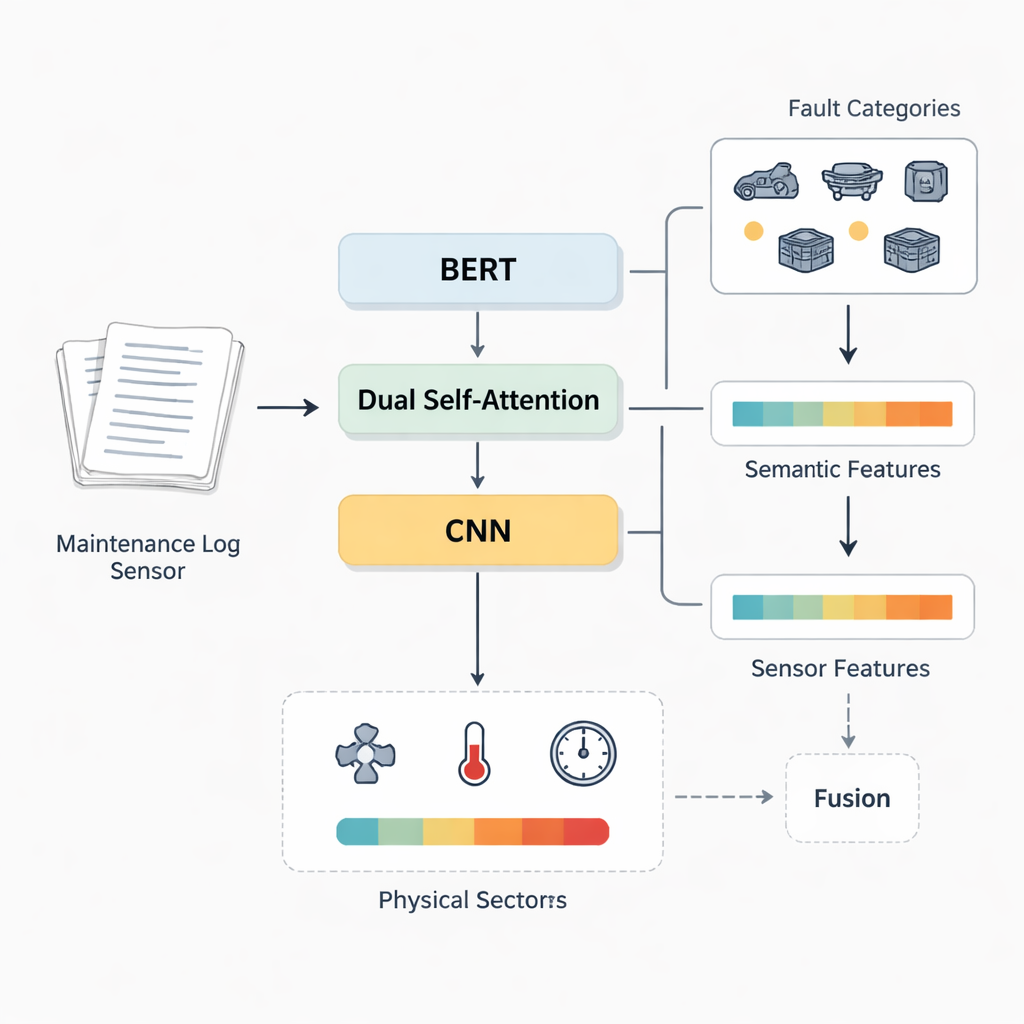
To transform words into useful signals, the researchers build a layered model combining several advances from natural language processing and deep learning. First, they use BERT, a widely used language model, to convert each Chinese fault description into rich numerical vectors that capture context and word meaning. Next, these vectors pass through a convolutional neural network (CNN), which is especially good at spotting local patterns and short phrases that reveal fault types. On top of this, they introduce a dual self-attention mechanism, which helps the model focus on the most informative words and feature patterns—terms like "oil pump failure" or "pressure loss"—rather than treating every token equally. Together, these components form the BERT-DSA-CNN model, whose final high-dimensional output serves two roles: it predicts which system is at fault and it provides a compact semantic feature vector that can later be fused with physical sensor data.
Putting the Method to the Test
The team evaluates their approach using fault logs from 2023 to 2025 for a particular type of heavy-duty maintenance machine, covering seven major fault systems such as power transmission, running gear, braking, and tamping devices. Because some systems fail more often than others, they use data augmentation methods—careful rephrasing and back-translation—to balance the training set while keeping the test set untouched. They then compare their proposed model with several alternatives: simpler CNNs without attention, a BERT plus recurrent network, classic word-embedding models, and a traditional support vector machine using bag-of-words statistics. Across accuracy, precision, recall, and F1-score, the BERT-DSA-CNN consistently performs best, often exceeding 97% F1-score across fault systems, and clearly outpacing older machine learning methods.
What the Results Reveal About Language and Faults
Beyond headline numbers, the authors inspect how the attention mechanism behaves. They find that the model naturally highlights words naming key components and symptoms, echoing how a human expert would read a fault report. Misclassifications tend to occur when descriptions are vague or when different systems share similar outward symptoms, such as "excessive vibration" appearing in both power transmission and running systems. This pattern underlines both the promise and the limits of text alone: language carries rich context, but it can blur boundaries when different faults look similar on the surface.
From Smarter Text Reading to Smarter Railways
In everyday terms, this study shows that teaching computers to read mechanics’ notes can make fault diagnosis for track maintenance machines more accurate and interpretable. The proposed model reliably turns short, messy fault descriptions into clean numerical features that behave like a new sensor channel. While the paper stops short of actually merging these semantic features with real-time physical sensor data, it lays the groundwork for such fusion. In future systems, numbers from vibration and temperature probes could be combined with the "virtual sensor" derived from text, offering maintenance teams earlier warnings, clearer explanations, and ultimately safer, more punctual train services.
Citation: Zhang, Y., Gao, C., Wang, R. et al. Semantic-aware fault diagnosis of heavy-duty railway maintenance machinery and its potential in multisensor fusion systems. Sci Rep 16, 6436 (2026). https://doi.org/10.1038/s41598-026-36456-8
Keywords: railway maintenance, fault diagnosis, maintenance logs, multisensor fusion, BERT