Clear Sky Science · en
Barriers to functional connectivity across contrasting landscapes in the widespread but declining Iberian common toad
Why this toad’s travels matter
The Iberian common toad used to be a familiar night-time visitor across much of Spain, yet in many regions its numbers are quietly shrinking. This study asks a deceptively simple question with big implications: how does the way we shape the land — with farms, roads, and dams — change where toads can go, who they can mate with, and whether their populations stay healthy over time? By comparing two very different landscapes in central Spain, the researchers reveal which features act as wildlife highways and which become walls, offering practical clues for conserving not only this species but many other small animals that move slowly across the ground.
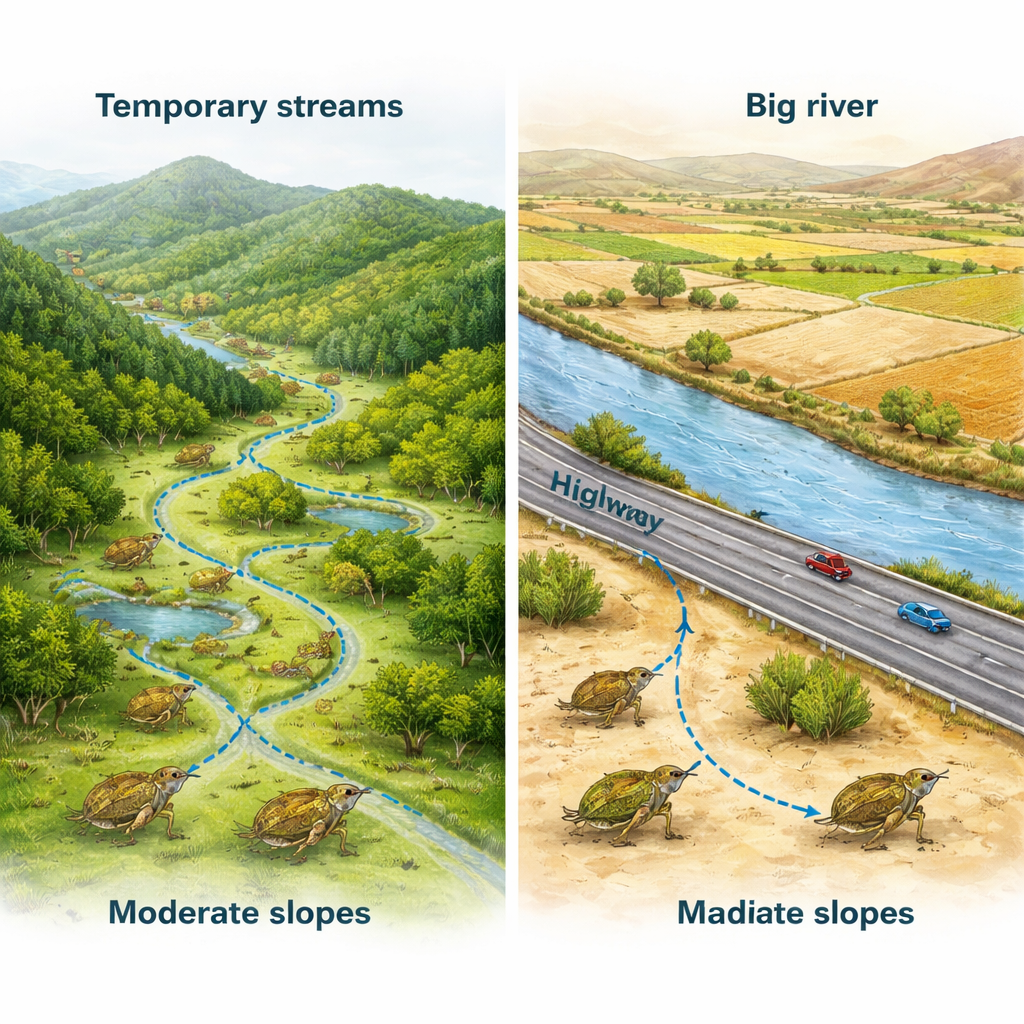
Two different worlds for the same toad
The team focused on the Iberian common toad in two nearby but contrasting regions around Madrid. In the Guadarrama foothills to the north, the terrain is hilly, greener and cooler, with streams, ponds and reservoirs dotted through woodlands and shrublands. Toads there are still relatively common and their distribution is fairly continuous. About 60 kilometers away lies the Alcarria plateau, a drier, flatter landscape dominated by crop fields, scattered scrub, and deep valleys carved by the Tajuña River. In this agricultural setting, water bodies are scarce, breeding sites are patchy, and toad populations are already more fragmented and vulnerable.
Reading the genetic footprints of movement
To see how easily toads move and mix between ponds, the researchers collected tissue samples from over 500 adult toads at 33 breeding sites and analyzed their DNA using microsatellite markers, a standard tool for detecting fine-scale genetic differences. If toads frequently disperse and mate across sites, populations will look genetically similar; if something blocks their movements, groups on either side gradually become distinct. In both regions, the overall level of genetic diversity was healthy and similar, suggesting that, for now, inbreeding is not a major concern. But the pattern of how that diversity was arranged in space differed: in Guadarrama, genetic structure was weak and patchy, while in Alcarria clear clusters emerged that lined up with geography, indicating more limited mixing between sites.
Streams, slopes, and the hidden map of toad travel
Next, the team overlaid the genetic data on detailed digital maps of land use, rivers, roads, elevation and slope. By treating the landscape like a board game in which each square is easier or harder for a toad to cross, they tested which features best explained the observed genetic distances. Some messages were consistent across both regions. Gently sloping ground and temporary streams acted as natural corridors, helping toads move and spread their genes. These small, often seasonal watercourses are key breeding sites in central Spain, but they also seem to guide movement through the countryside. In contrast, large permanent rivers and major highways behaved like hard barriers, sharply reducing genetic exchange between the toads living on opposite sides.
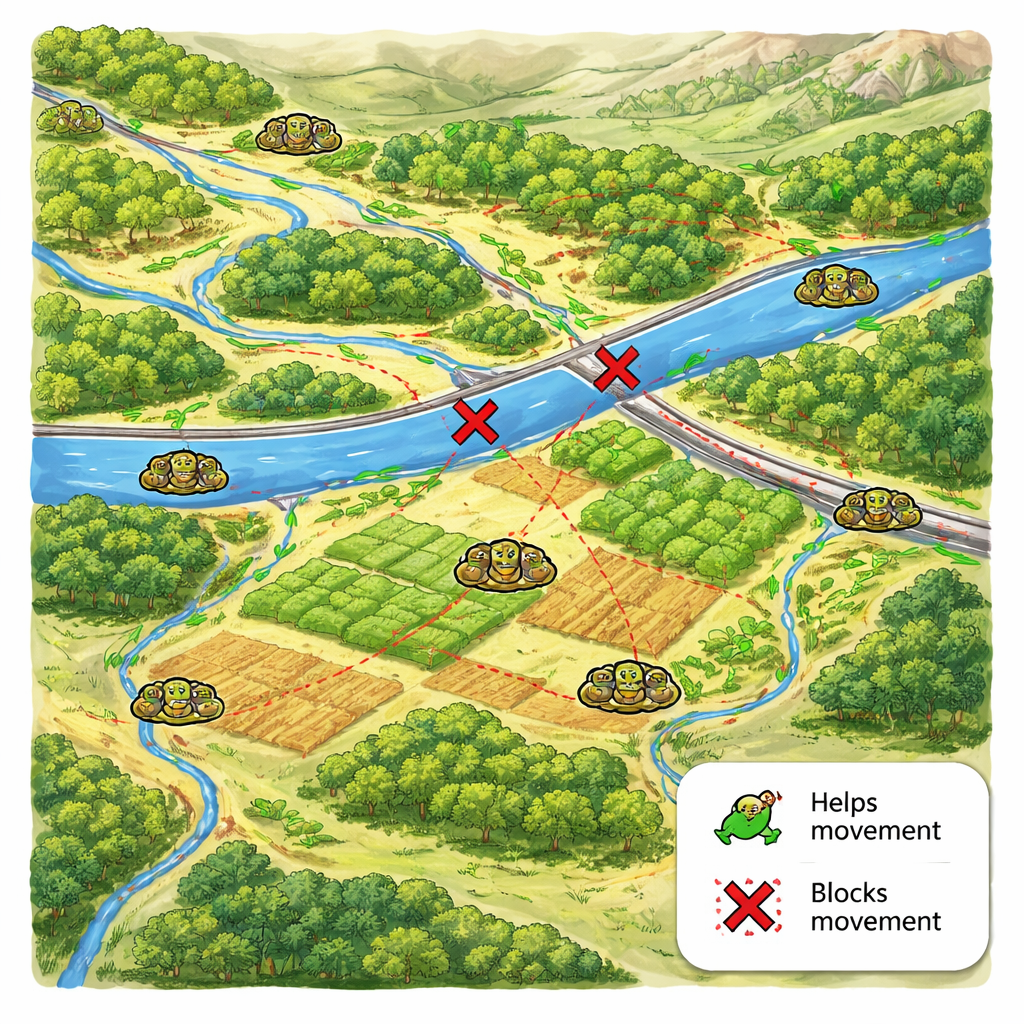
Same species, different land uses, different outcomes
Human-shaped land uses did not have a single, universal effect. In the Guadarrama foothills, forests and pastures — many of them managed as monocultures or open grazing lands — tended to resist movement, whereas patches of mixed, heterogeneous vegetation helped connectivity. On the Alcarria plateau, the picture flipped in an important way: crop fields, which cover most of the area, actually supported movement, likely because they provide open, relatively permeable ground between scattered ponds and streams. Urban areas and some scrublands were less favorable here. These contrasting results show that the same land-cover label, such as “agriculture” or “forest,” can have very different consequences depending on local climate, management, and how it is arranged in the wider landscape.
What this means for saving a ‘common’ species
For a species once considered ordinary, the Iberian common toad is becoming anything but, especially in the drier, heavily farmed parts of Spain. This study shows that keeping populations connected is not just about protecting any patch of habitat, but about understanding how the whole landscape either channels or blocks movement. Safeguarding and restoring temporary streams, reducing the barrier effect of major roads and large rivers, and designing vegetation and farmland in ways that leave safe corridors can help toads continue their seasonal journeys. Because many other amphibians and small animals share similar habits and limitations, these insights offer a roadmap for making human-dominated landscapes more permeable to wildlife without fundamentally changing how people live or farm there.
Citation: Caballero-Díaz, C., Sánchez-Montes, G., Tarroso, P. et al. Barriers to functional connectivity across contrasting landscapes in the widespread but declining Iberian common toad. Sci Rep 16, 7056 (2026). https://doi.org/10.1038/s41598-026-36452-y
Keywords: amphibian conservation, landscape connectivity, habitat fragmentation, gene flow, road and river barriers