Clear Sky Science · en
Few-shot cross-episode adaptive memory for metal surface defect semantic segmentation
Smarter Eyes for Factory Floors
Modern factories rely on cameras to spot tiny scratches, pits, and stains on metal parts long before they reach customers. But teaching computers to recognize every possible kind of defect usually demands huge, carefully labeled image collections that many factories simply do not have. This paper presents a new way to train inspection systems that can learn from only a handful of examples, making high-precision automated quality control more practical and affordable.
Why Few Examples Are Enough
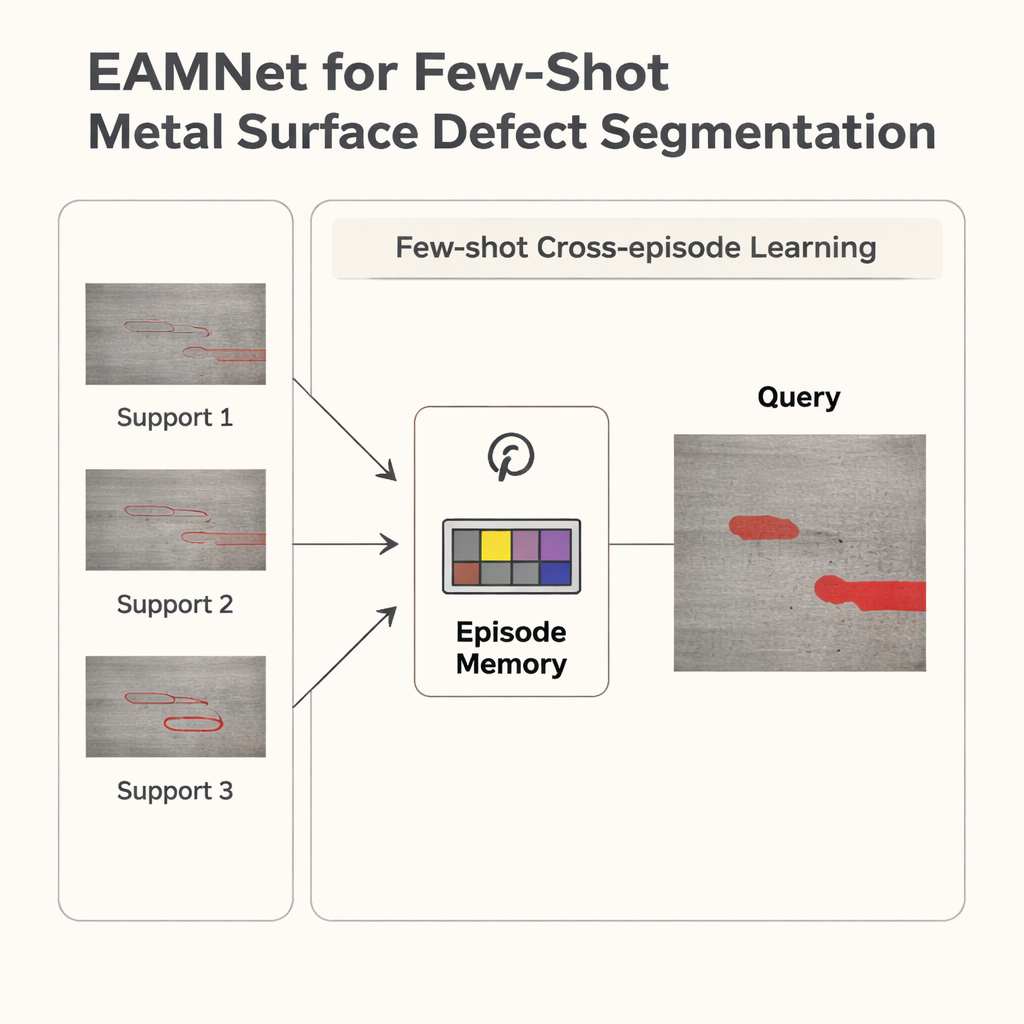
Traditional defect detection systems work best when they have seen thousands of labeled images of each defect type. That is a problem in real production, where rare flaws may appear only a few times, and labeling images pixel by pixel is slow and expensive. The approach studied here belongs to a field called “few-shot semantic segmentation.” In this setting, the system is given just a few labeled “support” images that show a particular defect, and it must then highlight that same kind of defect in a new “query” image. This is especially challenging on metal surfaces, where lighting, texture, and background patterns can easily confuse a model trained on limited data.
Learning Across Tasks, Not Just Within One
Most earlier few-shot methods treat each learning task, or “episode,” in isolation: they look at the support and query images for one defect type, produce a prediction, and then move on. As a result, they tend to latch onto superficial cues like brightness or local texture instead of deeper, reusable notions of what a defect looks like. The authors propose an Episode Adaptive Memory Network (EAMNet) that does the opposite: it remembers. A dedicated memory unit tracks how support and query images relate across many episodes, distilling a cross-task “adaptive factor” that guides the model toward more general and stable descriptions of defect regions instead of overfitting to one task at a time.
Focusing on Fine Details
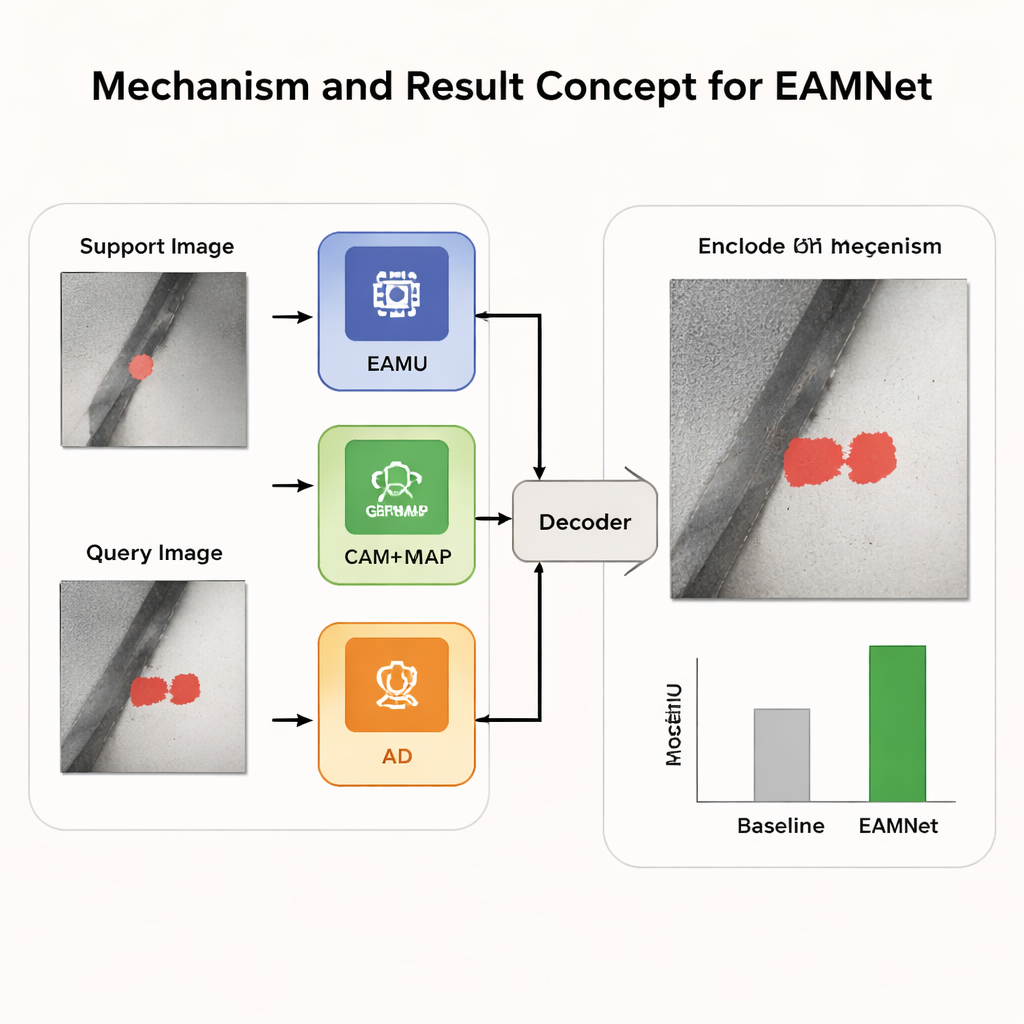
Beyond this cross-episode memory, EAMNet includes components that sharpen its eye for subtle details inside each episode. A context adaptation module compares deeper features of the support and query images to capture how defect pixels differ from clean metal in both appearance and surroundings. A second piece, called global response mask average pooling, refines the way the system summarizes the support defect example, making that summary more sensitive to strong, reliable signals and less to noisy background. Together, these parts help the network carve out precise defect shapes instead of rough blobs, even when the defect is small or blends into its surroundings.
Teaching the Network to Pay Better Attention
Training such a network from scratch can be unstable, because early layers tend to produce blurry, low-quality features when data are scarce. To counter this, the authors introduce an “attention distillation” step during training. In simple terms, higher-level, better-focused attention maps are used as soft teaching signals for lower-level parts of the network. This encourages the whole system to agree on where the important regions are, speeding up learning and improving its ability to adapt to new defect types without extra fine-tuning at test time.
What the Results Mean for Industry
The researchers test EAMNet on two benchmark datasets of metal surface defects—one general and one focused on strip steel—and compare it with several leading methods. Across both datasets and different network backbones, their model consistently achieves higher accuracy, often improving standard quality measures by more than ten percentage points over a strong baseline. For a layperson, this means a camera-based inspection system that can quickly learn new types of flaws from just a few labeled samples, while still marking the defective areas with fine-grained precision. In practice, such a system could reduce manual inspection, catch subtle faults earlier, and make advanced quality control accessible even when labeled data are scarce.
Citation: Zhang, J., Ding, H., Peng, M. et al. Few-shot cross-episode adaptive memory for metal surface defect semantic segmentation. Sci Rep 16, 5660 (2026). https://doi.org/10.1038/s41598-026-36445-x
Keywords: metal surface defects, few-shot learning, semantic segmentation, industrial inspection, computer vision