Clear Sky Science · en
Immediate four implants supported short arch rehabilitation for severe maxillary edentulism
Why rebuilding a smile is so challenging
Losing all the upper teeth is far more than a cosmetic problem. People struggle to chew, speak clearly, and feel confident, yet traditional dentures can be loose and uncomfortable. Modern dental implants promise a fixed, more natural-feeling solution—but in the upper jaw, especially when the back part of the bone has shrunk away, treatment can become long, complex, and expensive. This study explores a simpler way to quickly restore appearance and basic chewing using only four implants at the front of the upper jaw, offering patients a bridge they can leave the clinic with soon after surgery.
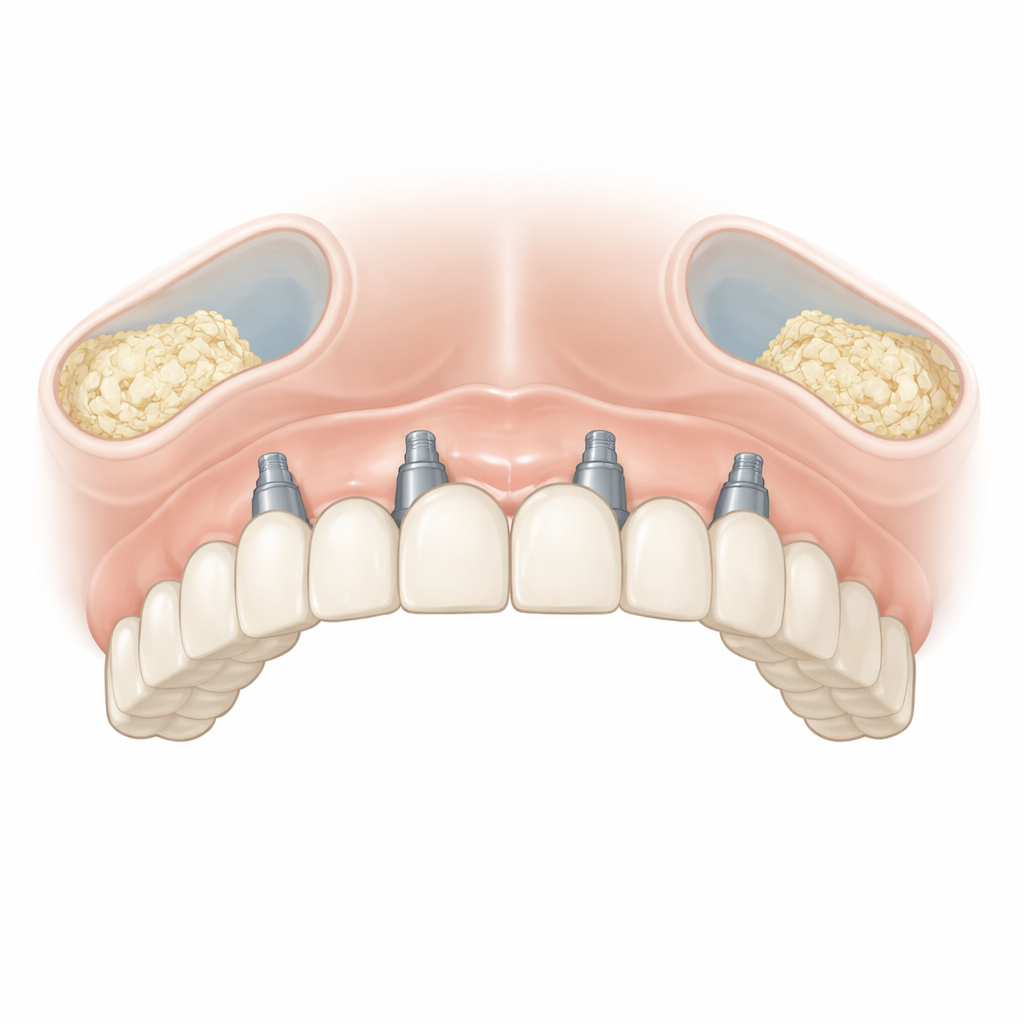
A shorter bridge for a faster start
The researchers focused on people who had no natural upper teeth and too little bone at the back of the upper jaw to safely place regular implants there. Normally, dentists might use very long implants into the cheekbone or perform complex sinus surgeries before building a full row of teeth—approaches that demand high skill and carry notable risks. Instead, this team placed four standard dental implants in the stronger bone at the front of the upper jaw and used them to support a "short arch" bridge replacing only six to eight front teeth. At the same time, they performed a common sinus lift and bone-grafting procedure in the back region so that additional implants could be placed later, once the area had healed.
How the treatment was planned and carried out
Before surgery, each patient received a custom trial denture and a detailed 3D X-ray scan. Using specialized computer software, the team combined scans of the jawbone, gums, and trial teeth to plan exactly where the four front implants should go. They then created a rigid surgical guide to transfer this plan precisely into the patient’s mouth. During surgery, the guide was fixed in place, pilot holes were drilled, and the four front implants were inserted with strong initial stability. At the same operation, the surgeons opened a small window in the side of the upper jaw, gently lifted the sinus membrane, and packed in bone-graft material to rebuild lost bone at the back. An impression was taken right away, and within a week a computer-milled plastic bridge was screwed onto the four implants, giving patients fixed front teeth while the grafted bone and any future implants quietly healed in the background.
What happened to the patients
Ten adults, most of them in their 40s to 60s, underwent this treatment. Over an average follow-up of almost 14 months, none of the 40 front implants failed—a strong sign that they successfully fused to the bone, even though they were used immediately to support a bridge. X-rays showed very modest bone changes around the implants, with an average bone loss of only about 0.6 millimeters, which is well within widely accepted success limits for dental implants. Some patients did report drawbacks: a few had trouble with speech, occasional cheek or lip biting, or felt their chewing was not as strong as they would like while they had only the short front bridge in place.
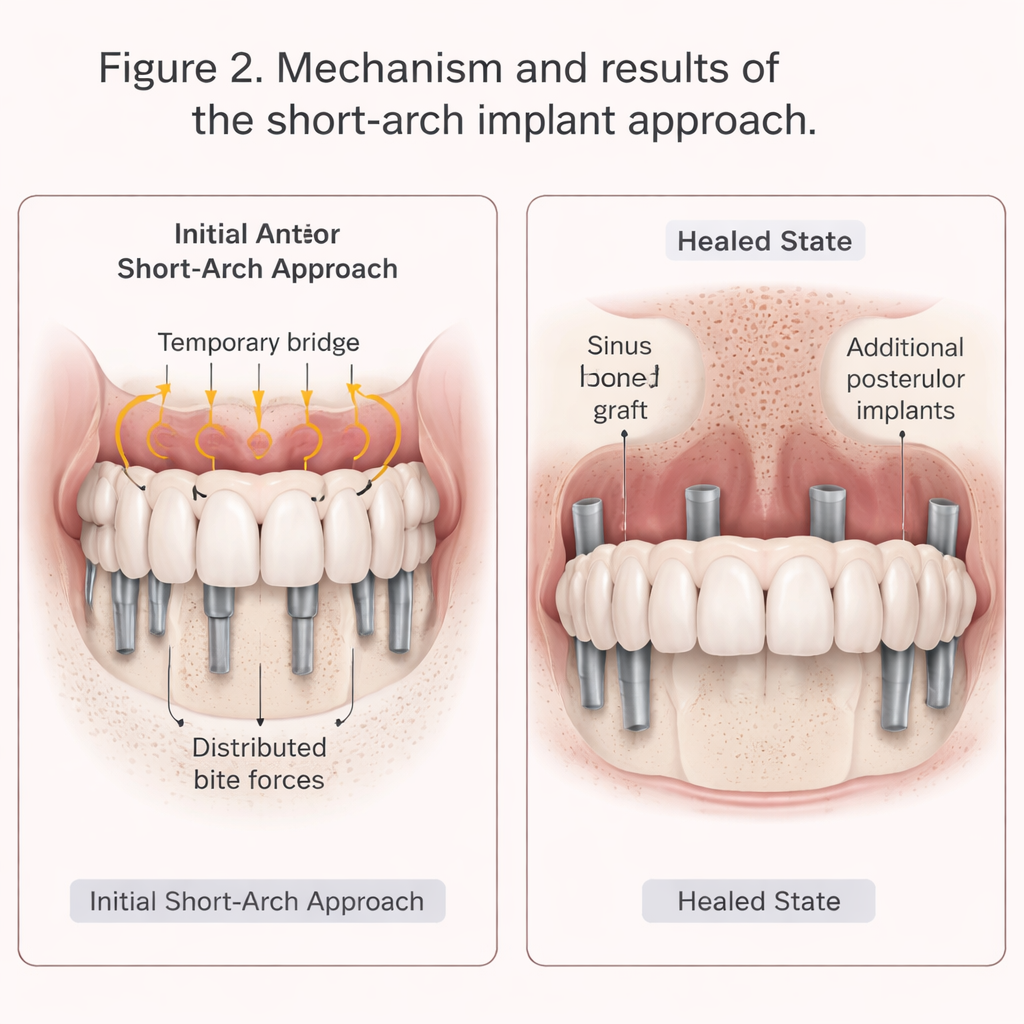
Cracks in the temporary bridge—but not in the implants
The most frequent problem was fracture of the temporary plastic bridge itself. Half of the patients experienced at least one break between five and sixteen months after their initial restoration, usually in the back part of the short bridge where biting forces concentrate. These bridges were made entirely of resin without a reinforcing metal framework, and they extended as far back as possible to improve chewing, which likely increased stress. Importantly, even when the bridge broke, the implants underneath remained stable and continued to heal well. The authors note that using stronger materials, adding metal reinforcement, and carefully adjusting bite forces could reduce these breakages in future patients.
What this approach really offers
For people missing all their upper teeth and lacking bone at the back of the jaw, this study suggests that four implants in the front can safely support a shorter fixed bridge almost right away. Patients regain a natural-looking smile and some chewing function while they wait for more complex bone-healing and final full-arch work to be completed. The trial involved only ten patients, was retrospective, and followed them for just over a year, so it cannot prove long-term success. Still, the combination of zero implant failures, small bone changes, and manageable complications makes this "immediate short arch" strategy a promising, less invasive stepping stone toward a permanent full upper jaw restoration.
Citation: Li, X., Deng, H., Gu, K. et al. Immediate four implants supported short arch rehabilitation for severe maxillary edentulism. Sci Rep 16, 5736 (2026). https://doi.org/10.1038/s41598-026-36442-0
Keywords: dental implants, short arch restoration, edentulous maxilla, sinus lift, implant-supported bridge