Clear Sky Science · en
Evaluating the predictive accuracy of supervised machine learning models to explore the mechanical strength of blast furnace slag incorporated concrete
Why smarter concrete matters
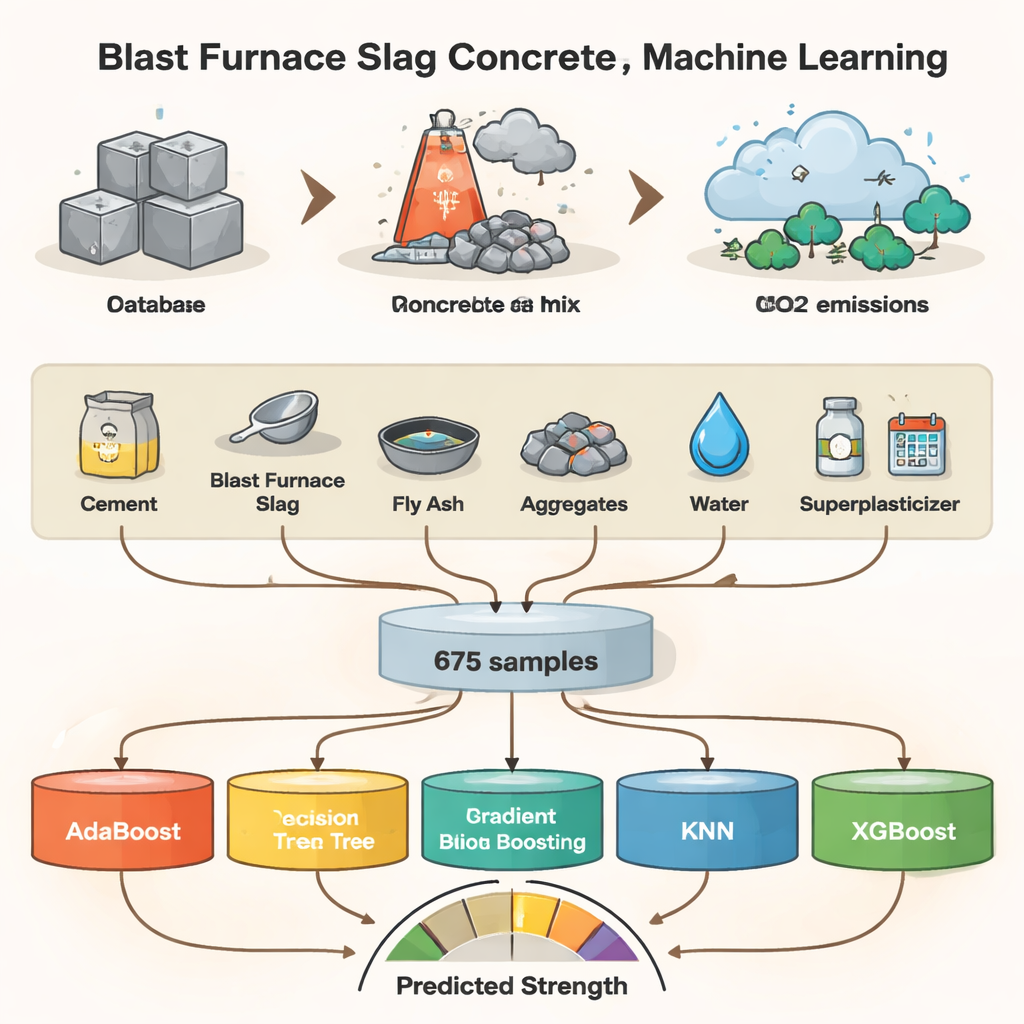
Concrete shapes our cities, but making the cement that holds it together releases huge amounts of carbon dioxide—about 8% of global emissions. One promising way to clean up this footprint is to swap part of ordinary cement with industrial byproducts such as blast furnace slag, a glassy material from steelmaking. The catch: finding the right recipe for strong, durable, low‑carbon concrete usually takes months of lab work. This study shows how modern machine learning can do much of that trial-and-error virtually, speeding up the design of greener concrete.
A cleaner ingredient from steelmaking
Blast furnace slag is produced when iron ore is smelted to make pig iron. When this molten byproduct is rapidly cooled and ground into fine powder, it behaves like a slow-acting cement. Mixed into concrete, it reacts with compounds formed during cement hydration to create extra binding gel, which tightens the internal pores. The benefits are threefold: less cement is needed (cutting CO₂ emissions), chemical attacks from salts and acids are resisted more effectively, and strength continues to grow over longer periods. But performance depends sensitively on how much slag is added, how it interacts with other materials, and how long the concrete is cured.
Turning scattered experiments into a single dataset
Instead of running new lab tests for every possible mix, the researchers combed through earlier studies and open datasets on slag-containing concretes. They assembled 675 data records, each describing a concrete recipe and its measured compressive strength (how much pressure it withstands before crushing). Eight key ingredients and conditions were tracked: amounts of cement, blast furnace slag, fly ash, coarse and fine aggregates, water, and a high-range water-reducing admixture called a superplasticizer, plus the curing age in days. All values were checked, standardized to common units, cleaned of obvious errors, and rescaled so that the machine learning models could compare variables on equal footing.
Training machines to predict concrete strength
With this database in hand, the team trained six different supervised machine learning models to predict compressive strength from the mix design: AdaBoost, a single Decision Tree, Gradient Boosting, k-Nearest Neighbors, and two advanced tree-based methods known as LightGBM and XGBoost. They used 80% of the data for training and 20% to test how well each model handled new, unseen recipes. To avoid overfitting—where a model memorizes past data but fails in practice—they systematically tuned model settings with grid search and cross-validation, then judged performance using standard accuracy measures such as the coefficient of determination (R²) and various error statistics.
What controls strength in greener mixes
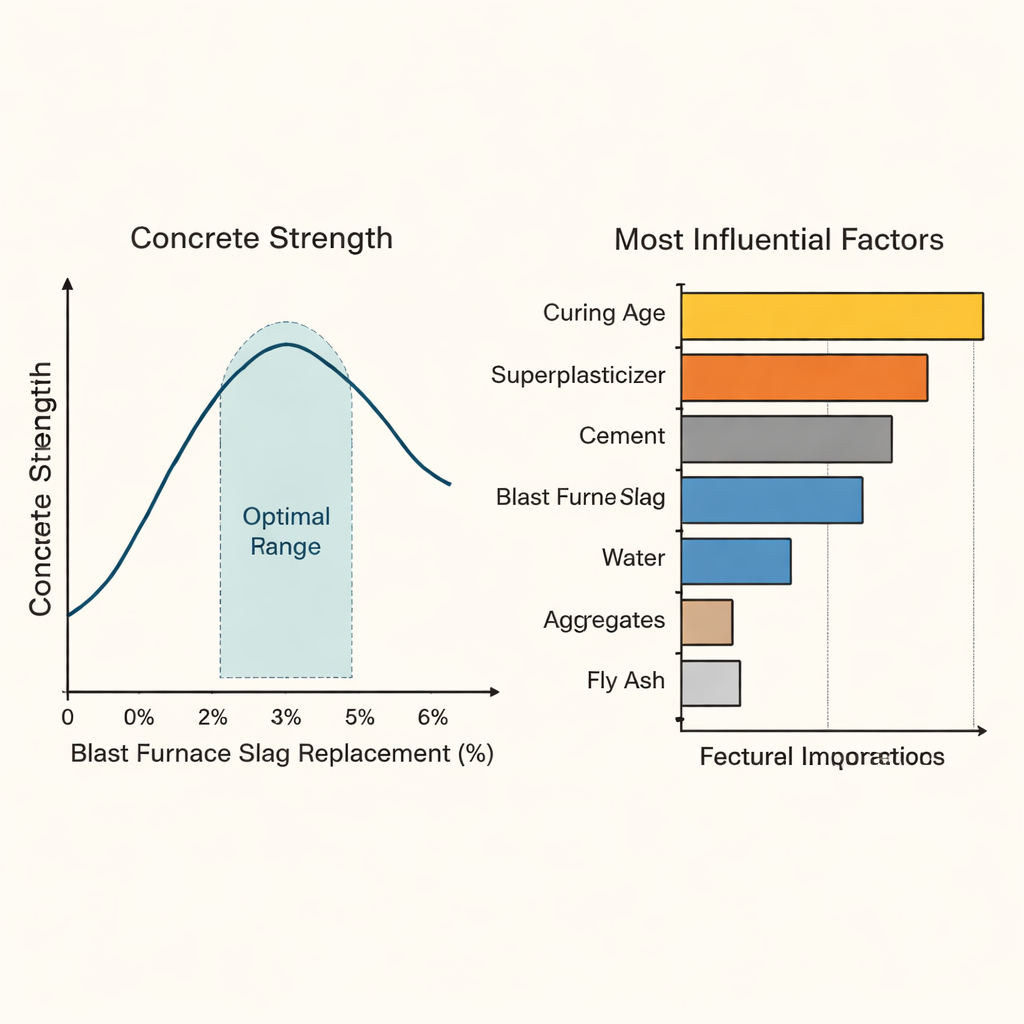
The two most powerful models, LightGBM and XGBoost, reproduced lab strengths with high accuracy, capturing over 94% of the variation in the test data. To make these “black box” models understandable, the authors applied SHAP (a method that assigns each input a share of the prediction) and partial dependence plots, which show how changing one variable shifts the predicted strength while others are held steady. These tools revealed that curing age had the largest positive effect: longer curing consistently meant stronger concrete. Superplasticizer and cement content were the next most influential, boosting strength by improving packing and reducing unnecessary water. Water itself showed a strong negative effect—too much weakens the mix—while blast furnace slag helped up to a point, then leveled off.
Finding the sweet spot for slag
By sweeping the models across different slag contents, the researchers identified an optimal replacement window: when blast furnace slag made up roughly 30–40% of the total cementitious material, concrete tended to reach higher compressive strengths, especially at curing ages of 28 days and beyond. Pushing slag much higher, particularly above 50%, often slowed early strength growth, which can be critical for construction schedules. These insights, extracted from many small studies, offer practical guidance: engineers can confidently target this intermediate slag range to balance strength, durability, and carbon savings without exhaustive testing for every project.
What this means for future building
For non-specialists, the key message is straightforward: computers can now learn from past concrete experiments well enough to suggest strong, low‑carbon mixes before a single batch is poured. In this work, the LightGBM model emerged as slightly more accurate than XGBoost, but both were precise and interpretable enough to show which ingredients matter most and where slag performs best. That combination of speed and transparency means designers can cut down on time, cost, and material waste while making better use of industrial byproducts. As datasets grow and become more standardized, such tools could help the construction industry shrink its climate impact while still delivering safe, durable structures.
Citation: Sobuz, M.H.R., Majumder, S., Afrin, M.S. et al. Evaluating the predictive accuracy of supervised machine learning models to explore the mechanical strength of blast furnace slag incorporated concrete. Sci Rep 16, 6712 (2026). https://doi.org/10.1038/s41598-026-36437-x
Keywords: blast furnace slag concrete, machine learning, compressive strength, sustainable construction, cement replacement