Clear Sky Science · en
Mechanical properties and energy evolution of cemented tailings-rock powder backfill under uniaxial compression: effect of rock powder type and content
Turning Mining Waste into Safer Underground Support
Modern mining leaves behind mountains of finely ground rock called tailings and piles of leftover quarry stone. Both are costly to store and can threaten nearby land and water. This study explores a way to turn these wastes into a stronger, safer building material that can be pumped back underground to support mined-out spaces, cutting costs and environmental risks at the same time. 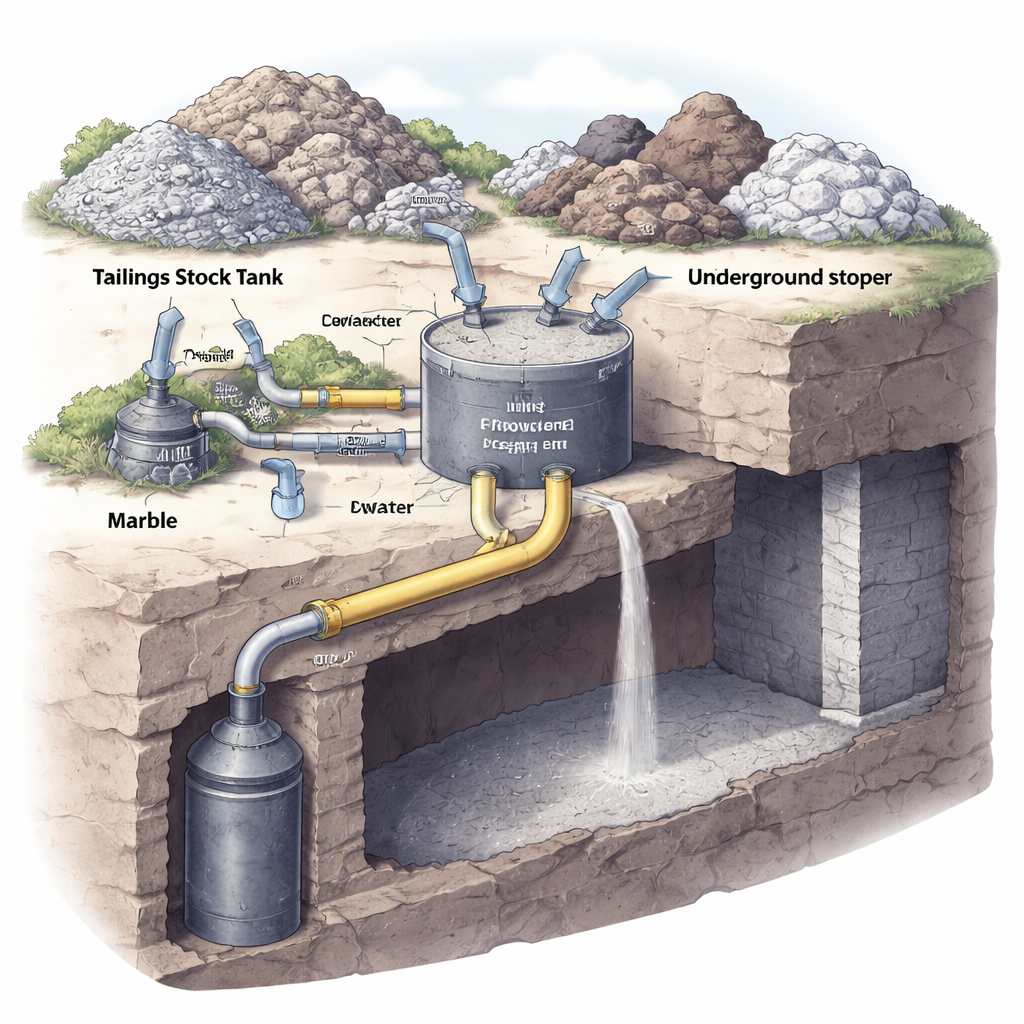
Why Leftover Rock Is a Growing Problem
Across major mining regions, including China, billions of tons of tailings have been stockpiled, with hundreds of millions of new tons added every year. These vast dumps take up land, can leak pollutants, and in rare cases may fail catastrophically. One promising solution is to mix tailings with cement and water to create a thick slurry that is pumped back into emptied mine tunnels and chambers, where it hardens into a man-made rock. This so‑called backfill helps hold the ground up, limits surface sinking, and locks waste safely underground. But conventional backfill often needs expensive chemical additives or synthetic fibers to achieve the required strength and durability, which raises both costs and environmental concerns.
Adding Rock Powder to Make Better Backfill
The researchers tested a simple idea: grind local quarry waste rock into fine powder and blend it with tailings, cement, and water to create a new material they call cemented tailings–rock powder backfill (CTRPB). They focused on three very common rocks—granite, basalt, and marble—and mixed each powder into the backfill at different levels, from 3% to 15% of the solid material. Cylindrical samples were cast, cured for 28 days, and then squeezed in a uniaxial compression test, which steadily crushes the sample while measuring how much stress it can take and how it deforms and breaks. This allowed the team to compare strength, stiffness, and failure behavior to a standard backfill with no rock powder.
How the Material Behaves Under Crushing
All samples showed four clear stages as they were compressed: first, tiny pores and cracks closed; next, the material stretched in a nearly straight, elastic way; then, cracks spread and the material yielded; finally, after peak strength, it broke and lost much of its load‑carrying ability. Rock powder changed each of these stages. At modest amounts, the fine particles filled spaces between tailings grains, creating a denser, more even structure and a smoother transfer of forces. As a result, the new backfill could carry higher loads and deform more before breaking. However, when too much rock powder was added, it diluted the cement, weakened the bonds between particles, and strength began to drop again. 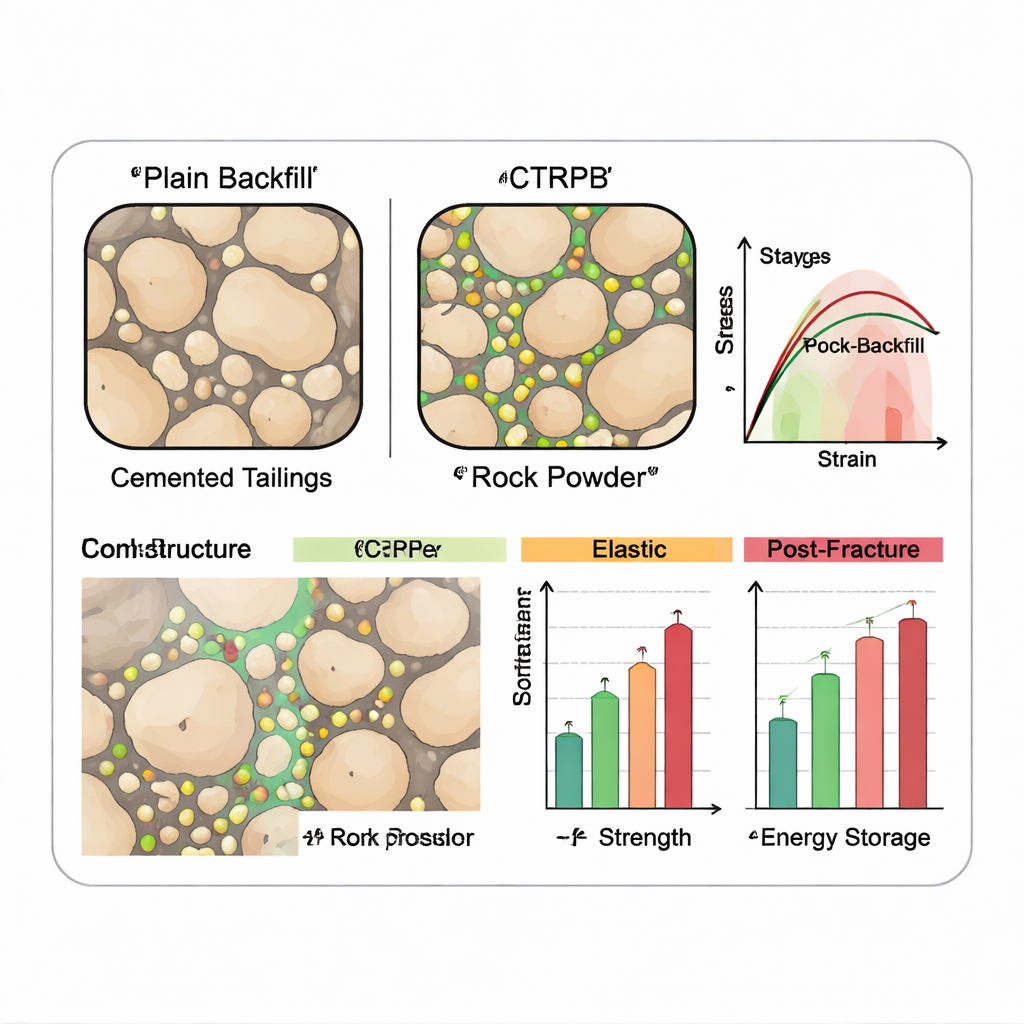
Strength, Toughness, and Stored Energy
The best-performing mixes were those with about 9% basalt or granite powder and about 12% marble powder. Compared with the plain backfill, these optimal blends increased compressive strength by up to roughly 70%, while also allowing larger strains at peak load. Interestingly, the material’s stiffness (elastic modulus) tended to go down slightly when rock powder was added, even as strength went up. That trade-off means the modified backfill can flex a bit more and absorb more energy before failing. By examining the area under the stress–strain curves, the authors calculated how much energy the samples stored elastically and how much they dissipated as damage. With rock powder, the total energy density and the amounts stored and dissipated all rose sharply—by more than two to four times in some cases—showing that CTRPB can take in and release much larger amounts of energy as it is loaded.
Tracking Damage and Predicting Failure
To better understand when and how the new backfill fails, the team built a mathematical “damage” model that tracks how internal microcracks grow as strain increases. They treated the material as if it were made of many tiny elements whose strengths vary statistically and used this framework to fit a piecewise equation to the measured stress–strain curves. The model captures four stages of damage: an undamaged stage, a slow initial damage stage, a rapidly increasing damage stage, and a final stage where damage levels off as the specimen reaches complete failure. In the pre‑peak region—before the material reaches its maximum strength—the model’s predictions match the experiments well, so engineers could use it to estimate how close a backfilled zone is to failure under expected underground loads.
What This Means for Greener, Safer Mines
In simple terms, this study shows that carefully chosen amounts of common rock powders can turn mine and quarry waste into a stronger, more energy‑absorbing backfill that supports underground openings more effectively. While very high rock powder contents can make the material more brittle after it fails, the boosted strength and energy storage before failure mean that, when designed properly, CTRPB can reduce the need for costly additives and help consume multiple waste streams at once. For mining operations seeking to cut disposal volumes, lower costs, and maintain ground stability, this approach offers a practical, science‑backed recipe for putting waste rock to work underground.
Citation: Zhang, J., Zou, Q., Cai, W. et al. Mechanical properties and energy evolution of cemented tailings-rock powder backfill under uniaxial compression: effect of rock powder type and content. Sci Rep 16, 5855 (2026). https://doi.org/10.1038/s41598-026-36436-y
Keywords: mine backfill, rock powder, tailings management, underground mining, waste utilization