Clear Sky Science · en
Virtual reality mediated brain-computer interface training improves sensorimotor neuromodulation in unimpaired and post spinal cord injury individuals
Walking Again, At Least in the Mind
For people living with paralysis after a spinal cord injury, the idea of walking or cycling again can feel out of reach. This study explores a different kind of recovery: retraining the brain itself using virtual reality and a brain-computer interface. By asking volunteers and people with spinal cord injuries to imagine moving their legs while they travel through a lush virtual forest, the researchers show that the brain can learn to send clearer movement signals—even when the body cannot move.
A Digital Bridge Between Brain and Virtual World
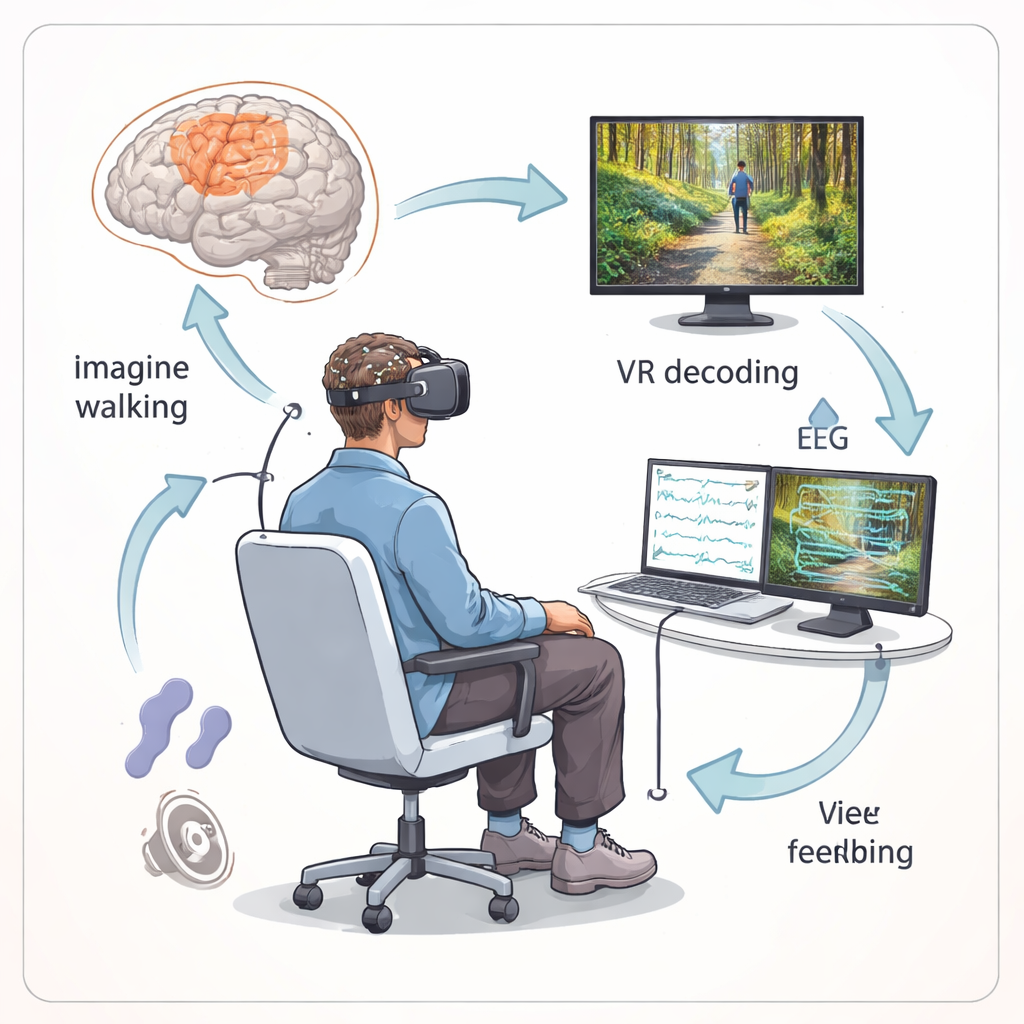
The research team built a system that links brain activity to a virtual world. Participants wore a cap with dry EEG sensors that picked up tiny electrical signals from the surface of the scalp, along with a VR headset showing a forest path. Unimpaired volunteers saw a walking avatar from a first-person view, as if they were looking through their own eyes, while individuals with complete spinal cord injury saw themselves cycling along the same trail. When participants relaxed, the avatar stood still. When they vividly imagined walking or cycling, a computer decoded their brain signals and moved the avatar forward in real time, also triggering sounds and, for the spinal cord injury group, gentle muscle stimulation delivered through electrical pulses to the legs.
Training the Brain Like a Muscle
Learning to control this brain-computer interface was not instant; it took practice, much like learning a sport or musical instrument. Unimpaired volunteers completed 15 training sessions on different days, each lasting about an hour. Every session began with a calibration period in which the system “listened” to the brain while the person alternated between relaxing and imagining walking. The computer then built a fresh model to distinguish those two states. After calibration, participants entered longer runs where they followed audio cues to either relax or imagine walking continuously for a full minute, with the avatar’s motion reflecting the decoded brain activity. In a separate free-control phase, they tried to make the avatar take as many self-initiated steps as possible within five minutes, without external cues.
Clearer Brain Signals and Better Control
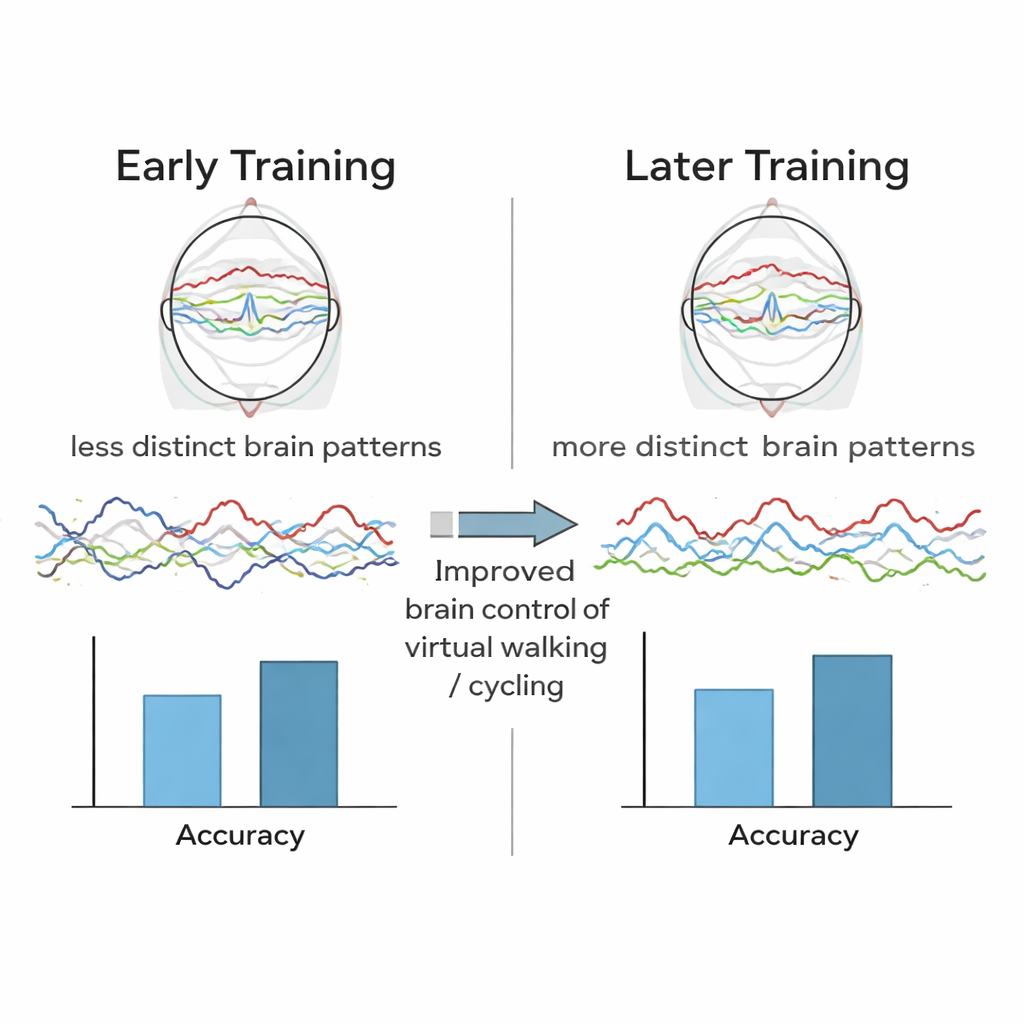
Over time, the participants’ brains produced more reliable patterns when they imagined moving versus resting. The researchers measured how distinct and stable these patterns were using mathematical tools that do not depend on any one decoding algorithm. Across sessions, these measures improved, showing that participants were actually learning to shape their brain activity. This learning translated into better control: in unimpaired people, the computer’s accuracy in telling “walk” from “relax” rose from about 60 percent in the early sessions to around 80 percent in later ones. During free-control trials, the number of correctly decoded steps more than doubled. People with long-standing, motor- and sensory-complete spinal cord injuries—who cannot move or feel their legs—also showed meaningful gains. Their classification accuracy climbed from roughly the high-50-percent range to above 70 percent as they learned to produce clearer “cycle versus relax” brain signals while experiencing both VR feedback and leg muscle stimulation.
Why Virtual Reality Matters
The immersive VR setting appears to play a key role. Simply watching a lifelike body move in sync with one’s own imagined actions can activate brain networks involved in movement and body awareness. The forest environment, first-person viewpoint, and subtle sounds make the experience more engaging than staring at simple symbols on a screen. For the spinal cord injury participants, the addition of electrical stimulation that moved their legs in the real world, linked to their brain commands, likely strengthened the connection between intention and feedback. Although the study did not include a non-VR control group, the results suggest that combining rich sensory feedback, a game-like setting, and repeated training helps the brain refine its internal “blueprint” for movement.
Steps Toward Future Rehabilitation
To a layperson, the main message is that the brain remains adaptable, even years after a devastating injury. By practicing imagined walking or cycling inside a virtual world that responds instantly to their thoughts, both unimpaired people and those with complete spinal cord injury learned to send more precise movement signals that a computer could understand. This work does not, by itself, restore walking in the real world. But it strengthens the brain circuits that underlie movement and shows that low-cost, dry-electrode headsets and consumer VR can support long-term training. In the future, similar systems might be paired with robotic exoskeletons or advanced electrical stimulation to help translate these improved brain signals into real, functional movements outside of virtual reality.
Citation: Mannan, M.M.N., Palipana, D.B., Mulholland, K. et al. Virtual reality mediated brain-computer interface training improves sensorimotor neuromodulation in unimpaired and post spinal cord injury individuals. Sci Rep 16, 6215 (2026). https://doi.org/10.1038/s41598-026-36431-3
Keywords: virtual reality rehabilitation, brain-computer interface, motor imagery training, spinal cord injury, neuroplasticity