Clear Sky Science · en
Stable operation of a network-based multi-algorithm earthquake early warning system: the Korea meteorological administration platform
Why Faster Quakes Warnings Matter
Earthquakes strike without notice, but the first ripples that race through the ground are weaker and arrive earlier than the truly damaging waves. Modern warning systems try to grab those first hints and send an alert seconds before strong shaking begins—just enough time to stop trains, shut valves, or duck under a sturdy table. This article looks at how South Korea has built a more stable and reliable earthquake early warning system by letting several computer methods “vote” together, rather than trusting a single one to decide when to sound the alarm.
How Early Warnings Work
When an earthquake starts, it sends out different types of waves. The fastest, called P-waves, usually cause only light shaking. Slower waves that follow can cause serious damage. The key idea behind early warning is simple: detect the P-waves as soon as at least a few ground sensors feel them, estimate where the quake is and how big it might become, and issue a warning before the stronger waves arrive. This is harder than it sounds. With data from only a small number of stations, location and size estimates can be rough, and any mistake—such as a false alert or a missed event—can erode public trust in the warning system.
A Network That Thinks in Threes
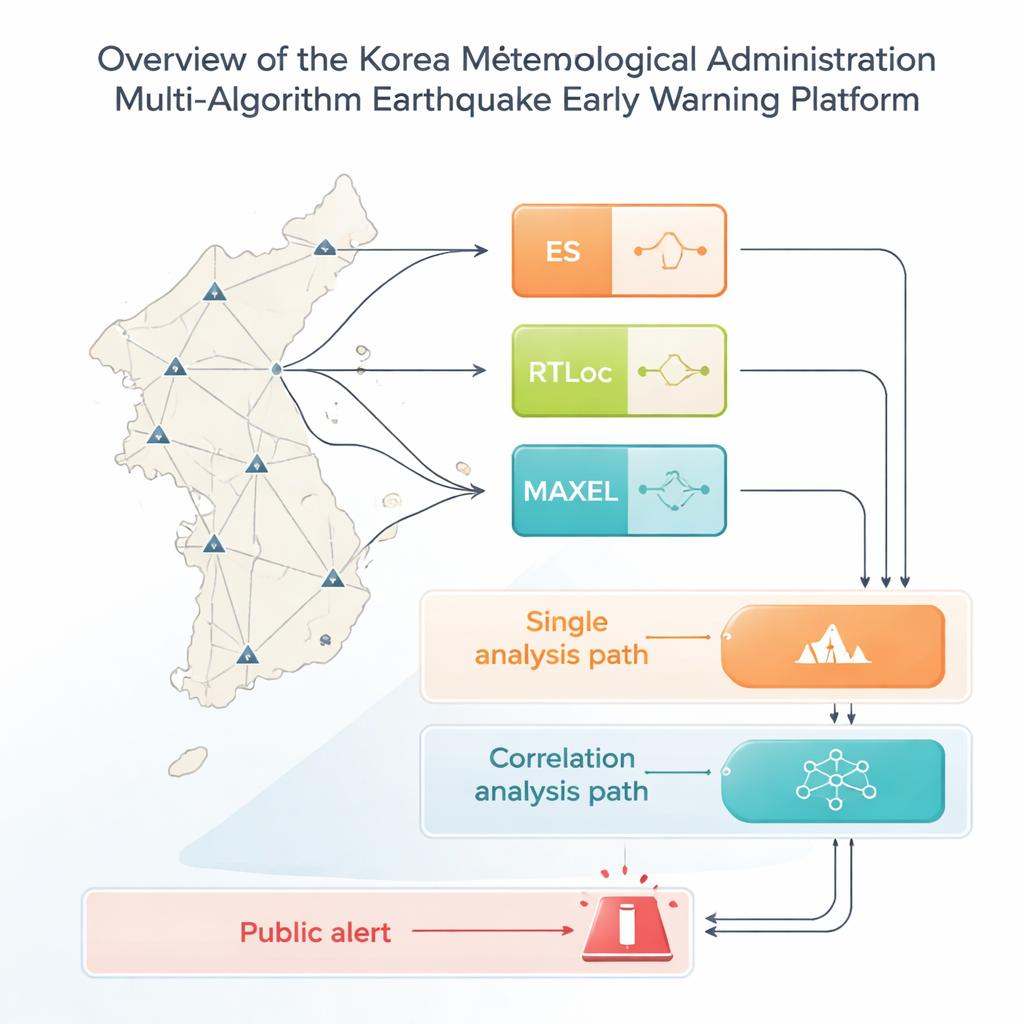
To tackle these challenges, the Korea Meteorological Administration (KMA) runs three independent algorithms in parallel: ElarmS 3.0 (ES), RTLoc (RTL), and MAXEL (MX). Each one listens to the national network of seismometers, picks out possible earthquake signals from background noise, and quickly estimates where and when the quake began and how strong it is. On top of this, a separate “correlation analysis module” compares their answers. If the three agree closely enough—for example, in origin time, location, and the stations they use—the system treats the event as confirmed and issues an alert based on this combined view. In parallel, a single-algorithm path is kept as a backup so that a warning can still go out rapidly if one method detects a clearly large event before the others catch up.
Real-World Performance in Korea
The authors examined how this multi-algorithm platform performed between mid-2021 and mid-2025, a period with 270 recorded earthquakes of magnitude 2.0 or larger in and around the Korean Peninsula. Only nine of these were strong enough to meet Korea’s policy thresholds for public alerts—magnitude 3.5 on land and 4.0 offshore, roughly the level at which most people can feel shaking. Even in this relatively quiet seismic setting, the system successfully detected almost all recorded quakes: individual algorithms each caught more than 93% of events, and the combined platform raised the rate to nearly 99%, missing only three small quakes near the edges of the network. Importantly, every event that should have triggered a public warning was detected by all three algorithms.
Balancing Speed and Accuracy
For the nine alert-level earthquakes, the researchers looked closely at how accurately and how quickly the system estimated the quake’s source. On average, the correlation module produced the most accurate locations, with typical errors of only a few kilometers on land. Offshore, errors were larger because there are fewer stations and they sit farther from the source, but the combined approach still did better than any single method acting alone. Most alerts were ready within about ten seconds of the first station’s trigger; only closely spaced “doublet” events and quakes near the network boundary took longer. When they compared estimated magnitudes to official values, the final platform again came out on top, keeping the average error to around a quarter of a magnitude unit while smoothing out the occasional over- or under-estimate from any one algorithm.
What This Means for Public Safety
To non-specialists, the main message is that diversity and cross-checking make earthquake warnings more trustworthy. Instead of betting everything on one way of reading the seismic signals, Korea’s system asks three different methods to weigh in and then blends their answers, while still preserving a fast track for clearly large quakes. This design cuts down on missed events and unstable estimates without adding much delay, even in a country where strong earthquakes are rare and data for tuning models are limited. As other regions consider upgrading their own warning systems, this work shows that carefully combining multiple algorithms can deliver steadier, higher-confidence alerts—giving people and critical infrastructure a better chance to act in the few seconds that matter most.
Citation: Heo, Y., Lim, D., Cho, S. et al. Stable operation of a network-based multi-algorithm earthquake early warning system: the Korea meteorological administration platform. Sci Rep 16, 6092 (2026). https://doi.org/10.1038/s41598-026-36429-x
Keywords: earthquake early warning, seismic monitoring, South Korea earthquakes, multi-algorithm systems, disaster preparedness