Clear Sky Science · en
Analysis of the influence of bottom bag grouting lifting on the mechanical response of shield tunnels
Keeping subway tunnels safe and level
Modern cities depend on underground rail lines, yet the tunnels that carry trains can slowly sag or tilt as nearby construction and soft ground disturb the soil. This paper explores a promising way to gently “jack up” sunken subway tunnels from below using flexible grout-filled bags. By clarifying how these bags expand in different soils and how they push on the tunnel, the study points toward safer and more predictable repairs that can extend the life of busy metro systems.
Why tunnels sink in the first place
Shield tunnels, the circular tubes built with tunneling machines, sit in soil that is constantly being disturbed by new foundations, underpasses, and other underground works. Over time, parts of a tunnel can settle more than others, producing a gentle but harmful bend along its length and a slight squashing of its round cross-section. These deformations can open joints between segments, cause leaks, chip concrete edges, and threaten the smooth and safe passage of trains. Engineers already use grouting—injecting fluid slurry into the ground—to lift and support tunnels, but traditional methods inject grout directly into the soil, making it hard to predict where the slurry will spread and how much force it will actually apply to the tunnel.
A new way to aim the underground “jack”
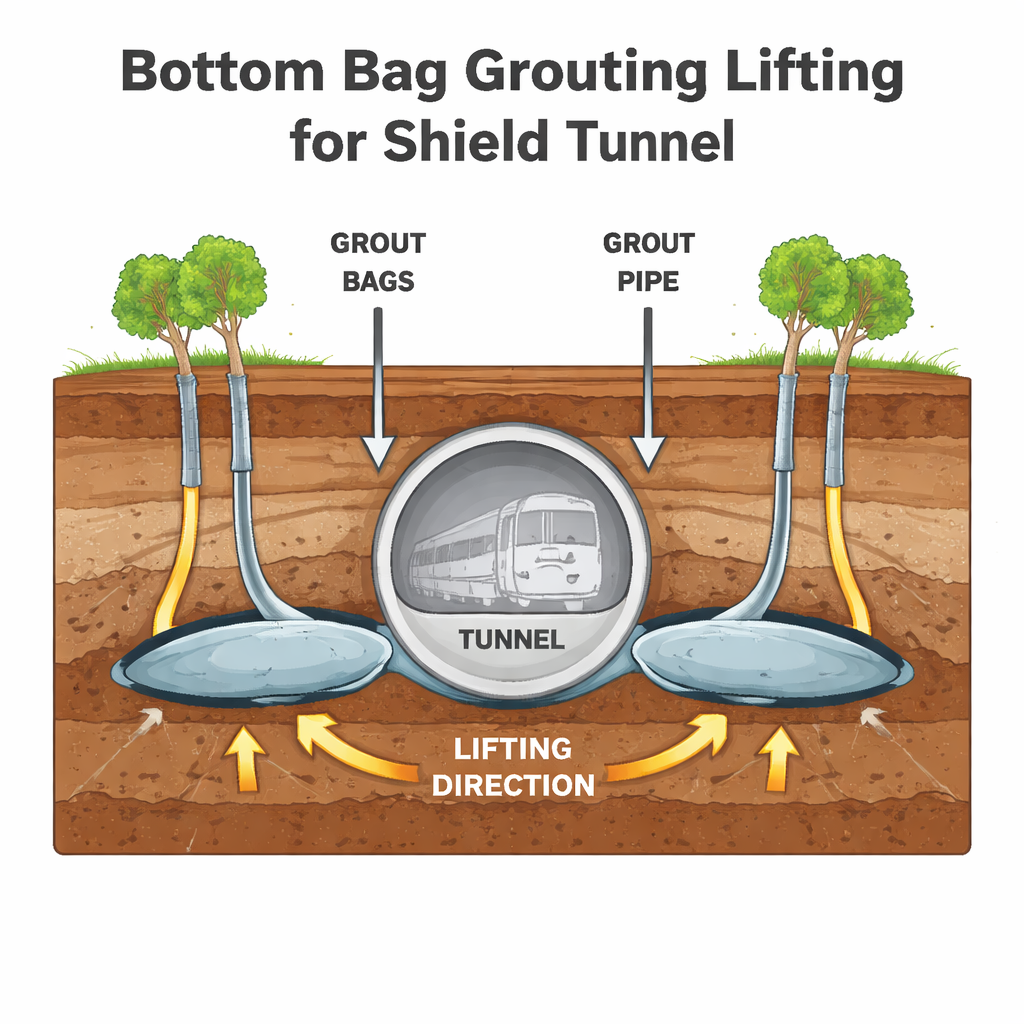
The bag grouting method tackles this uncertainty by placing flexible bags in predrilled holes beneath or beside the tunnel and then pumping grout into the bags. The bag confines the slurry, so instead of squirting along unpredictable cracks, it swells like a controlled balloon that presses against the surrounding soil. The authors first carried out small-scale “unit” tests in transparent soil boxes filled with either sandy soil or clay. By measuring how pressure changed at many points as grout was injected, they showed that, for the same volume of slurry and bag setup, stiffer soils (with lower compressibility) developed higher additional soil pressure than softer ones. In both soil types the grout spread mainly by compacting within the bag, creating a limited, well-defined pressure zone instead of a wide, uncertain plume.
Scaling up to a realistic tunnel model
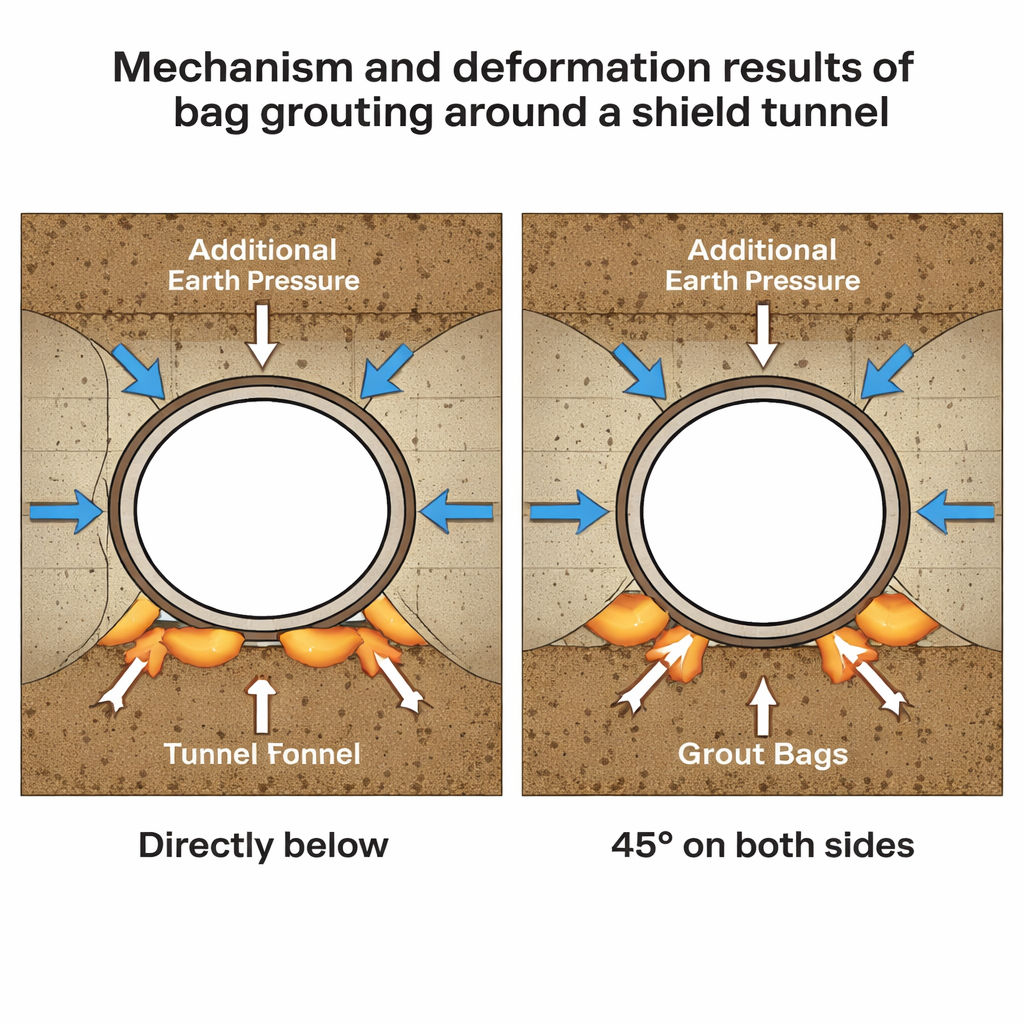
Next, the team built a large three-dimensional model: a steel ring representing a metro tunnel, buried in a box of compacted sand and instrumented with dozens of pressure sensors and displacement rulers. They tested two repair strategies. In one, a single bag was placed directly beneath the tunnel. In the other, two bags were installed at positions 45 degrees off the bottom, one on each side. As grout was pumped, sensors tracked how soil pressure grew around the tunnel, how the tunnel’s inner diameter changed vertically and horizontally, and how much the tunnel rose along its length.
How bag placement changes tunnel behavior
When grout was injected directly under the tunnel, the soil pressure at the bottom increased sharply while the top changed only slightly. The tunnel did lift as intended, but its circular cross-section was squeezed into a more horizontal oval: the vertical diameter shrank and the horizontal diameter grew by nearly the same amount. This “horizontal elliptical deformation” is undesirable because it can introduce new stresses and damage. In contrast, when the bags were placed at 45 degrees on both sides, the tunnel still experienced a clear upward lift, but its shape changed very little. Soil pressures at the bottom and sides rose in a more balanced way, and the tunnel’s vertical and horizontal diameters stayed close to their original values.
Tracing how pressure moves from pump to tunnel
By dissecting the hardened grout after the tests, the researchers visualized how the grout bulbs evolved. Under the tunnel center, the final grout block was cone-shaped and somewhat asymmetric, matching the uneven pressures recorded on the two sides of the tunnel and the pronounced oval distortion. With side bags at 45 degrees, the grout bodies were more cylindrical and similar on both sides, and the measured pressures were nearly symmetrical. From these observations, the authors describe a clear load-transfer chain: pump pressure inflates the bag, the expanding bag squeezes the nearby soil and raises earth pressure, and that added earth pressure is finally transmitted to the tunnel wall as additional loads that bend and lift the structure.
What this means for real-world tunnels
For non-specialists, the main message is that using grout-filled bags under subway tunnels can make repairs more accurate and less risky than traditional free-flowing injections. The study shows that soil type strongly influences how much lifting force a given grout volume can provide, and that where the bags are placed around the tunnel is crucial. Bags set at 45 degrees on both sides can raise a settled tunnel while largely preserving its round shape, limiting new stresses and cracks. This improved understanding of how pressure travels from the pump, through the bag and soil, and into the tunnel offers engineers a more solid scientific basis for designing safe, targeted lifting operations beneath our cities.
Citation: Liu, J., Huang, D., He, S. et al. Analysis of the influence of bottom bag grouting lifting on the mechanical response of shield tunnels. Sci Rep 16, 5867 (2026). https://doi.org/10.1038/s41598-026-36427-z
Keywords: shield tunnel, grouting, subway maintenance, ground settlement, tunnel uplift