Clear Sky Science · en
Using a meshless method to investigate the effects of confining pressure on the hydraulic fracturing processes of hydraulic tunnels
Why breaking rock with water matters
As cities grow and countries move more water and energy underground, engineers are digging longer and deeper tunnels through hard rock. Far below the surface, these tunnels face huge pressures from the surrounding ground and from water pushing through cracks. When pressurized water forces rock apart—a process called hydraulic fracturing—it can trigger sudden water inrush, mud bursts, or even tunnel collapse. This study uses a new kind of computer modeling to watch, in fine detail, how cracks start and spread around a water‑filled tunnel under different underground pressure conditions, offering clues for safer tunnel design and operation.
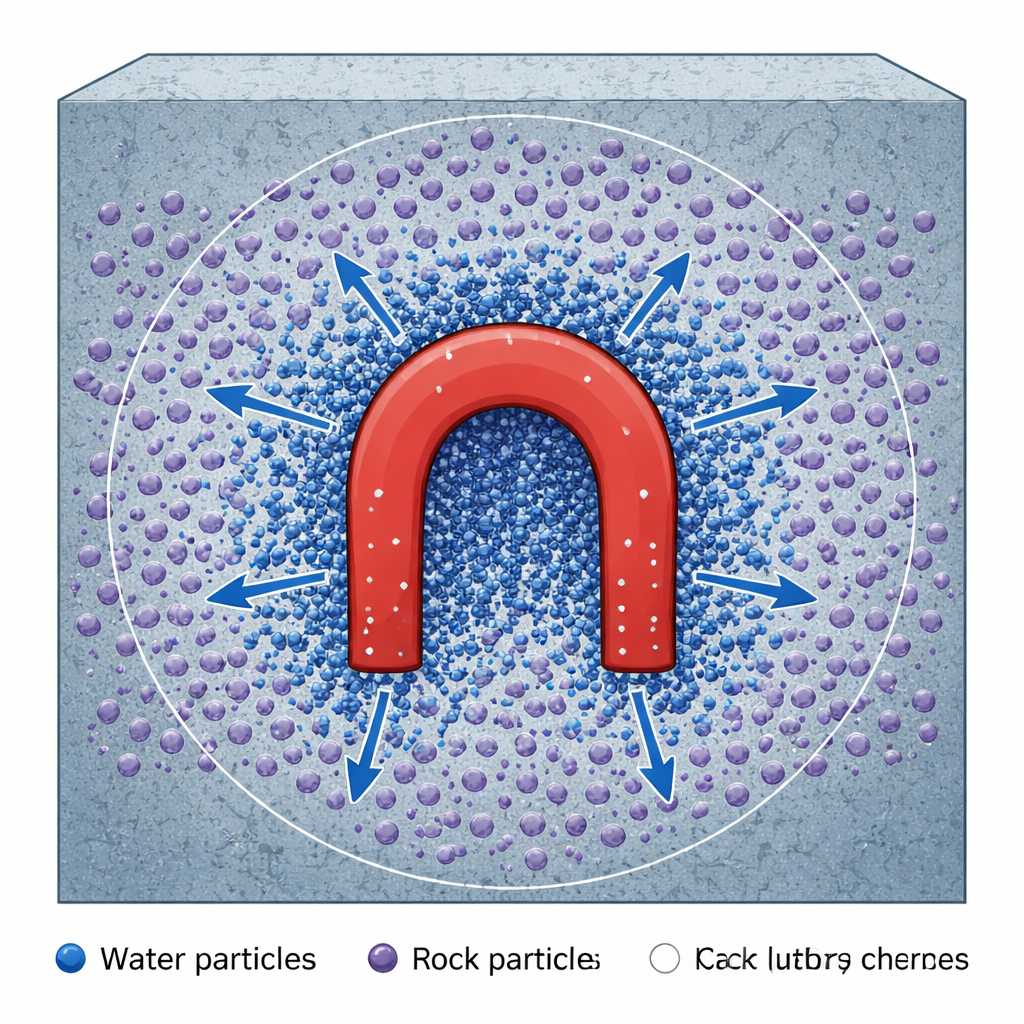
A new way to watch rock break
Traditional computer methods for simulating rock failure divide the ground into a rigid grid. That works well until cracks appear and the rock starts separating, twisting, and branching in complex ways. Then the grid must be constantly updated, which is slow and can easily fail. The authors instead rely on a “meshless” method known as Smoothed Particle Hydrodynamics (SPH). In this approach, the rock and water are represented as clouds of discrete particles that interact with one another. Because there is no fixed grid, large deformations, new cracks, and branching fracture networks can emerge naturally as the simulation runs.
Turning tunnels and water into particles
In the model, a square block of rock 50 meters by 50 meters contains a central horseshoe‑shaped tunnel 9 meters across. The rock is represented by thousands of “base particles,” while the water inside the tunnel and in any fractures is represented by “water particles.” As the simulated water pressure inside the tunnel increases over time, forces are transmitted between water and rock particles according to simple rules: water pushes outward, rock resists, and stresses concentrate in certain regions. Each rock particle is constantly checked—if the local pulling force exceeds the rock’s tensile strength, that particle is marked as failed and no longer carries stress, mimicking a tiny piece of new crack. By updating millions of such particle interactions, the model can track how cracks initiate, grow, branch, and finally cut across the entire rock mass.
How underground squeezing steers cracks
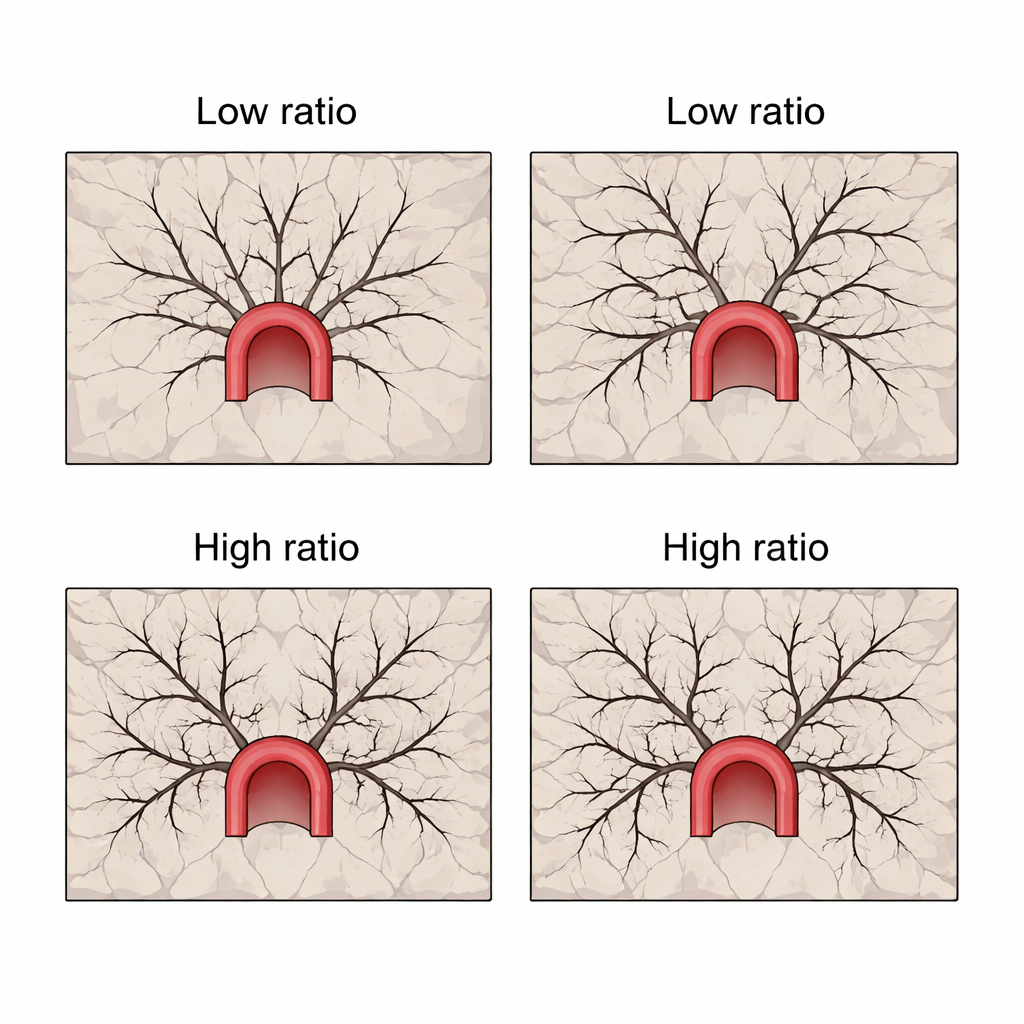
A key focus of the study is “confining pressure,” the squeezing effect the surrounding ground exerts horizontally and vertically on the tunnel. The authors examine several cases where the ratio of horizontal stress to vertical stress changes. When this ratio is low—meaning vertical squeezing dominates—cracks triggered by rising water pressure start at the tunnel’s lower corners, where stress is highest, and shoot mostly straight upward. The resulting fracture network looks like a sparse, tree‑shaped pattern of vertical branches. As horizontal stress becomes more important, secondary cracks at the tunnel surface and at the tips of the main cracks begin to spread sideways, making the overall pattern more complex and more widely distributed.
From simple trees to snowflakes of cracks
As the horizontal stress grows closer to the vertical stress, the crack networks change character. At intermediate ratios, the pattern becomes “M‑shaped,” with strong vertical cracks joined by pronounced side branches that arc outward. At still higher ratios, the crack network resembles a snowflake: vertical and horizontal branches are both well developed, and fractures spread more evenly in all directions around the tunnel. In these cases, the tunnel itself deforms more noticeably before full failure, and the growth of cracks slows as the overall confining pressure increases. Across all scenarios, however, one feature remains constant: the first cracks almost always start at the corners of the horseshoe tunnel, where stresses naturally concentrate.
What this means for real tunnels
The study shows that a meshless SPH approach can faithfully reproduce complex crack patterns around deep hydraulic tunnels and reveal how different stress conditions shape those patterns. For engineers, the message is straightforward: where vertical stress dominates, attention should focus on tall, vertical cracks that may suddenly connect the tunnel to distant water‑bearing layers. Where horizontal stress is strong, lateral cracking and snowflake‑like fracture networks become more likely, calling for extra reinforcement around the tunnel walls and corners. By linking underground stress conditions to predictable crack shapes, this work provides a practical tool to help anticipate and prevent dangerous water‑related failures in deep tunnel projects.
Citation: Zhang, H., Shi, Y., Mu, J. et al. Using a meshless method to investigate the effects of confining pressure on the hydraulic fracturing processes of hydraulic tunnels. Sci Rep 16, 5702 (2026). https://doi.org/10.1038/s41598-026-36426-0
Keywords: hydraulic tunnels, hydraulic fracturing, rock cracks, underground water, numerical simulation