Clear Sky Science · en
SBTM: epileptic seizure prediction from EEG signal using deep learning in blockchain-enabled smart healthcare monitoring with IoT networking
Why predicting seizures before they strike matters
For millions of people living with epilepsy, seizures can arrive without warning—while walking down stairs, crossing the street, or driving a car. An unexpected seizure can cause falls, injuries, or worse, and the constant uncertainty can be as disabling as the seizures themselves. This study explores a way to forecast seizures from brainwave recordings, using wearable electronics, advanced artificial intelligence, and secure online record keeping, so that patients and doctors can get a few crucial minutes of warning and better protect daily life.
A digital safety net around the patient
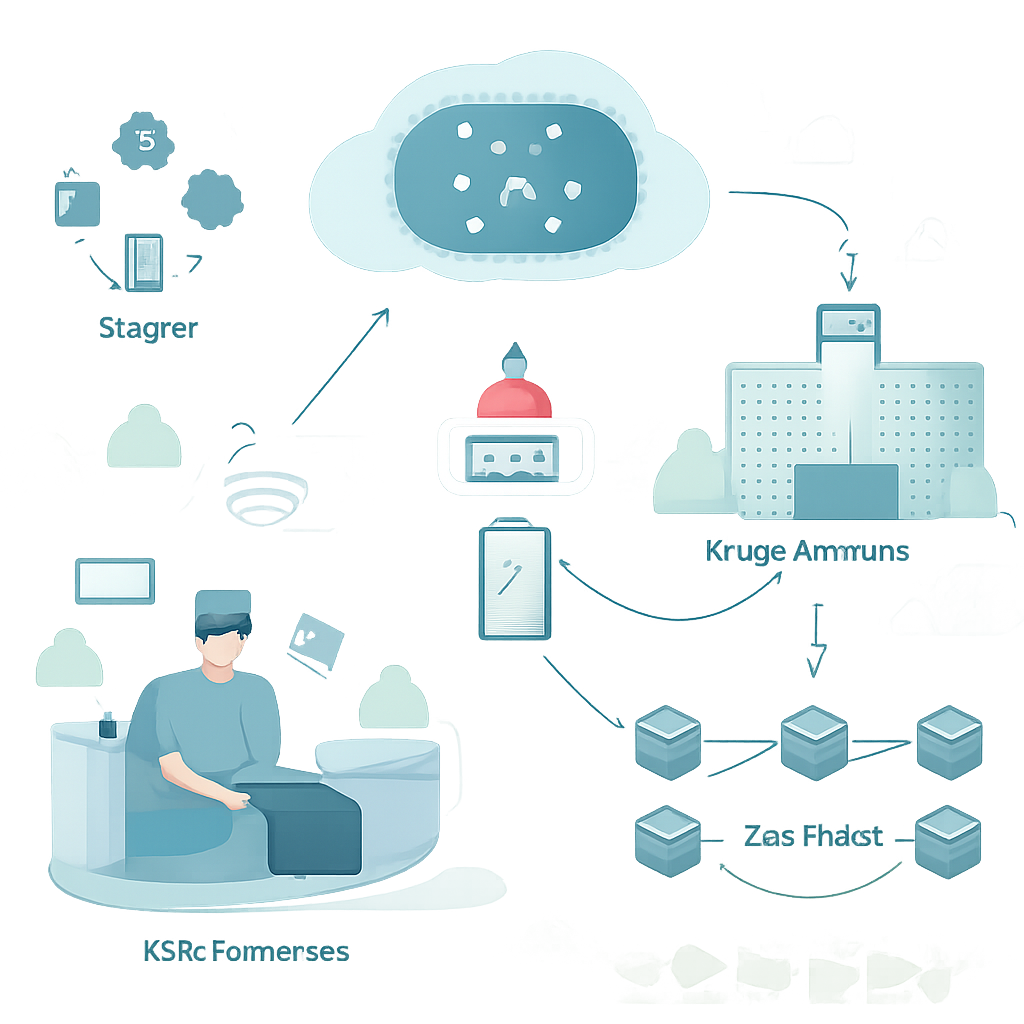
At the heart of the work is a vision of smart healthcare that reaches patients wherever they are. Tiny Internet-connected sensors measure electrical activity in the brain, called EEG signals, and send these data through wireless networks to hospital servers. There, software continuously scans the incoming signals to decide whether the brain is in a normal state or edging toward a seizure. Because the information involves highly sensitive medical details, the system uses blockchain technology—an approach borrowed from digital finance—to log and share records in a way that is difficult to tamper with and easy to audit. Only authenticated doctors with the right digital keys can unlock a patient’s data, which are organized across hospital departments and sites.
Turning brainwaves into early warnings
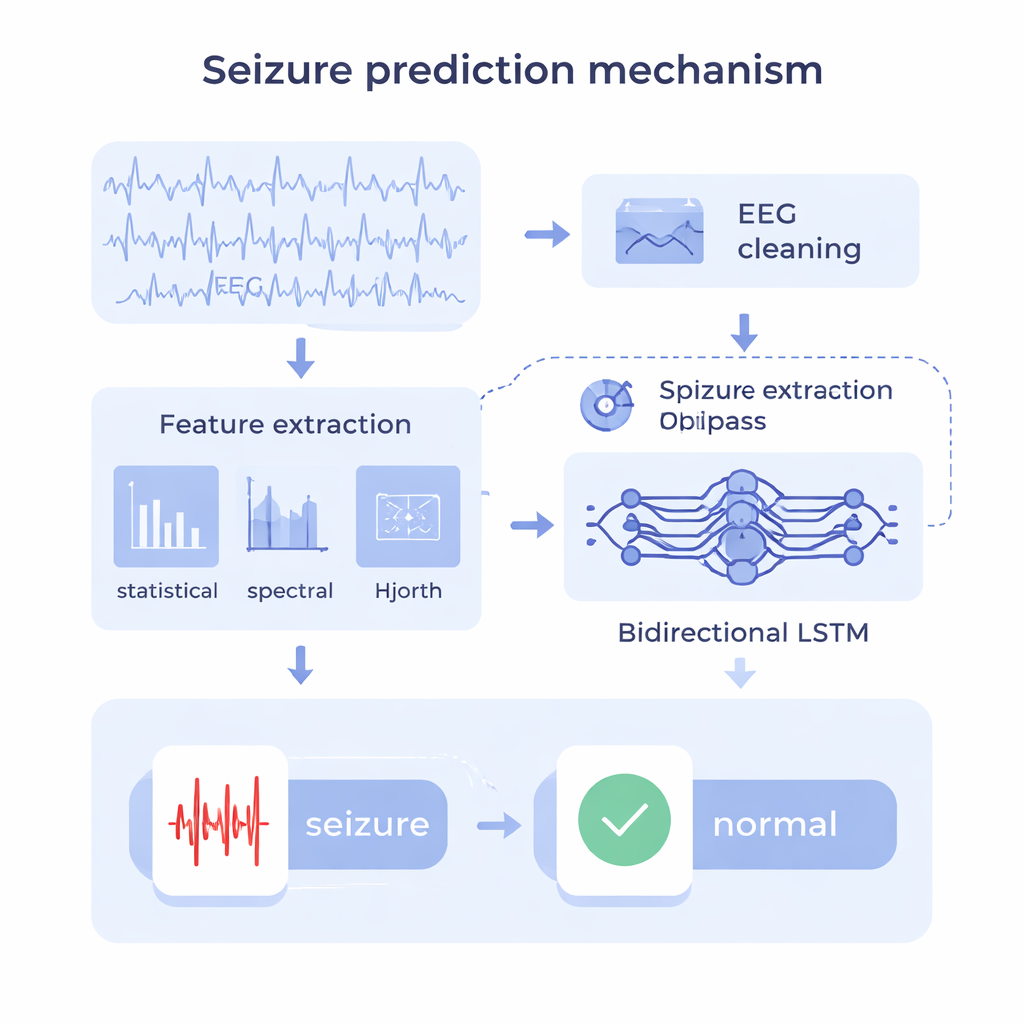
EEG traces are messy: they are full of noise from muscle movement, blinking, and the outside world. The researchers first clean the raw signals with filters that keep only the frequency range most relevant to brain activity linked to seizures. They then compress each long signal into a compact description using three families of features. Statistical features capture how values are spread out or skewed. Spectral features describe how the signal’s energy is distributed across different frequencies. Hjorth features, a classic EEG measure, summarize how strong, mobile, and complex the signal is over time. Together, these numbers provide a rich but manageable snapshot of the brain’s state, reducing the heavy computing cost of working directly on raw waveforms.
A smarter neural network tuned by nature-inspired search
To read these feature snapshots, the team designed a deep learning model called the Spizella-based Bidirectional Short-Term Memory network, or SBTM. It is built on a type of recurrent neural network that is especially good at handling sequences, such as language or time-series data. The "bidirectional" design lets the model look at patterns in the EEG features both forward and backward in time, helping it capture the subtle build-up and decay that can signal an approaching seizure. On top of this, the researchers introduce a new optimization method inspired by the food-search and escape behavior of small birds and cougars. This "Spizella" optimizer automatically adjusts the many internal settings of the network so that it settles on combinations that best separate seizure from non-seizure patterns while avoiding common pitfalls like getting stuck in poor local solutions.
Testing on real patients and real-world conditions
The system was evaluated on a well-known EEG collection from a children’s hospital, as well as an additional real-time dataset, both containing recordings from patients who experienced frequent seizures. The SBTM model learned to distinguish seizure-related patterns from normal activity with notable success: on the main dataset, it reached around 98% specificity (meaning very few false alarms) and about 97.5% sensitivity (meaning it rarely missed true seizures), with overall accuracy near 97.5%. Importantly, it did so faster and with less computing effort than several established machine-learning approaches, and it outperformed a range of rival deep learning models that did not use the same feature design or optimization strategy.
Building toward safer, more private epilepsy care
For a non-specialist, the takeaway is that this work combines three powerful ideas—ahead-of-time seizure prediction from EEG, a compact and efficient neural network, and secure record sharing using blockchain—into a single framework. In practical terms, such a system could one day allow a wearable device to alert a person with epilepsy, their family, and their care team minutes before a seizure, while keeping their medical data strongly protected as it flows between devices and hospitals. Although more testing and refinement are needed before it can be deployed widely, the study points toward a future in which connected, intelligent, and privacy-aware tools help people with epilepsy live more safely and independently.
Citation: Kumar, A., Tripathi, E., Tripathi, A.K. et al. SBTM: epileptic seizure prediction from EEG signal using deep learning in blockchain-enabled smart healthcare monitoring with IoT networking. Sci Rep 16, 6830 (2026). https://doi.org/10.1038/s41598-026-36425-1
Keywords: epilepsy, EEG, seizure prediction, deep learning, smart healthcare