Clear Sky Science · en
Integrating machine learning and explainable AI for employee attrition prediction in HR analytics
Why Losing People Hits Hard
Every resignation carries a hidden price tag. When an experienced employee walks out the door, a company does not just lose a salary line; it loses skills, relationships, and momentum. This article explores how modern data tools can help organizations spot who might be about to leave and, crucially, understand why. By blending machine learning with explainable artificial intelligence, the researchers aim to give HR teams a practical early‑warning and guidance system for keeping valuable people on board.
Turning HR Records into Signals
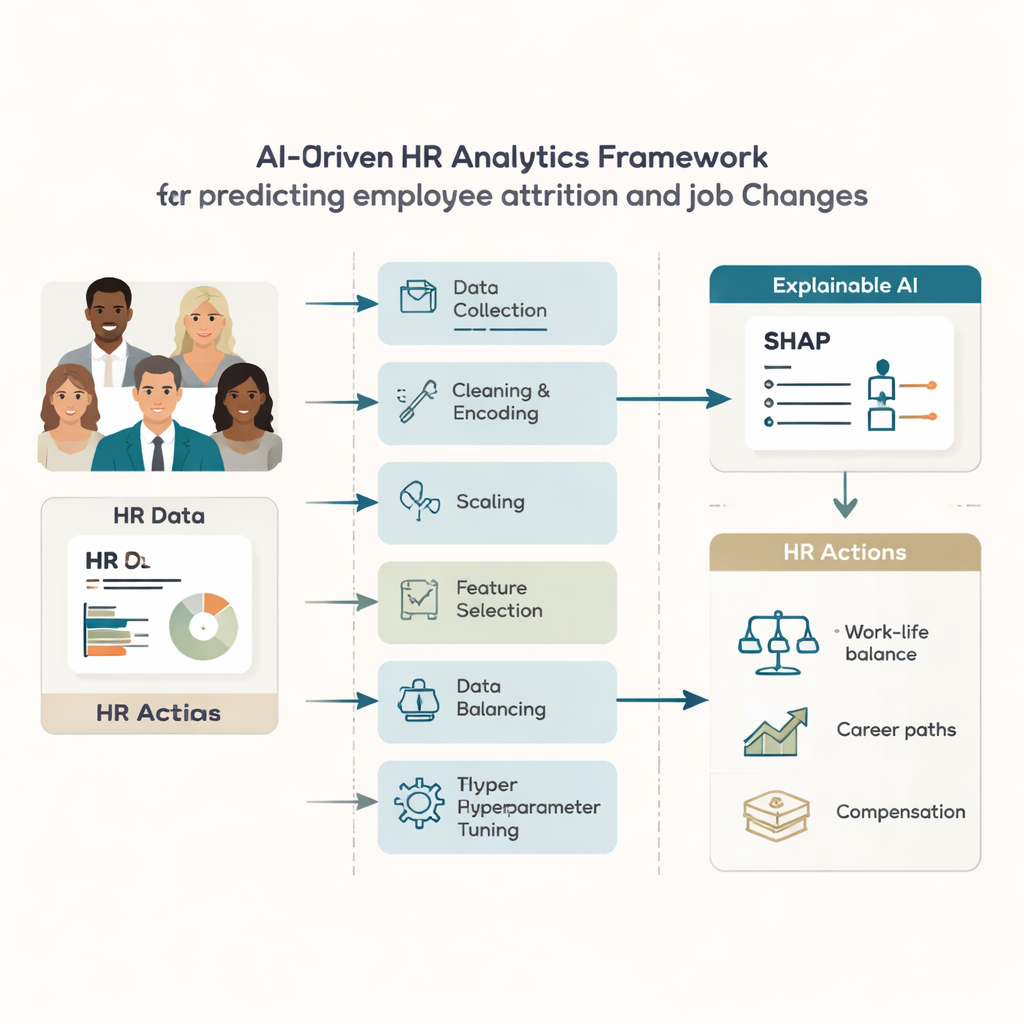
Most organizations already collect rich information about their staff: age, role, pay, performance scores, and even answers to satisfaction surveys. The study harnesses four such datasets, including a widely used IBM sample and several real or realistic company collections with thousands of employees. These tables mix numbers (like monthly income or years at the firm) with categories (such as job role or marital status). The authors first clean and standardize all this information, converting text labels into numbers and putting measurements onto comparable scales. This careful preparation turns messy HR records into a consistent foundation that computers can learn from.
Teaching Machines to Spot Flight Risks
Once the data are ready, the team tests a wide range of prediction methods, from simple logistic regression to more advanced "boosting" techniques that combine many weak rules into a strong one. A key challenge is that in any company, most employees stay, so the “leavers” form a small minority. If left unchecked, a model could simply predict that everyone stays and still look accurate on paper. To avoid this trap, the authors use balancing methods that create realistic synthetic examples of leavers, helping the algorithms learn the subtle patterns that separate those likely to quit from those likely to remain. They also use an automated search strategy to fine‑tune each model’s internal settings across thousands of trials, squeezing out extra performance.
Who Leaves and What Matters Most
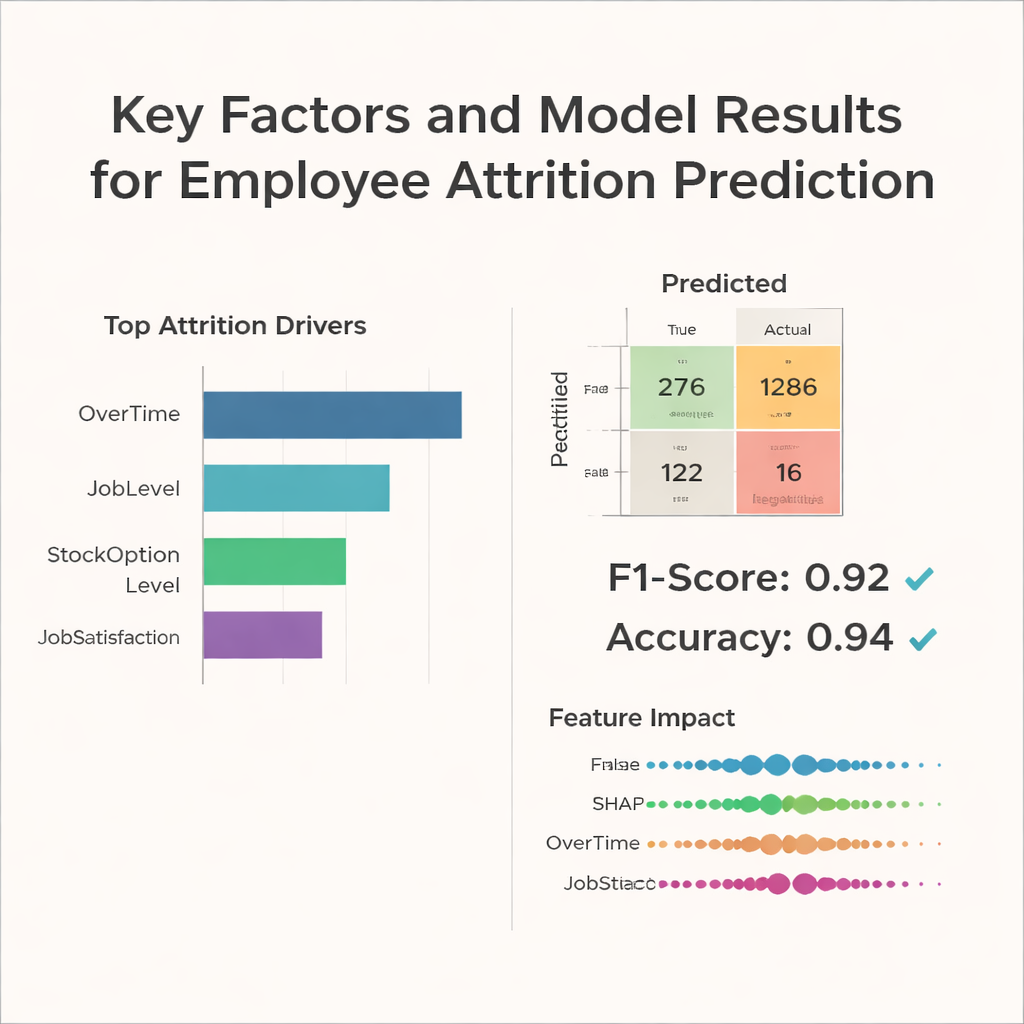
Across datasets, two families of models stand out: Adaptive Boosting (AB) and Histogram Gradient Boosting (HGB). These approaches reach high scores for precision (how often a predicted leaver really leaves), recall (how many actual leavers are caught), and overall accuracy. But raw performance is not enough for real‑world use. HR managers need to know which factors drive a prediction in order to respond fairly. To open up these “black boxes,” the team uses a technique called SHAP, borrowed from game theory. SHAP assigns each feature a contribution to the final prediction for an individual worker and, when averaged across many workers, reveals which factors matter most overall. In this study, working overtime, job level, stock options, and job satisfaction repeatedly emerge as powerful signals of future departures or job changes.
From Numbers to Concrete Actions
Because SHAP explanations work both globally and for each individual, they bridge the gap between statistics and everyday decisions. At a company level, they highlight broad problem areas: for example, frequent overtime or stagnant mid‑career roles tied to higher quitting risk. For a single employee, they can show whether overtime, pay, or lack of promotion opportunities are pushing their risk score upward. The authors argue that this dual view allows HR teams to design targeted responses—such as rebalancing workloads, clarifying promotion paths, or revisiting equity plans—while also having transparent reasons to discuss with managers and staff.
What This Means for Workplaces
In plain terms, the article shows that it is now feasible to build systems that not only forecast who might leave but also explain why in a human‑understandable way. By carefully cleaning HR data, balancing the odds between stayers and leavers, and pairing strong prediction models with clear visual explanations, organizations can move from reactive exit interviews to proactive retention strategies. Used responsibly, with attention to privacy and bias, such tools can help companies protect their human capital while offering employees fairer, more responsive workplaces.
Citation: AL-Ali, M., Alwateer, M., Alsaedi, S.A. et al. Integrating machine learning and explainable AI for employee attrition prediction in HR analytics. Sci Rep 16, 6344 (2026). https://doi.org/10.1038/s41598-026-36424-2
Keywords: employee attrition, HR analytics, machine learning, explainable AI, retention strategies