Clear Sky Science · en
Association between idiopathic scoliosis and facial asymmetry: a gender-balanced case–control study
Why your spine might shape your face
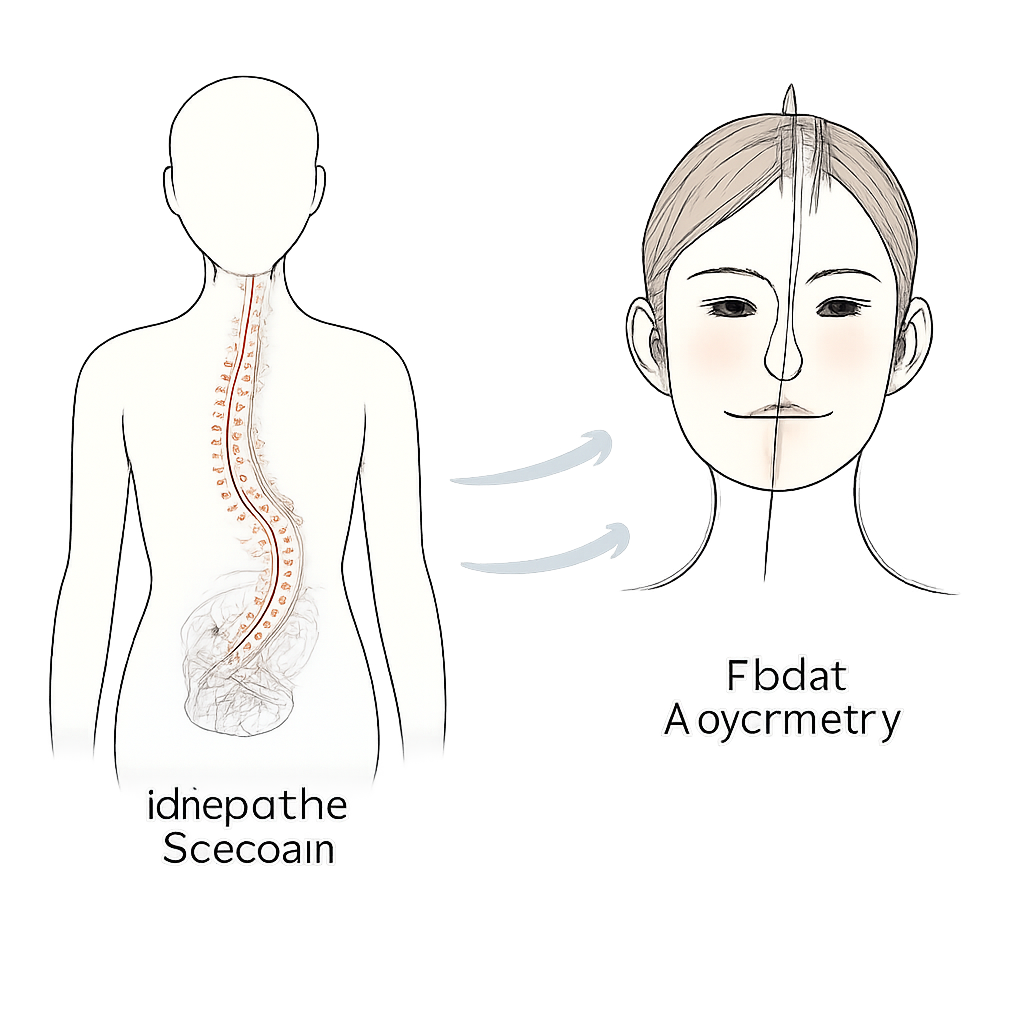
Most people think of scoliosis—a side-to-side curve in the spine—as something that only affects the back. This study asks a striking everyday question: could a crooked spine also be linked to a slightly uneven face? Because both the spine and the bones of the face grow rapidly during adolescence, understanding any hidden connection could change how doctors and dentists screen and treat young people.
Looking at backs and faces together
To explore this link, the researchers carried out a case–control study, a common way to compare two carefully matched groups. They recruited 100 young people aged 14 to 25. Half had idiopathic scoliosis, the most common kind that arises without a clear cause, and half had normal spines confirmed by X‑ray. Each group was evenly split between males and females so that any differences found would not simply reflect the greater number of girls usually seen with scoliosis.
Measuring a subtle kind of unevenness
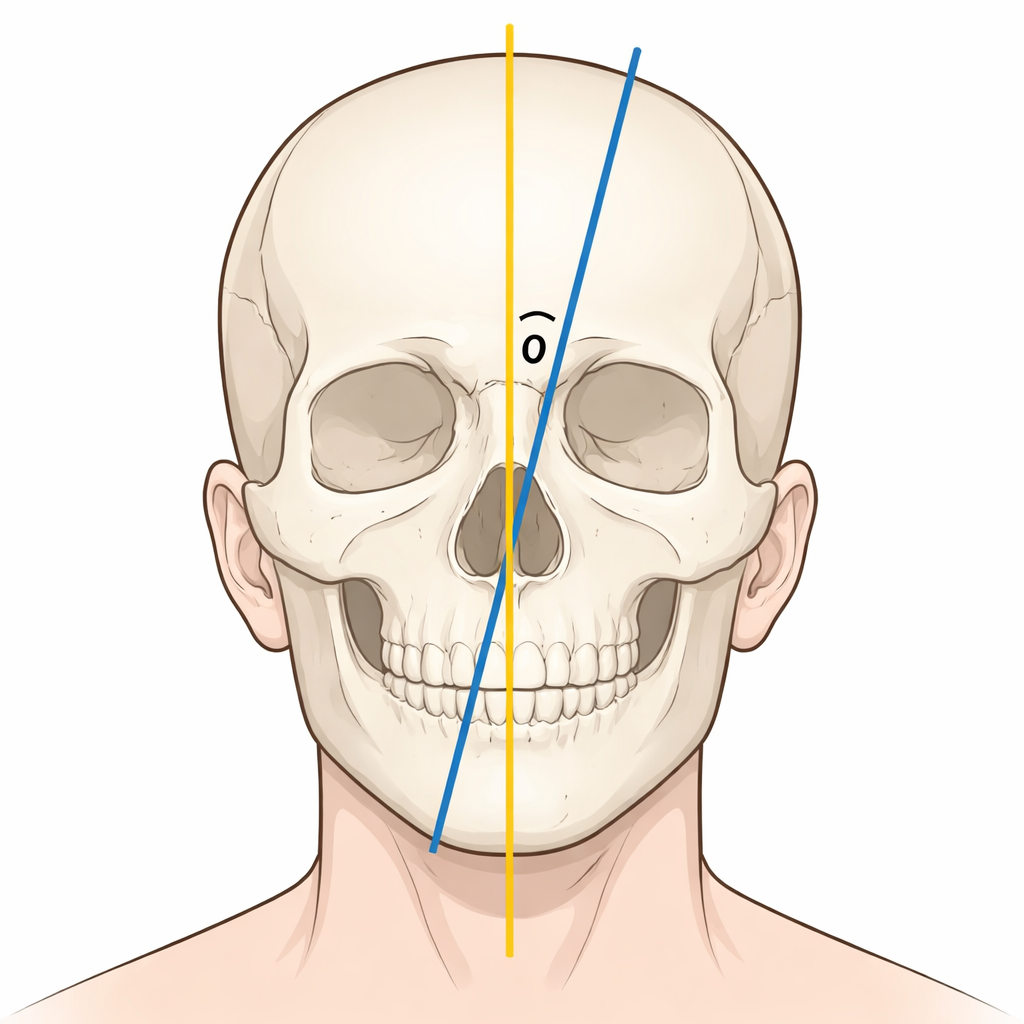
Facial asymmetry in this study did not mean dramatic, easily visible deformities. Instead, the team focused on small shifts of the lower face away from the ideal midline. Using frontal skull X‑rays, they marked key points along the nose and chin and used a custom computer script to calculate the angle between a perfectly vertical line and the actual line running down the face. Any non‑zero angle was counted as asymmetry, making the method very sensitive to even mild deviations. A second, stricter cut‑off—roughly equivalent to a 3‑millimeter sideways shift—was also tested to check how robust the findings were.
What the numbers revealed
The contrast between the two groups was striking. In the scoliosis group, 82 percent of participants showed facial asymmetry, compared with 36 percent of those without scoliosis. Put another way, people with idiopathic scoliosis had about seven and a half times higher odds of having an uneven face than those in the control group. When the researchers applied the stricter definition of asymmetry, the pattern became even clearer: 72 percent of the scoliosis group versus 22 percent of controls met the criterion, and the odds ratio rose close to ten. Careful statistical checks suggested these results were very unlikely to be due to chance, and the study had more than enough participants to support its conclusions.
Same story for boys and girls
A key question was whether this spine–face connection differed between males and females. Despite the usual female predominance in scoliosis, the study found almost identical rates of facial asymmetry in boys and girls with the condition: 84 percent and 80 percent, respectively. The calculated odds of asymmetry relative to controls were also similar in both sexes. This suggests that whatever ties the curved spine to an uneven face operates in much the same way for young men and women.
How a crooked spine might influence the face
The study cannot prove cause and effect, but it does highlight several plausible pathways. One leading idea is postural compensation: when the spine curves, the body may subtly tilt the shoulders, neck, and head to keep the eyes level and maintain balance. Over years of growth, these small adjustments could guide the jaw and facial bones into a slightly off‑center position. The authors also note that many patients with scoliosis and facial asymmetry had their lower jaws shifted toward the outward‑bulging side of the spinal curve. Other possibilities include shared underlying factors—such as changes in the upper neck bones or genetic influences—that affect both the spine and the face as they develop.
What this means for patients and families
For patients, parents, and clinicians, the main message is practical: idiopathic scoliosis and facial asymmetry often travel together, and this pattern appears in both sexes. The authors argue that young people diagnosed with scoliosis should also have their faces and teeth checked for subtle misalignment, and that dentists or orthodontists noticing a marked facial tilt should consider whether a spinal assessment is needed. Working together, spine specialists and dental experts may be able to detect problems earlier and plan treatments that consider the whole growing body, from the curve in the back to the balance of the face.
Citation: Taskin, R., Kalkan, E. & Ugur, F. Association between idiopathic scoliosis and facial asymmetry: a gender-balanced case–control study. Sci Rep 16, 6805 (2026). https://doi.org/10.1038/s41598-026-36422-4
Keywords: idiopathic scoliosis, facial asymmetry, adolescent spine, craniofacial growth, orthodontics