Clear Sky Science · en
Structural controls on multi-field coupled ore-bearing hydrothermal migration in Zhugongtang Zn-Pb deposit, Southwestern China
Why the shape of underground rocks matters
Modern life depends on metals like zinc and lead, which end up in everything from car batteries to building materials. But these metals are not spread evenly underground; they concentrate in rich deposits that miners must first find. This study looks at one such giant lead–zinc deposit in southwestern China and asks a deceptively simple question: how does the shape and breakage of rocks deep below ground control where metal-rich fluids travel and finally leave their metals behind? Using advanced computer simulations, the authors turn a complex, slow geological process into something we can see and measure.
A metal treasure in folded mountains
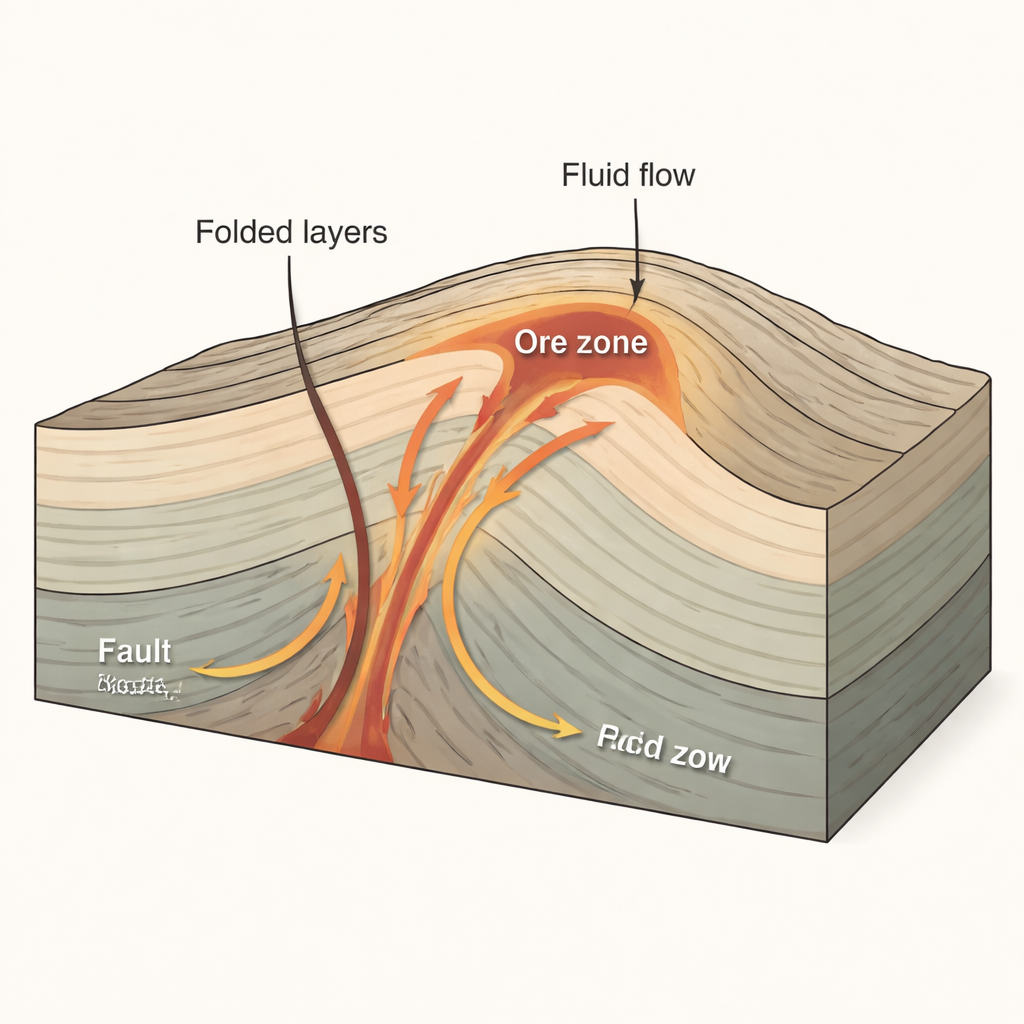
The Zhugongtang deposit lies in a mountainous region where Earth’s crust has been squeezed, folded, and broken along large faults. These movements created arches of rock called anticlines and long fractures that act like underground highways. The ores here are hosted in thick layers of carbonate rock, and previous field studies showed that metal-bearing fluids rose from depth along faults and then spread sideways into these folded layers. However, until now, scientists mostly relied on static geological maps and could not watch how heat, pressure, and flowing fluids interacted through time to focus metals into ore bodies.
Turning geology into a virtual experiment
To tackle this, the researchers built a simplified two-dimensional computer model of the Zhugongtang area. They used COMSOL Multiphysics software, which solves equations describing how heat moves, how fluids flow through porous rocks, how pressure builds or drops, and how dissolved zinc drifts with the water. The model mimics realistic conditions: hot, zinc-bearing fluid is injected along a deep fault at about 250 °C, then allowed to move for 10,000 years—roughly the lifetime of the ore-forming event. The rocks are given different densities, porosities, and permeabilities, based on local geological data, so that the simulation reflects how easily fluids and heat would really move through each layer.
Following heat, pressure, and metal-rich water
The results show a clear sequence. First, hot fluid rushes vertically upward along the fault because it is buoyant and the broken rock offers an easy path. As it meets more gently fractured rock near the fold, the flow slows and begins to spread sideways along bedding planes. At certain depths and positions—especially where the fault meets the fold core—the model shows pockets of unusually low pressure. These “suction zones” encourage new fractures to open and create extra storage space for fluids. Over hundreds of years, zinc concentrations build up along the fault and then leak into nearby layers, matching the observed pattern of ore bodies in Zhugongtang. The temperature field, mostly between about 110 and 220 °C, also agrees with measurements from tiny fluid inclusions trapped in real minerals.
When gentle bends or tight kinks change the game
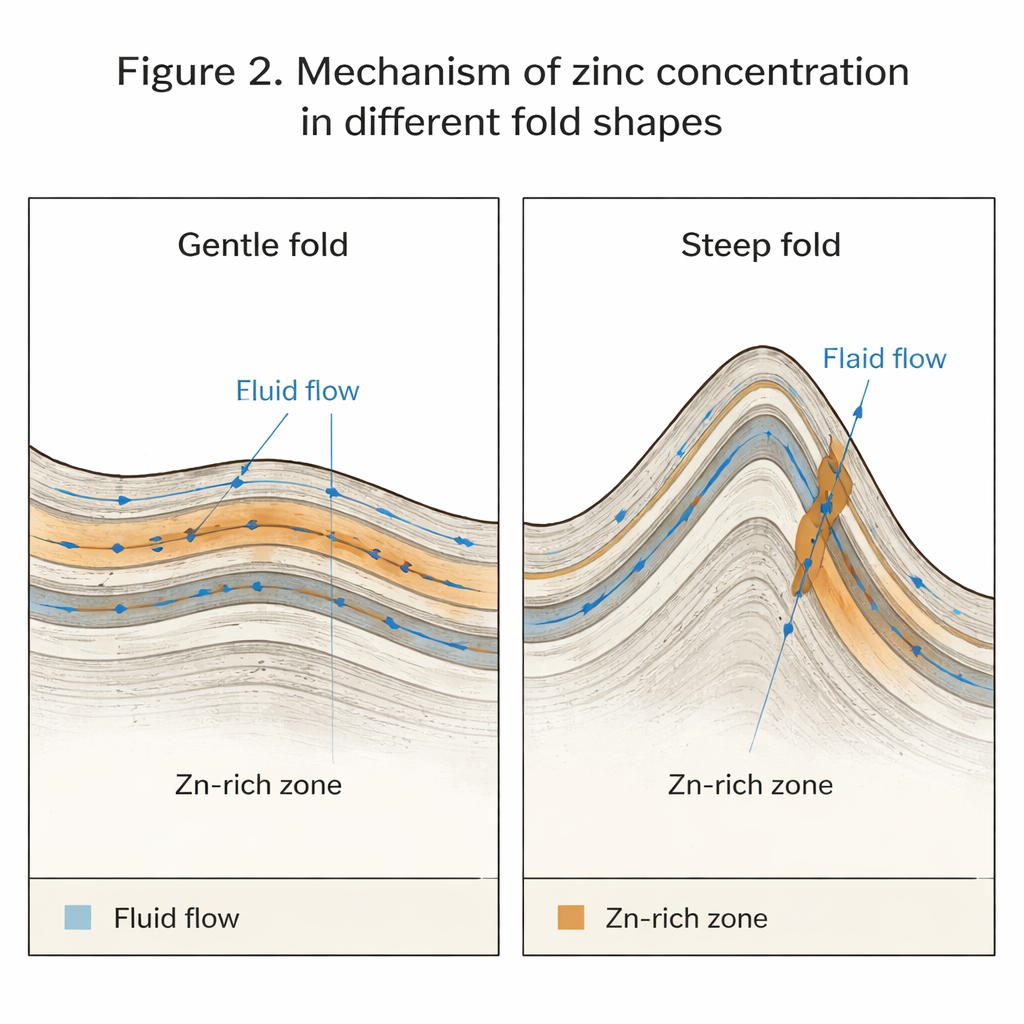
A key innovation of the study is testing how different fold shapes affect metal concentration. The team compared two scenarios without changing the fault: one with a gentle, open fold and another with a steep, tightly curved fold. In the gentle case, nearly flat layers act like long, horizontal pipes, allowing the zinc-rich fluid to travel far and spread widely through the strata. This favors ore bodies that are mostly layer-bound. In the steep case, the layers are sharply inclined, increasing resistance to sideways flow. Fluids are forced to stay in the main fault and only spread over shorter distances, concentrating ore mainly along the fault itself. This shift from strata-hosted to fault-hosted mineralization closely matches what geologists see in several nearby deposits.
What this means for finding future metal resources
For non-specialists, the takeaway is that the geometry of underground structures strongly guides where valuable metals end up. Faults supply fast vertical pathways for hot, metal-bearing fluids, while folds and their internal stress patterns decide where those fluids slow, mix, and finally drop their load of zinc and lead. Gentle, open folds tend to favor broad, layer-following ore bodies; tight folds focus metals into narrower zones along faults. By combining field observations with physics-based simulations, this study turns rock shapes into practical clues, helping exploration teams better predict where the next hidden ore body might lie in similar mountain belts around the world.
Citation: Zhang, Y., Zhou, W., Zhang, W. et al. Structural controls on multi-field coupled ore-bearing hydrothermal migration in Zhugongtang Zn-Pb deposit, Southwestern China. Sci Rep 16, 3471 (2026). https://doi.org/10.1038/s41598-026-36421-5
Keywords: lead-zinc deposits, hydrothermal fluids, fault-fold structures, numerical simulation, mineral exploration