Clear Sky Science · en
Improved neutral lipid production from Tetradesmus obliquus through fed-batch mixotrophic cultivation at high pH using potato peel hydrolysate
Turning Kitchen Scraps into Clean Fuel
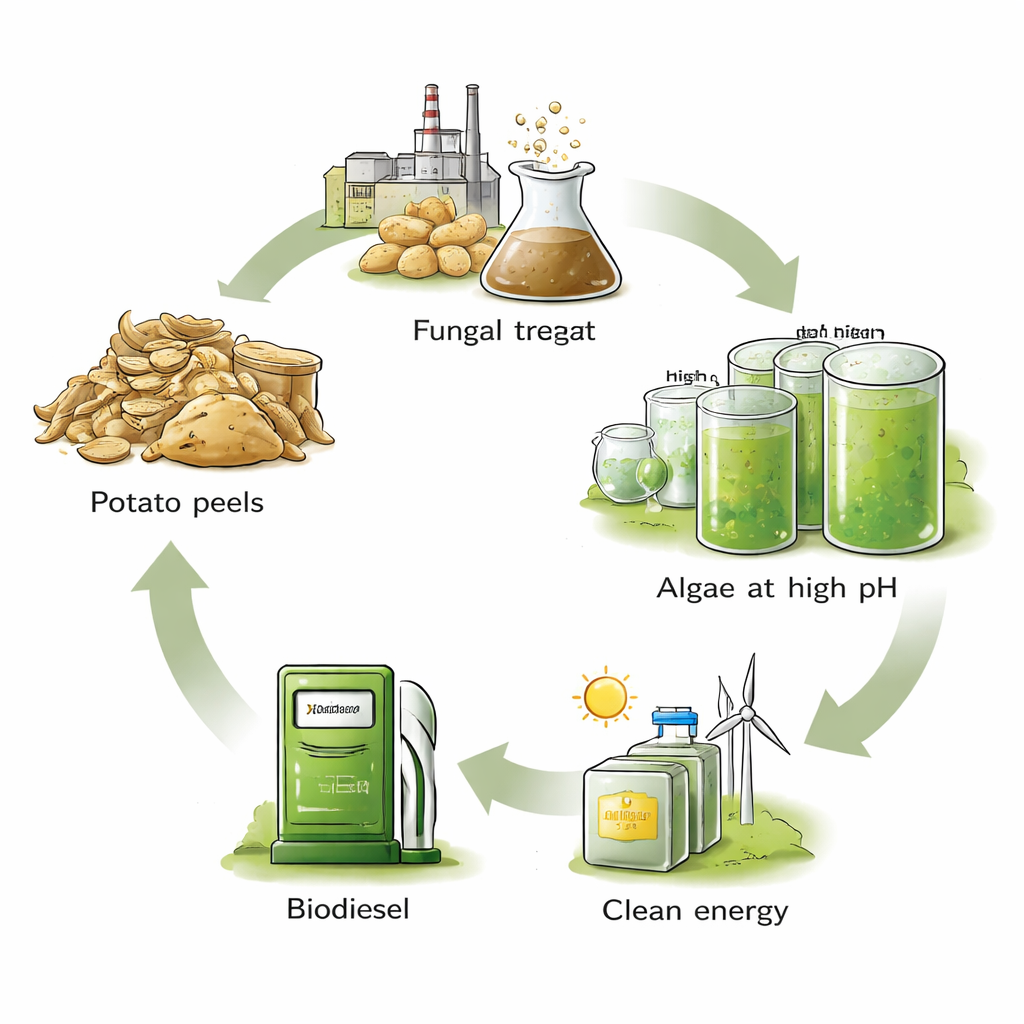
Every day, factories that make French fries and potato chips throw away mountains of potato peels. This study asks a simple question with big consequences: could that “trash” be turned into a cheap feedstock for growing microscopic algae that, in turn, become a source of cleaner diesel fuel? By pairing food waste with hardy algae that thrive in very alkaline water, the researchers explore a low-cost, low-contamination route to sustainable biodiesel.
Why Algae Matter for Future Energy
Microalgae are tiny plant-like organisms that grow fast, capture carbon dioxide, and can store large amounts of oils inside their cells. These oils, especially a kind called neutral lipids, can be converted into biodiesel that runs in ordinary diesel engines. Unlike crops such as soy or palm used for biofuels, algae do not need farmland and can be grown in controlled tanks. Yet the high costs of feeding and maintaining algal cultures, and the risk of contamination, have held back commercial-scale production.
Giving Waste Peels a Second Life
Instead of buying pure sugar or other expensive ingredients to feed the algae, the team collected potato peels from local restaurants and used a common fungus to break them down. Over four days, the fungus digested the tough peel material and released sugars, proteins, and a small amount of other nutrients into a liquid known as potato peel hydrolysate. This liquid became a low-cost “broth” that could supplement sunlight and carbon dioxide, allowing the algae to grow mixotrophically—that is, using both light and organic food at the same time.
Growing Algae in Harsh but Helpful Conditions
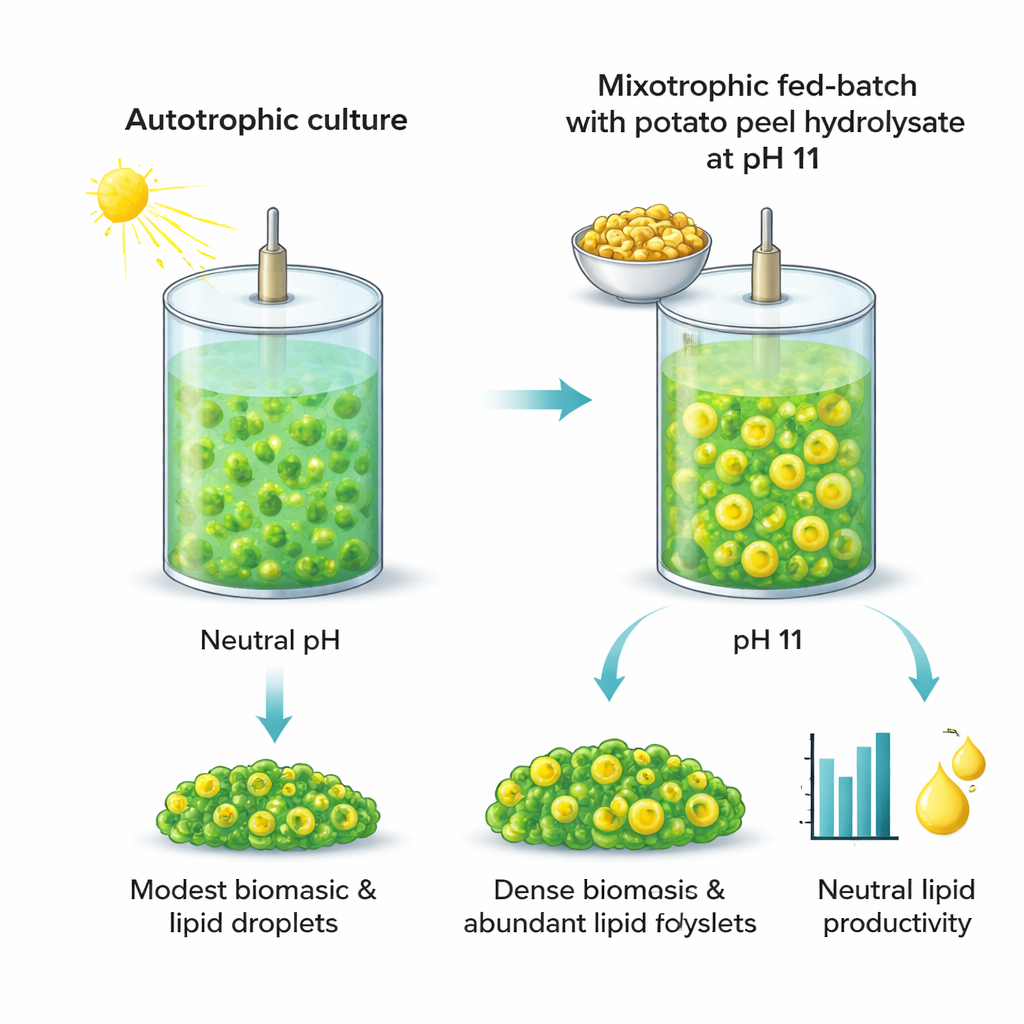
The researchers worked with a green microalga called Tetradesmus obliquus, which naturally tolerates very alkaline water. They raised the culture medium to a starting pH of 11, a level that would kill or inhibit many unwanted microbes that might otherwise invade the tanks. Under these harsh but stable conditions, the algae grew more quickly and produced more oil than at neutral pH. When the potato peel liquid was added in small, regular doses (a fed-batch approach), biomass production increased by up to 1.8 times and neutral lipid formation by about 2.5 times compared with algae grown on light and carbon dioxide alone.
Fine-Tuning Nutrients to Boost Useful Oils
Beyond simply adding the peel-derived broth, the scientists adjusted the levels of key nutrients—nitrogen, phosphorus, and sulfur—to see how stress would reshape oil production. Mild shortages of nitrogen or sulfur, combined with the potato peel feeding at high pH, nudged the cells to stockpile even more neutral lipids without collapsing their growth. Under these tuned conditions, the daily output of these storage oils rose to almost three times that of the standard, fully fed culture. Chemical analysis showed that most of the resulting fats were in ranges favored for biodiesel, rich in 16- and 18-carbon chains with predominantly single double bonds, which are linked to good engine performance and fuel stability.
What This Means for Everyday Fuel
When the algal oils were virtually “test-driven” on paper, their predicted biodiesel properties—including ignition quality, cold-weather behavior, and safety-related measures such as flash point—met international fuel standards. In everyday terms, that means the oil made from algae fed on potato peel waste and grown in very alkaline water could be turned into a diesel substitute that engines can use reliably. While scaling up will still require robust reactors and efficient harvesting methods, this work shows that a troublesome food-industry by-product can be transformed into a valuable input for clean energy, closing a loop between our plates and our fuel tanks.
Citation: Gomaa, M., Mohamed, A.K.S.H., Youssef, A.M. et al. Improved neutral lipid production from Tetradesmus obliquus through fed-batch mixotrophic cultivation at high pH using potato peel hydrolysate. Sci Rep 16, 4713 (2026). https://doi.org/10.1038/s41598-026-36418-0
Keywords: microalgae biodiesel, potato peel waste, mixotrophic cultivation, alkaline cultivation, neutral lipid production