Clear Sky Science · en
Improved flexural fatigue behavior and strengthening mechanisms of rubberized concrete using pretreated crumb rubber
Turning Old Tires into Stronger Roads
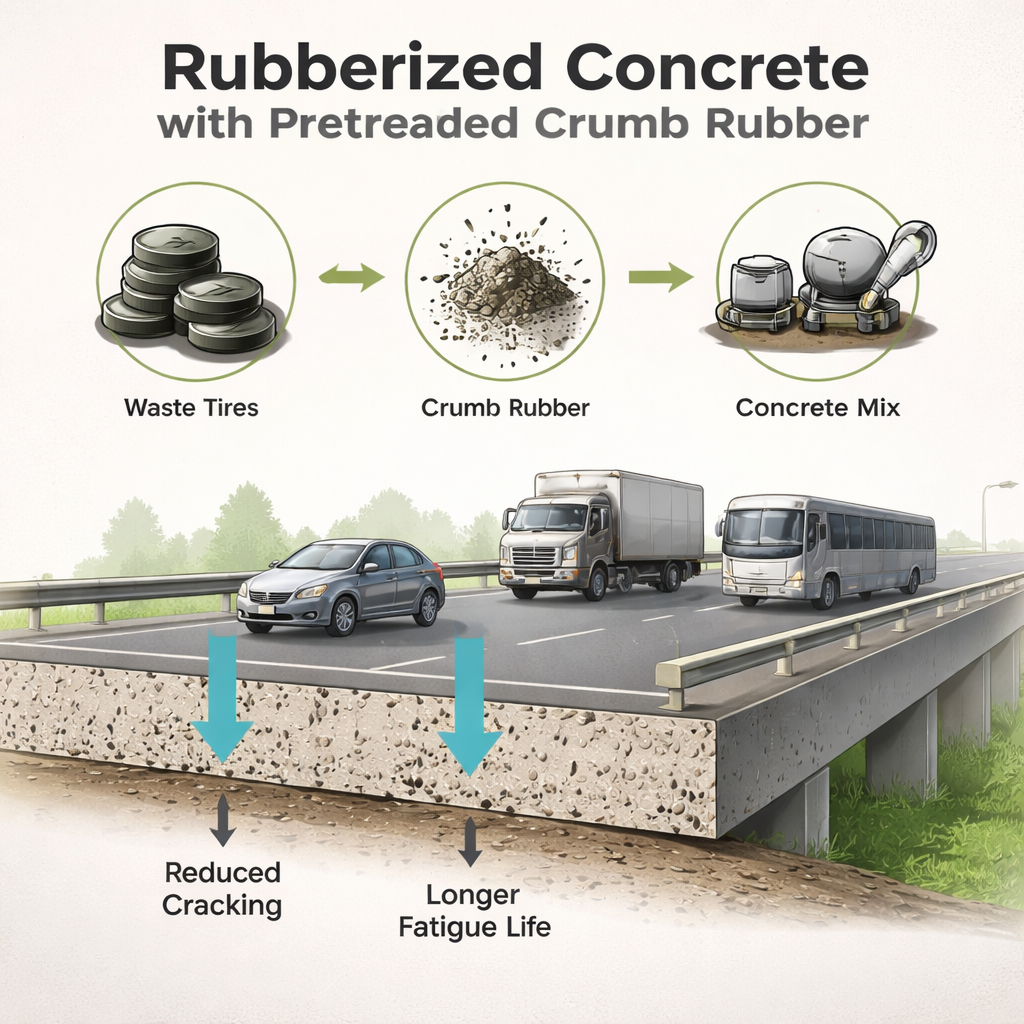
Every year, more than a billion vehicle tires reach the end of their lives, creating a massive waste problem. This study explores an elegant way to recycle those tires: grinding them into tiny rubber particles and blending them into concrete. The goal is to make roadways and bridge decks that better withstand the endless rhythm of traffic, all while cutting landfill use and supporting a lower‑carbon construction industry.
Why Add Rubber to Concrete?
Traditional concrete is strong but brittle: it performs well under a one‑time heavy load, yet repeated traffic can slowly weaken it, leading to cracks and eventual failure. By replacing part of the sand in concrete with “crumb rubber” made from waste tires, engineers can give the material a bit of flexibility, like adding shock absorbers at the microscopic scale. Earlier research showed that this rubberized concrete can better resist repeated loading, but often at the cost of lower overall strength. The central question of this paper is whether treating the rubber before mixing it into the concrete can preserve, or even improve, both durability under fatigue and basic mechanical strength.
How the Experiments Were Set Up
The researchers produced a series of concrete mixes that differed only in how much crumb rubber they contained and whether that rubber had been pretreated. In all mixes, small rubber particles 1–2 millimeters across partly replaced the fine sand by volume, at levels ranging from 2.5% up to 20%. Some mixes used untreated rubber, while others used rubber whose surface had been chemically modified with a silane coupling agent. This treatment makes rubber less water‑repellent and helps it bond more tightly to the surrounding cement. The team measured standard properties such as compressive strength, splitting tensile strength, and bending strength, then performed flexural fatigue tests: long‑running experiments in which concrete beams are repeatedly bent up and down until they fail.
What Happens to Strength and Fatigue Life
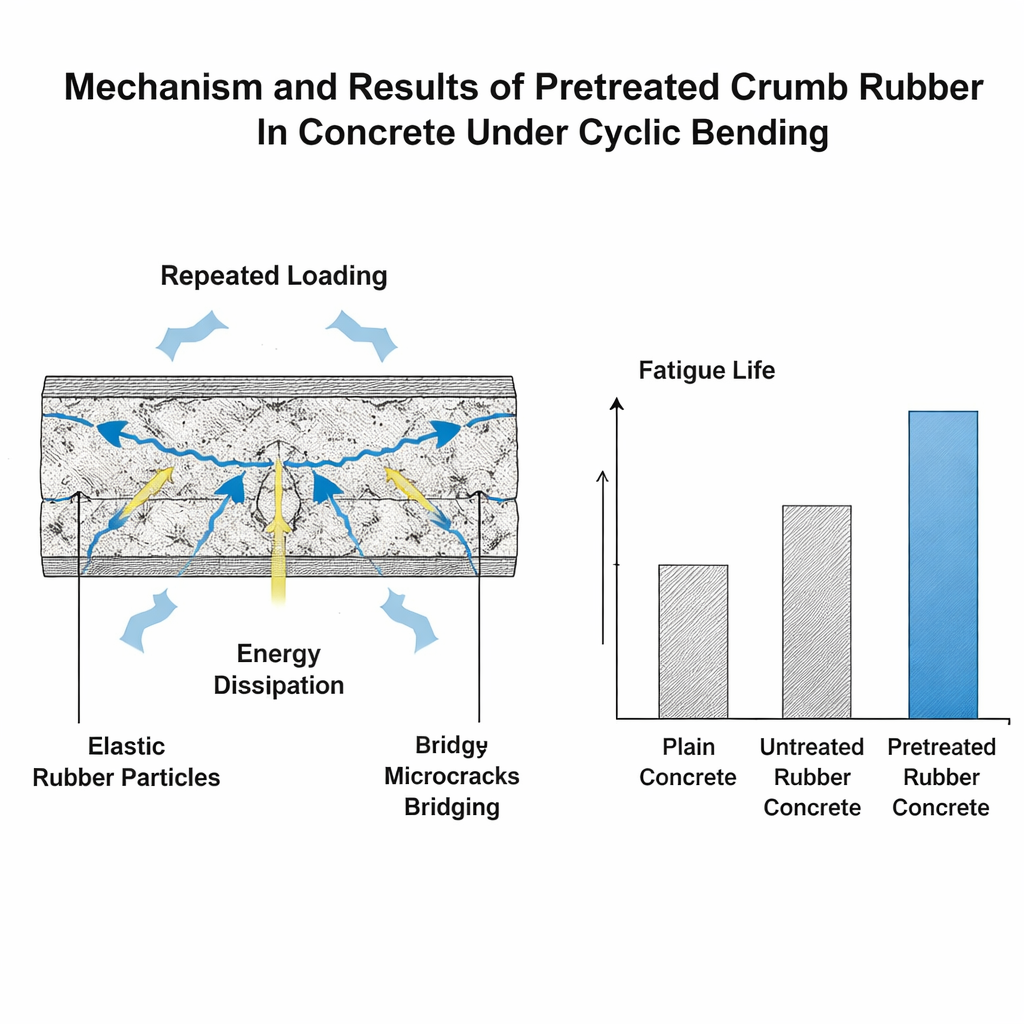
As expected, adding rubber generally reduced the concrete’s compressive and tensile strength, because soft particles and extra air pockets interrupt the rigid mineral skeleton. However, pretreating the rubber partially reversed this loss. For example, when 7.5% pretreated rubber was used, the compressive strength was 15% higher than with the same amount of untreated rubber. Under bending, the maximum load before failure decreased with more rubber, but the beams could bend much farther before breaking. At 5%, 10%, and 15% rubber content, the peak deflection was about 1.6, 2.1, and 2.5 times that of normal concrete, showing a clear gain in deformability. Most importantly for real‑world roads and bridge decks, the fatigue life—the number of load cycles endured before failure—grew substantially with rubber content. Concrete with 10% pretreated rubber survived about 21% more load cycles than the reference concrete. Pretreated mixes consistently outperformed untreated ones at the same rubber level, especially at higher contents.
Looking Inside at the Microscopic Changes
To understand why these improvements occur, the authors looked at the concrete’s internal structure using electron microscopy and analyzed the fatigue data with a statistical tool known as the Weibull distribution. Images showed that rubberized concrete contains many small air bubbles, elastic rubber particles, and “weak” zones around those particles. These features are harmful for one‑time strength but valuable under repeated loading: they act like tiny cushions and sliding interfaces that absorb and dissipate energy, slowing the growth of microcracks. In concrete with untreated rubber, the bond between rubber and cement is poor, and cracks can easily form and widen along that interface. After pretreatment, the contact zone becomes denser and more continuous, reducing initial defects and allowing the elastic rubber to spread stresses more evenly. The statistical analysis confirmed that, across many specimens and stress levels, mixes with more—and especially pretreated—rubber have longer expected fatigue lives and higher flexural fatigue strength.
What This Means for Future Roads and Bridges
For a non‑specialist, the core message is simple: blending properly treated tire rubber into concrete can make pavements and bridge decks that last longer under traffic, even if their one‑time crushing strength is somewhat lower. The rubber particles turn part of the rigid concrete into a controlled energy‑absorbing network that delays cracking and extends service life. By combining careful surface treatment of the rubber with statistical design methods, engineers can tune mixes that balance strength, durability, and sustainability. In practical terms, this approach offers a promising path to turn a mounting tire‑waste problem into tougher, more fatigue‑resistant infrastructure.
Citation: Han, X., Cheng, Z., Yang, L. et al. Improved flexural fatigue behavior and strengthening mechanisms of rubberized concrete using pretreated crumb rubber. Sci Rep 16, 5576 (2026). https://doi.org/10.1038/s41598-026-36416-2
Keywords: rubberized concrete, waste tire recycling, fatigue resistance, sustainable pavements, crumb rubber treatment