Clear Sky Science · en
Mixing regimes shape microbial community composition, nutrient regimes, and plant growth attributes in Jeevamrit: metagenomics and culturomics-based insights
Why Farmers Care About a Simple Fermented Brew
Across India, many small farmers are turning to “natural farming” to cut fertilizer costs and revive tired soils. A key recipe in this movement is Jeevamrit, a home-brewed liquid made from cow dung and urine, jaggery, pulse flour, and soil, which is poured onto fields as a microbial booster. Yet results in the field are mixed: some farmers see clear yield gains, others see little change. This study asks a deceptively simple question with big practical stakes: does how often you stir (and aerate) Jeevamrit change the microbes it contains, the nutrients it releases, and ultimately how well it can help crops grow?
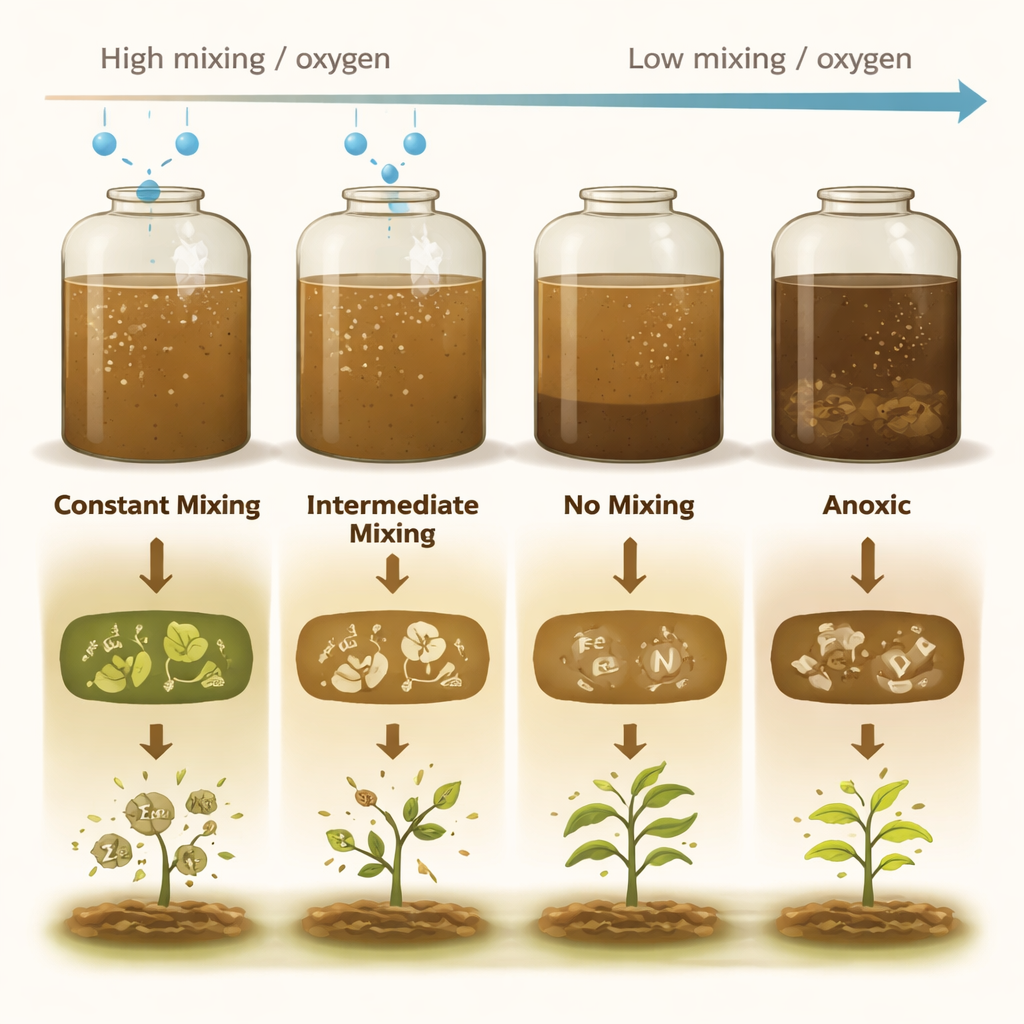
How a Traditional Brew Was Put to the Test
The researchers prepared Jeevamrit in four ways that mainly differed in how much air the mixture received: constant mixing (stirred several times a day), intermediate mixing (stirred once a day), no mixing (left still), and an anoxic version (sealed to shut out air). They then followed what happened over a week to the chemistry of the liquid, the microscopic life inside it, the small organic compounds that formed, and the performance of selected microbes on plant growth tests. To do this, they combined DNA-based community profiling (metagenomics), cultivation of individual strains (culturomics), and detailed chemical and metabolite measurements normally used in advanced environmental and medical labs.
Stirring Changes Oxygen, and Oxygen Changes Everything
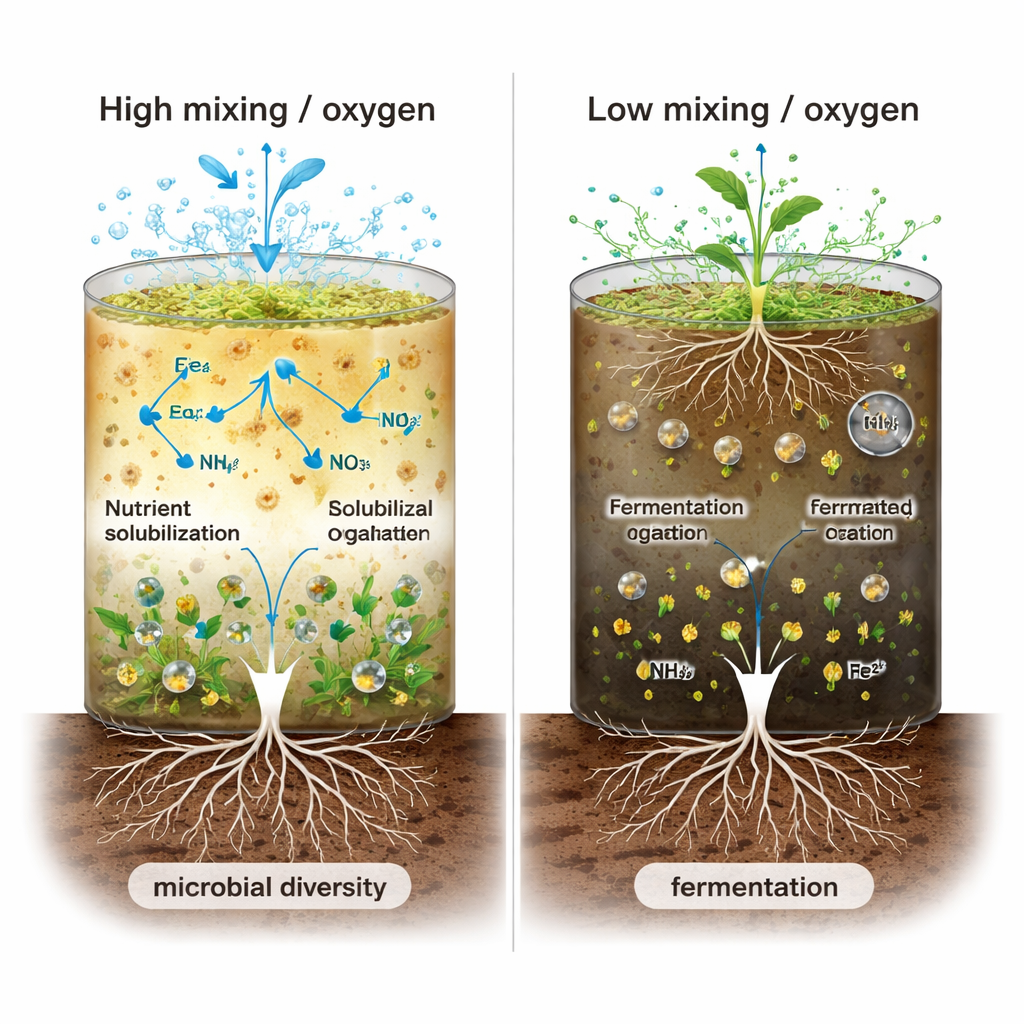
Mixing turned out to be a powerful control knob. Frequent stirring kept more oxygen available and drove what the authors call oxidative pathways: complex manure and plant residues were broken down into simpler forms, and metals such as iron, zinc, copper, and manganese were more strongly solubilized. Constantly mixed Jeevamrit had higher total nitrogen, more dissolved organic carbon, and elevated levels of these trace elements. In contrast, the sealed anoxic treatment favored reductive pathways. Here, soluble iron and ammonium (a reduced form of nitrogen) accumulated, and the liquid became slightly more acidic. Interestingly, the low-oxygen setups (especially anoxic) harbored the richest and most varied microbial communities, indicating that quiet, un-stirred brews allow many different types of microbes to establish micro-niches.
Good Microbes, Different Teams for Different Conditions
DNA sequencing revealed that all versions of Jeevamrit were dominated by bacteria, but the leading players shifted with oxygen. Under constant mixing, aerobic or oxygen-tolerant genera such as Acinetobacter, Comamonas, Pseudomonas, Lysinibacillus, and Stenotrophomonas thrived. These microbes are known for breaking down organic matter, cycling nitrogen, producing plant hormones, and releasing acids and chelating agents that free up phosphorus and potassium from minerals. Under anoxic, sealed conditions, the community swung toward fermenters like Clostridium sensu stricto, Lactobacillales, Enterococcus, and other Enterobacterales, which specialize in turning sugars into organic acids, alcohols, and gases while converting nitrate to ammonium and altering the form of iron.
From Microbial Chemistry to Plant-Friendly Effects
By reconstructing partial genomes and gene inventories from the mixed communities, the team showed that the highly aerated brews were enriched in genes for mineral solubilization, iron-scavenging molecules (siderophores), and auxin-like plant hormones. The static brews, in turn, carried more genes linked to fermentation, ammonium formation, and anaerobic respiration. When the researchers isolated individual bacteria and tested them, several strains of Bacillus, Rhodococcus, Sphingobium, and Shigella-like groups produced notable amounts of auxin (IAA), released ammonia, and solubilized phosphorus and potassium in lab tests—traits that can stimulate root growth and improve nutrient uptake. In simple seed germination experiments with mung bean, an intermediate mixing regime gave the best combination of rapid germination and vigorous root and shoot growth, suggesting that neither extreme—constant churning nor total stillness—is ideal.
Toward Smarter Recipes for Natural Farming
For farmers and advisors, the message of this work is that Jeevamrit is not a single, fixed product: its biology and chemistry depend strongly on how it is prepared, especially the amount of mixing and exposure to air. Strong aeration tends to maximize immediate nutrient solubilization through oxidative breakdown, while still or sealed brews favor fermentative microbes, higher microbial diversity, and more reduced forms of nitrogen and iron. A moderate mixing schedule appears to balance these effects, supporting both diverse microbial life and useful plant-growth compounds. The authors argue that standardizing mixing and oxygenation regimes—possibly tailoring them to local soil conditions—could make Jeevamrit more reliable as a low-cost biofertilizer, helping farmers get more consistent benefits from this traditional yet scientifically rich formulation.
Citation: Jain, A.G., Agwan, D., Kumar, A. et al. Mixing regimes shape microbial community composition, nutrient regimes, and plant growth attributes in Jeevamrit: metagenomics and culturomics-based insights. Sci Rep 16, 6603 (2026). https://doi.org/10.1038/s41598-026-36414-4
Keywords: Jeevamrit, natural farming, soil microbiome, biofertilizer, plant growth promotion