Clear Sky Science · en
Mechanical properties and microscopic damage of sandstone under prolonged tailings water immersion
Why leaking mine water matters
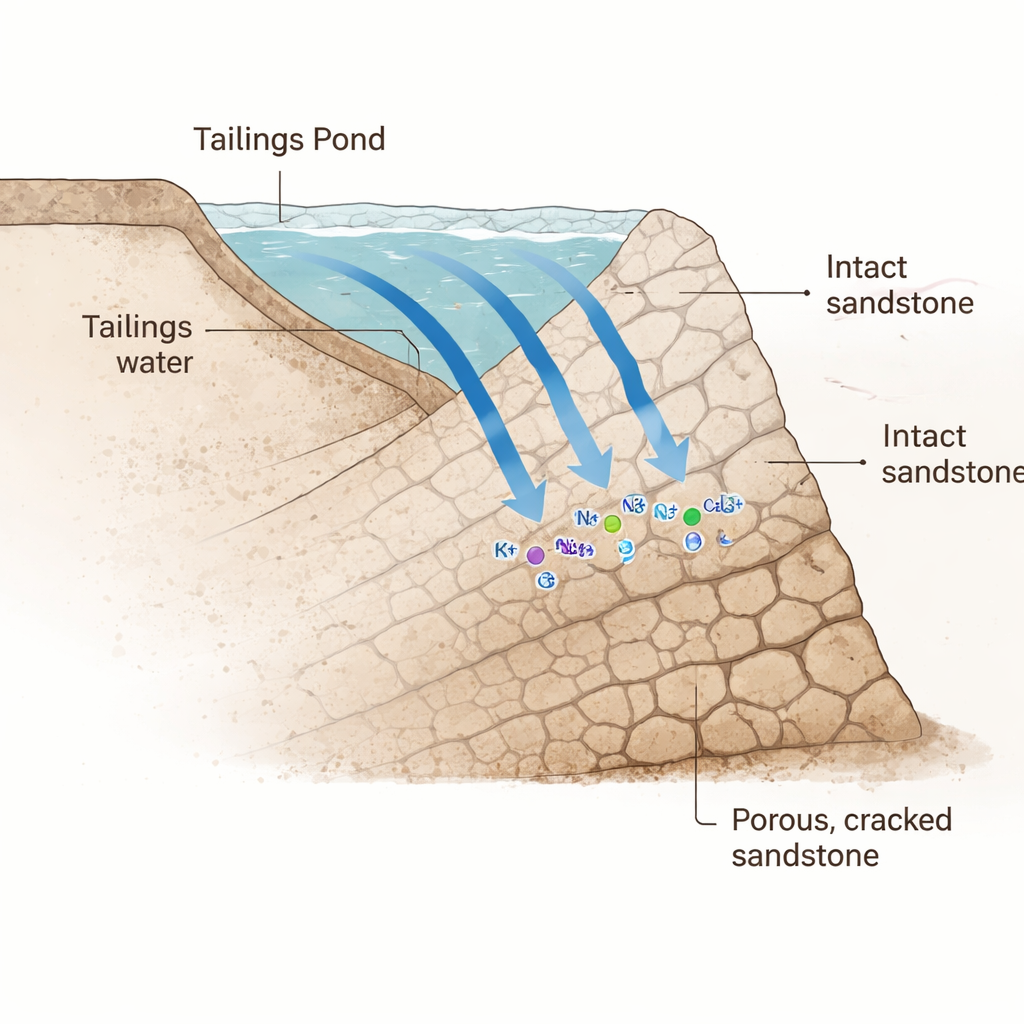
Across the world, mining companies store huge volumes of finely ground rock waste, called tailings, behind earthen dams. These ponds look calm on the surface, but the water they hold is laced with leftover chemicals and dissolved metals. When that water seeps into the nearby rock, it can slowly weaken the foundations of dams and surrounding slopes, raising the risk of collapse. This study asks a simple but critical question: what happens to a common rock, sandstone, when it sits in tailings water for months on end?
How the rock was put to the test
The researchers collected tailings water from a storage facility in Anshan, China. The water was weakly alkaline and rich in dissolved ions such as potassium, sodium, calcium and aluminum—ingredients known to react with minerals in rock. They then prepared standard sandstone cylinders and immersed sets of samples in this water for up to six months, while keeping other samples dry for comparison. At regular intervals, the team measured how fast sound waves passed through the rock, how easily it deformed and broke under compression, and how its internal pores and tiny cracks evolved using nuclear magnetic resonance (NMR), a method that can “see” water-filled spaces inside solids.
From tight rock to sponge-like stone
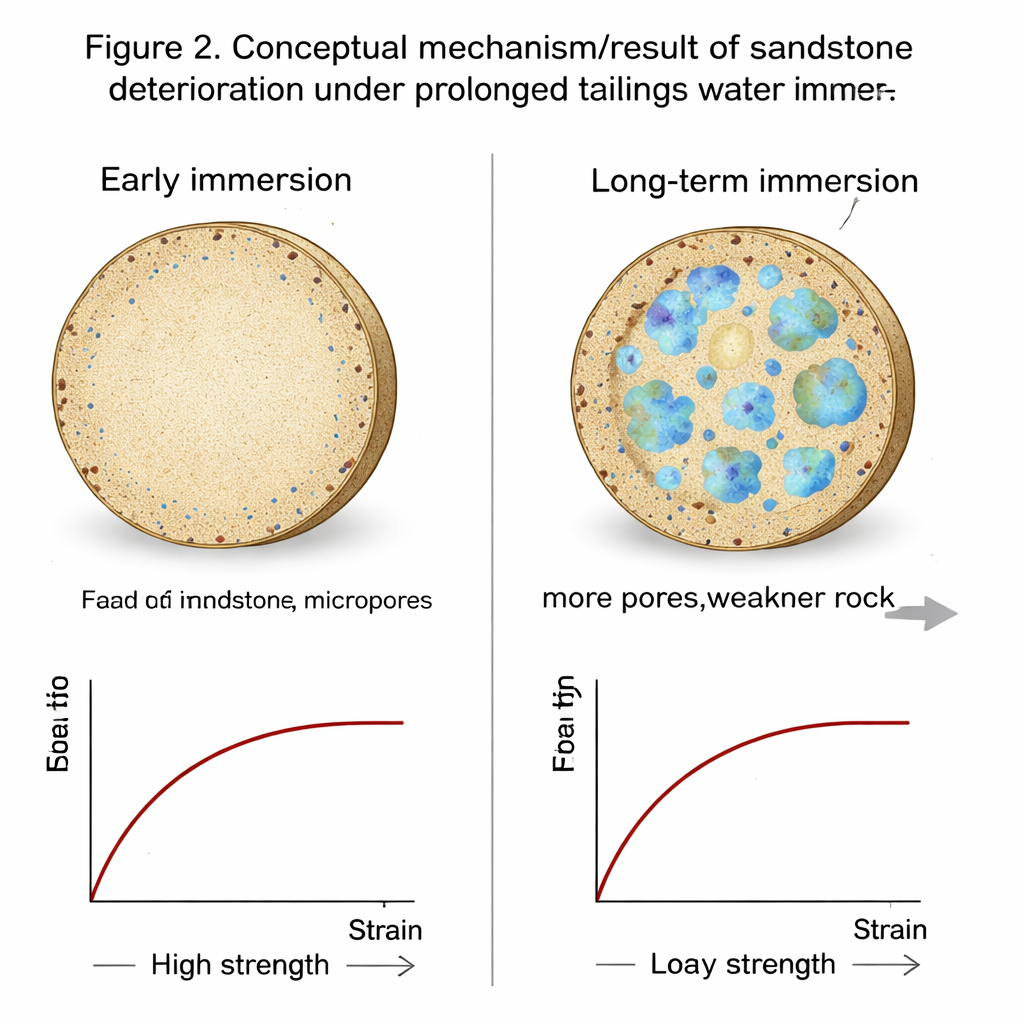
NMR scans revealed that tailings water gradually reshapes the internal structure of sandstone. At first, the rock is dominated by very small pores. As immersion time increases, these micropores enlarge into medium and then larger pores, and previously isolated spaces begin to connect. After six months, overall porosity has risen noticeably, and damage has spread from the outer surface toward the core following a “fast growth, then slowing, then stabilizing” pattern. Instead of opening big visible cracks, the water quietly turns the rock into a more porous, better-connected network of tiny voids, loosening the contact between grains and making the stone less stiff and more deformable.
Quiet fractures and softer strength
Mechanical tests showed that this internal reshaping has serious consequences for strength. With longer immersion, the sandstone’s stress–strain curves become flatter, indicating a softer material with a longer squashing phase before it finally fails. Both the rock’s stiffness (elastic modulus) and its maximum load-bearing capacity (compressive strength) fall by about one-third after six months, with the most rapid drop occurring in the first one to three months. At the same time, acoustic emission sensors—essentially microphones for tiny internal fractures—record far fewer and weaker signals in long-soaked samples. Dry rocks fail suddenly and noisily, releasing bursts of energy as brittle cracks shoot through them. Water-weakened rocks fail more quietly, with grains sliding and shearing past each other in a more plastic, less explosive way.
Linking chemistry, cracks and computer models
The authors trace this behavior to chemical reactions between the alkaline tailings water and feldspar minerals in the sandstone. Over time, feldspar grains dissolve and transform into clay-like products, while dissolved ions migrate and may even reprecipitate as new coatings on grain surfaces. These changes weaken the “glue” between grains and reroute where stresses travel through the rock. Using a particle-based computer model, the team reproduced these effects: force chains—the invisible paths along which loads are carried—become more focused and uneven in immersed sandstone, and the number of microscopic cracks, especially shear-related ones, increases. An acoustic-emission-based damage model further showed that damage grows quickly early on and then levels off, mirroring the chemical slowdown as the system approaches equilibrium.
What this means for tailings dams
For a lay reader, the bottom line is that tailings water acts like a slow, silent corrosive agent on sandstone. It turns a strong, brittle rock into a softer, more cracked material, cutting its strength by more than a third in half a year and changing the way it breaks. Because this weakening progresses rapidly at first and then stabilizes, the early years of exposure may be especially critical for dam safety. By tying together pore growth, chemical reactions, fracture sounds and computer simulations, the study provides engineers with tools to estimate how quickly rock around a tailings pond may degrade—and to factor that time-dependent loss of strength into the design, monitoring and long-term risk assessment of tailings dams and nearby slopes.
Citation: Li, M., Yang, B., Hu, J. et al. Mechanical properties and microscopic damage of sandstone under prolonged tailings water immersion. Sci Rep 16, 5789 (2026). https://doi.org/10.1038/s41598-026-36413-5
Keywords: tailings dams, sandstone weakening, water–rock interaction, mine waste, rock stability