Clear Sky Science · en
Multipassage Landau-Zener tunneling oscillations in the dual dressing of atomic qubits
The art of steering a quantum compass
Imagine being able to steer the tiniest magnets in nature—individual atomic “compasses” that can store and process quantum information—just by rhythmically shaking the magnetic fields around them. This study shows how to do exactly that. By driving atoms with two carefully timed, non-resonant magnetic fields, the authors uncover a surprisingly rich pattern of quantum oscillations that could be harnessed for faster and more versatile quantum control in sensors, clocks, and future quantum technologies.
Shaking atoms with two magnetic rhythms
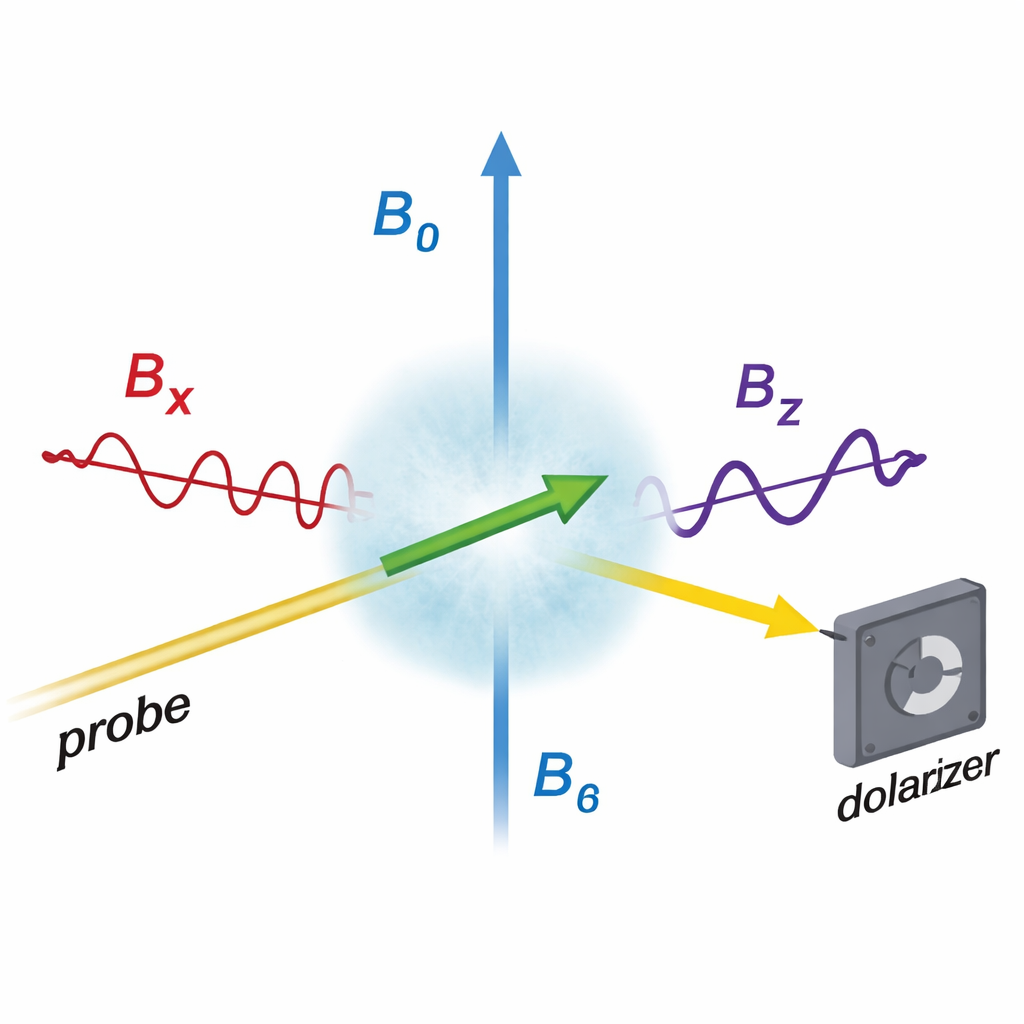
At the heart of the work is an atomic qubit, a two-level quantum system realized with ensembles of rubidium and cesium atoms in ultralow magnetic fields. A static magnetic field sets a basic rhythm: the atoms’ spins precess, like tiny compass needles slowly circling around the field direction. On top of this, the researchers apply two oscillating magnetic fields at the same low frequency but in different directions—one along the static field (longitudinal) and one perpendicular to it (transverse. This “dual dressing” does not flip the atoms in the usual on-resonance way; instead, it periodically distorts both the size and direction of the total magnetic field, creating a landscape in which the energy gap between the two qubit states shrinks and widens in a regular sequence.
A quantum interferometer made of repeated passages
As the energy gap is driven up and down, the system repeatedly passes through near-crossings of its two energy levels—a scenario known from Landau–Zener–Stückelberg–Majorana (LZSM) interferometry. Each passage partly tunnels population between the two levels, and the multiple passages interfere like waves in a multi-slit optical interferometer. What is new here is that the additional transverse field continuously tilts the effective magnetic axis. This means that not only the probabilities of being in one level or the other change, but also the phase and direction of the spin in the plane perpendicular to the static field become central observables. The authors exploit this by monitoring the transverse spin component via the tiny rotation that the atoms imprint on a laser beam’s polarization as it passes through the cloud.
Watching complex quantum rhythms unfold in real time
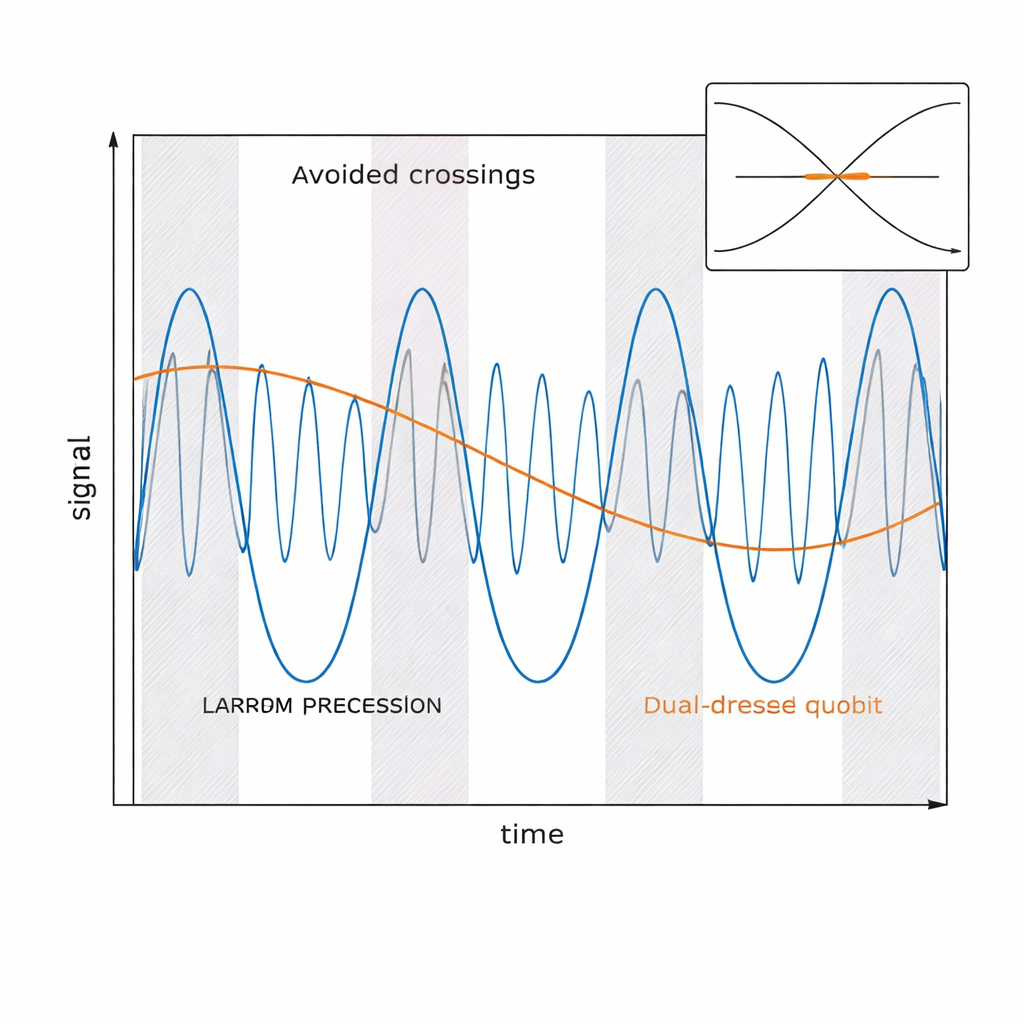
Using a cold rubidium magnetometer and a warm cesium vapor cell, the team tracks the spin evolution over many cycles of the driving fields, with negligible decoherence on these timescales. The resulting signals show a hierarchy of oscillations: a very fast wobble at the instantaneous Larmor frequency, slower modulations caused by repeated Landau–Zener passages (Stückelberg-like patterns), and even slower “Rabi-like” envelopes arising from multi-passage interference. By extracting the times when the measured spin signal crosses zero, the authors reconstruct a time-dependent “dressed” Larmor frequency and find that it oscillates in step with their driving fields, in clear disagreement with the usual assumption of a fixed effective frequency used in standard Floquet engineering.
Beyond standard theories of driven quantum systems
Because the driving frequency in these experiments is lower than the bare Larmor frequency, familiar high-frequency approximations break down. To interpret the data, the authors combine full numerical solutions of the Schrödinger equation with tailored analytical approaches. They develop an adiabatic picture valid for weak driving, a quasi-adiabatic geometric description that emphasizes the rotation of the effective magnetic field, and a modified Floquet-style perturbation theory adapted to the low-frequency, strong-amplitude regime. This theory reveals how the dual dressing reshapes the energy landscape, produces multiple avoided crossings within a single driving period, and generates the observed mixture of fast and slow oscillations in the spin coherence.
New levers for quantum control
In everyday terms, the researchers have learned to “play” the atomic spin like a musical instrument driven by two overlapping rhythms. By tuning the amplitudes and relative phase of the longitudinal and transverse fields, they can enhance or suppress tunneling between states, control the phase of the quantum wavefunction, and generate rich interference patterns. Their continuous, phase-sensitive monitoring of the spin goes beyond conventional LZSM experiments that mainly track population transfer. This dual-dressing approach adds powerful new knobs for manipulating quantum states and suggests routes to faster quantum logic operations and advanced quantum sensors that exploit non-adiabatic dynamics rather than avoiding them.
Citation: Fregosi, A., Marinelli, C., Gabbanini, C. et al. Multipassage Landau-Zener tunneling oscillations in the dual dressing of atomic qubits. Sci Rep 16, 6285 (2026). https://doi.org/10.1038/s41598-026-36403-7
Keywords: atomic qubits, Landau-Zener interferometry, Floquet engineering, quantum control, spin dressing