Clear Sky Science · en
Quantifying women’s water polo overhead movement volumes using inertial measurement units and machine learning techniques: a cross-sectional study
Why tracking water polo moves matters
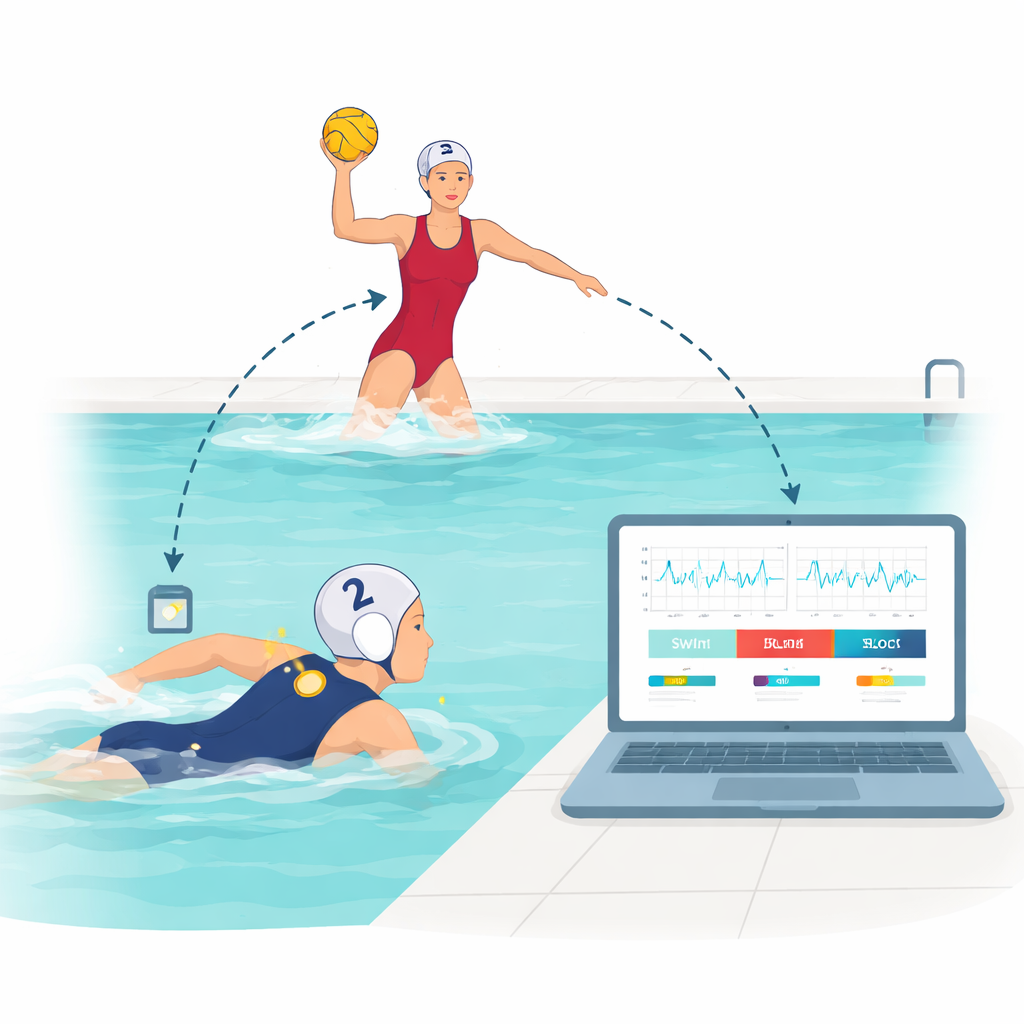
For elite water polo players, every stroke, pass and shot adds up to hundreds of powerful arm movements in a single practice. These repeated overhead actions help win games, but they also place heavy strain on the shoulders and elbows. Coaches know that too much throwing or swimming at high intensity can raise the risk of painful overuse injuries, yet they currently rely on time‑consuming video review or gut feeling to judge training load. This study explores whether small waterproof motion sensors, combined with modern computer algorithms, can automatically count and classify these movements in real time—offering a new way to protect athletes’ shoulders while still pushing performance.
From pool deck to data stream
The researchers worked with ten nationally ranked women’s water polo field players at an Australian high‑performance program. During four typical, coach‑led training sessions—each lasting about an hour and three‑quarters—athletes wore two tiny devices called inertial sensors: one taped to the forearm and one just below the neck. These sensors captured how the arm and upper body accelerated and rotated during freestyle swimming, passing, shooting and blocking. At the same time, two video cameras recorded the sessions. An experienced coach later watched the footage and carefully labeled every overhead movement, creating a trusted “ground truth” against which the sensor‑based system could be tested.
Teaching computers to recognize pool skills
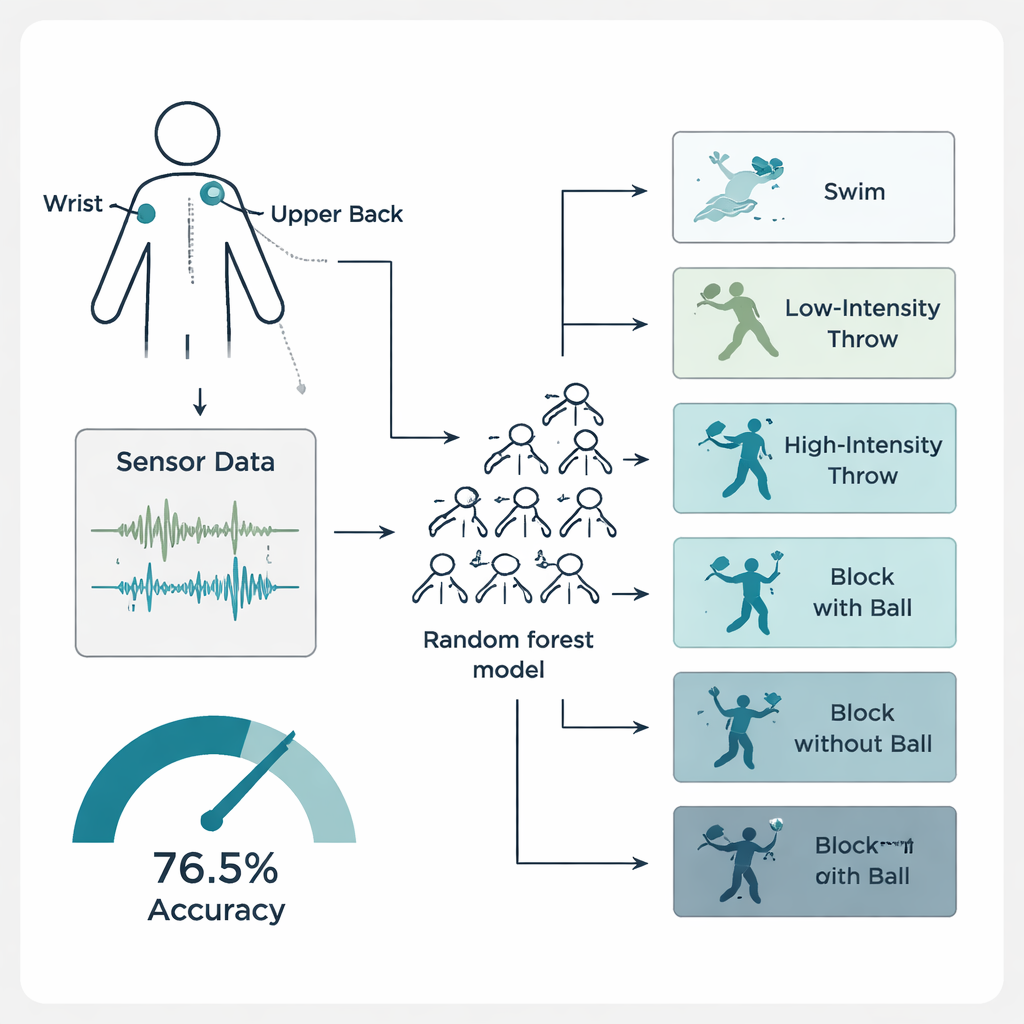
Turning raw sensor signals into recognizable actions required several steps. First, the team filtered the data to remove noise from splashing and general body motion, then identified sharp peaks that marked individual arm actions. Around each peak, they calculated a rich set of simple statistics—such as the average, spread and shape of the acceleration in each direction at the wrist and upper back. Each event was tagged as one of five classes: swimming, high‑intensity throws at goal, low‑intensity passes, blocks where the ball hit the hand, and blocks without ball contact. Because some actions, like hard shots, occurred less often than constant swimming, the researchers used a data‑balancing technique to make sure rarer events were still visible to the algorithms during training.
Which model best reads the water?
The team then trained and compared five common machine‑learning models—computer methods that learn patterns from data—to see which could best guess the movement type from the sensor features alone. Across more than 18,000 labeled movements, a method called a random forest performed the strongest. It correctly classified about three‑quarters of all events and was especially good at spotting swimming strokes and gentle passes. Other models, including simple decision trees, logistic regression and a neural network, were less accurate. By probing which sensor features mattered most, the researchers found that certain directions of arm acceleration, particularly at the forearm and upper back, were especially important for distinguishing powerful blocks and shots from more relaxed movements.
What this means for training and injury risk
Although the random‑forest system fell short of the researchers’ original hope of 95 percent accuracy, it still marks an important proof of concept. The study shows that it is feasible to monitor the full mix of overhead actions in real, noisy training sessions—not just in tightly controlled drills—using only two small wearable devices and an automatic classifier. With larger datasets collected over longer periods and during official matches, the approach could be refined to track how each player’s throwing and swimming volume changes across a season, or during a return from shoulder injury. This kind of objective, session‑by‑session record could help coaches tailor workloads, match practice demands to game realities and spot sudden spikes that might signal an increased injury risk.
Take‑home message for athletes and coaches
In simple terms, this study shows that smart sensors can “watch” a women’s water polo practice and reasonably tell whether a player is swimming, passing, shooting or blocking, without relying on slow, manual video analysis. While the current system is not perfect, it offers a solid starting point for building practical tools that automatically log how much overhead work each athlete does. In the future, such tools could support shared decisions about training plans and safe return to play, giving coaches, medical staff and athletes clearer insight into the hidden load on the shoulder—and potentially helping to keep more players healthy and in the pool.
Citation: King, M.H., Sanchez, R., Watson, K. et al. Quantifying women’s water polo overhead movement volumes using inertial measurement units and machine learning techniques: a cross-sectional study. Sci Rep 16, 5773 (2026). https://doi.org/10.1038/s41598-026-36402-8
Keywords: water polo, wearable sensors, shoulder injury, machine learning, women athletes