Clear Sky Science · en
Enhancing aerodynamic performance using biomimetic wavy trailing edges on aircraft wing at low Reynolds number
Why wavy wings matter
Modern drones and small aircraft need to fly efficiently at low speeds, where air behaves in a tricky, unstable way around their wings. This study explores an idea borrowed from birds: adding gentle waves to the back edge of a wing. These "wavy trailing edges" are inspired by the rippled feathers you see near a gull’s wingtip. The research asks a simple question with big implications: can copying those natural ripples make small aircraft safer, more stable, and more efficient in slow or demanding flight?
Learning from birds in flight
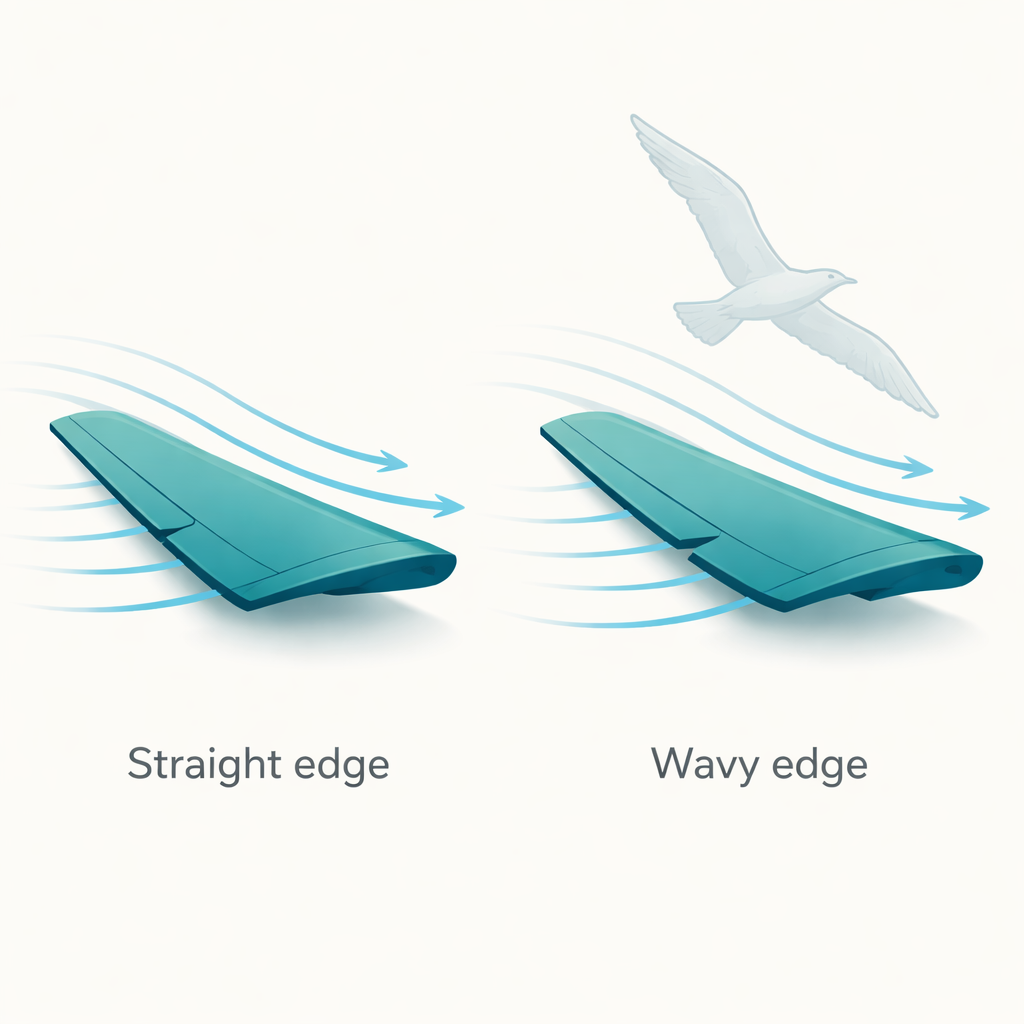
Nature has spent millions of years fine-tuning wings. Birds and some marine animals use ridges, bumps, and waves along their flippers or feathers to stay aloft, turn sharply, and avoid stalling—the sudden loss of lift that can make a wing drop. The authors focus on the wavy outline along a bird’s trailing feathers and apply this pattern to a standard aircraft wing shape commonly used in research. Their target is the kind of wing found on micro air vehicles and small unmanned aircraft, which often fly at low speeds where the airflow is especially prone to separating from the surface and causing stall.
Designing a bird-inspired test wing
The team designed a swept-back, tapered wing based on the well-known NACA 0012 cross-section, then reshaped only the back edge to follow a smooth, sinusoidal wave. They carefully varied three main features of this wave: how tall the ripples are (amplitude), how far they stretch from front to back (chordwise length), and how much of the outer wing span they cover. Using advanced computer fluid simulations, they examined how these parameters affected lift (the upward force), drag (the resistance), and stall behavior at a realistic low flight speed corresponding to a Reynolds number of 30,000. They then built precise 3D-printed wing models and tested them in a low-speed wind tunnel to confirm the simulations.
How the waves reshape the airflow
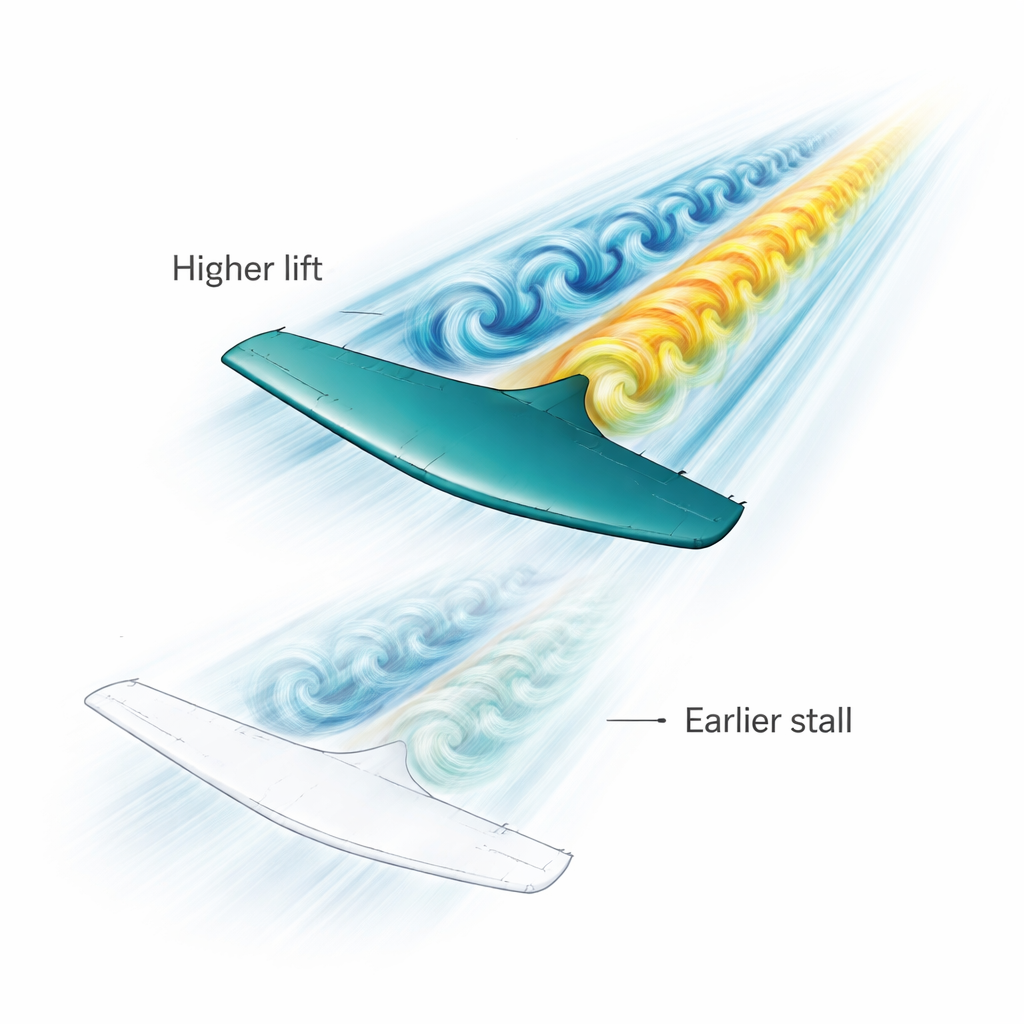
The results show that modest ripples along the trailing edge can gently reorganize the flow of air behind the wing. Instead of letting a large, sluggish wake form and peel away from the surface, the wavy edge creates a series of small, orderly vortices that mix high-energy air from outside into the slower air near the surface. This “re-energizes” the thin layer of air hugging the wing, helping it stay attached longer as the wing tilts up. The study finds that a moderate wave height—about 20% of the tip chord—and carefully chosen lengths in both directions give the best trade-off: about 12% more lift at a typical operating angle with only a small increase in drag. Too-small waves do little, while overly large ones stir up excess turbulence and unwanted drag.
Delaying stall and stabilizing the wake
Perhaps the most striking outcome is how the wavy edge changes stall, the point where the wing can no longer generate enough lift. For the smooth “clean” wing, stall appears around 12 degrees of nose-up tilt, with a maximum lift level set by that limit. With the optimized wavy trailing edge, stall is pushed back to about 18 degrees, and the peak lift rises by roughly 31%. Flow measurements and visualizations show that the separation region on the upper surface shrinks and moves downstream, while the strong tip vortex and wake behind the wing become more orderly and less intense. In practical terms, the wing can operate safely at higher angles without suddenly losing lift, improving stability and control for small aircraft flying slowly, maneuvering, or coping with gusts.
What it means for future small aircraft
For a non-specialist, the takeaway is that adding subtle, birdlike ripples to the back edge of a wing can make small aircraft perform better when flight conditions are most demanding. The optimized wavy design boosts lift, softens and delays stall, and improves the balance between lift and drag, all without adding moving parts or power-hungry control systems. Because this approach is purely geometric, it is especially attractive for lightweight drones and micro air vehicles, where simplicity and reliability are crucial. The authors suggest that further work across a wider range of speeds, structural tests, and noise studies could help turn these biomimetic wavy edges into practical design features on the next generation of quiet, efficient, and more forgiving flying machines.
Citation: Aziz, M.A., Khalifa, M.A., Elshimy, H. et al. Enhancing aerodynamic performance using biomimetic wavy trailing edges on aircraft wing at low Reynolds number. Sci Rep 16, 4714 (2026). https://doi.org/10.1038/s41598-026-36401-9
Keywords: biomimetic wings, wavy trailing edge, stall delay, UAV aerodynamics, low Reynolds number flight