Clear Sky Science · en
Genomic insights into novelBurkholderia sp. Bmkn7 from coastal saline-affected rice fields unveils potential antimicrobial metabolites and plant growth-promoting traits
Hidden Helpers in Salty Rice Fields
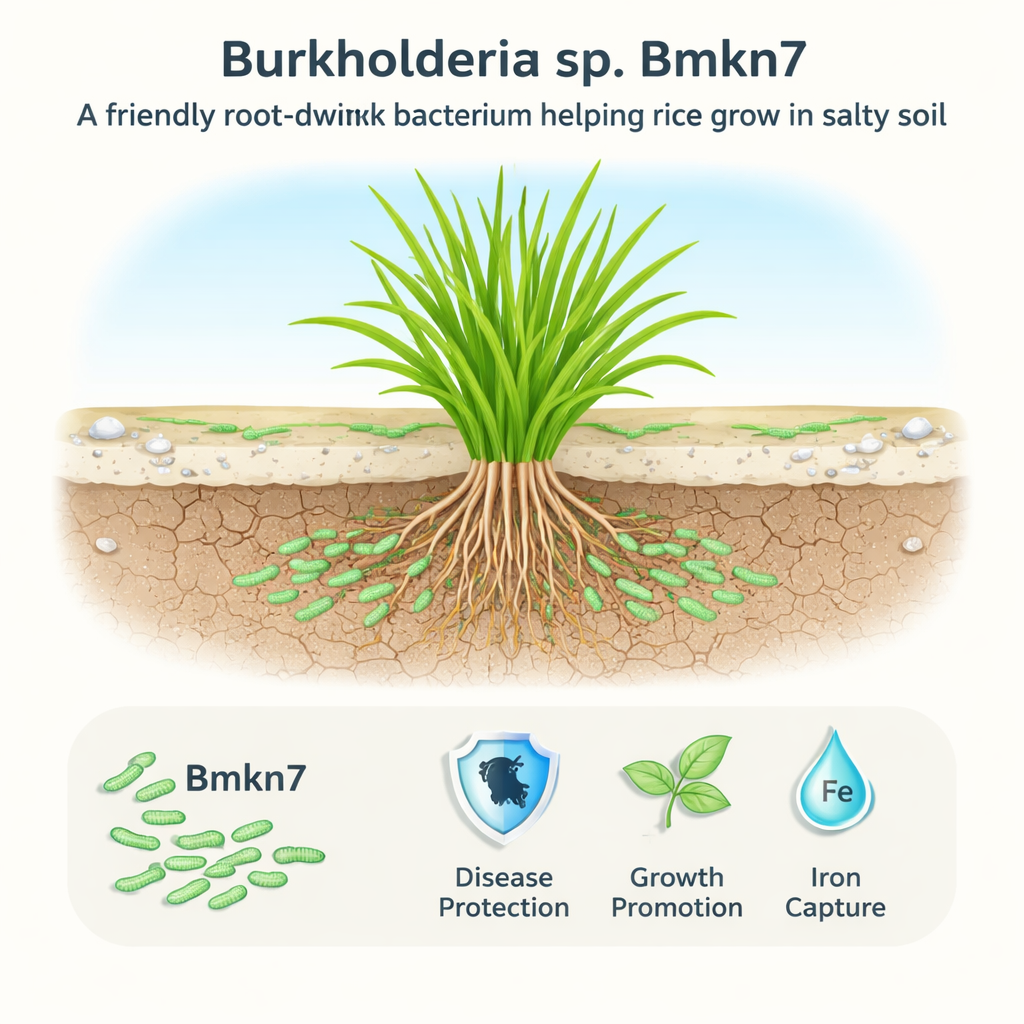
Coastal rice farmers face a double challenge: salt-damaged soils and relentless disease-causing microbes. This study uncovers a naturally occurring soil bacterium, Burkholderia sp. Bmkn7, living around rice roots in salty fields in Kerala, India. By decoding its entire genome and testing it in the lab, the researchers show that this tiny ally can both shield plants from harmful germs and help them grow better—offering a promising, eco-friendly alternative to chemical fertilizers and pesticides.
A New Microbe from a Tough Neighborhood
The team began by sampling soils and roots from traditional, salt-tolerant rice varieties grown in underexplored coastal fields. From about 200 bacterial isolates, they focused on 25 that were especially good at making siderophores—molecules that grab iron from the environment. One standout strain, named Bmkn7, came from the rice root zone and belonged to the diverse Burkholderia group. Using advanced DNA sequencing technologies, the authors assembled a high-quality, complete genome for Bmkn7, revealing a single large circular chromosome rich in genes linked to metabolism, stress tolerance, and life alongside plants. Comparison with related species showed that Bmkn7 sits within a plant-associated branch of the Burkholderia cepacia complex, but forms its own distinct lineage adapted to salty, coastal soils.
Built-In Arsenal Against Crop Diseases
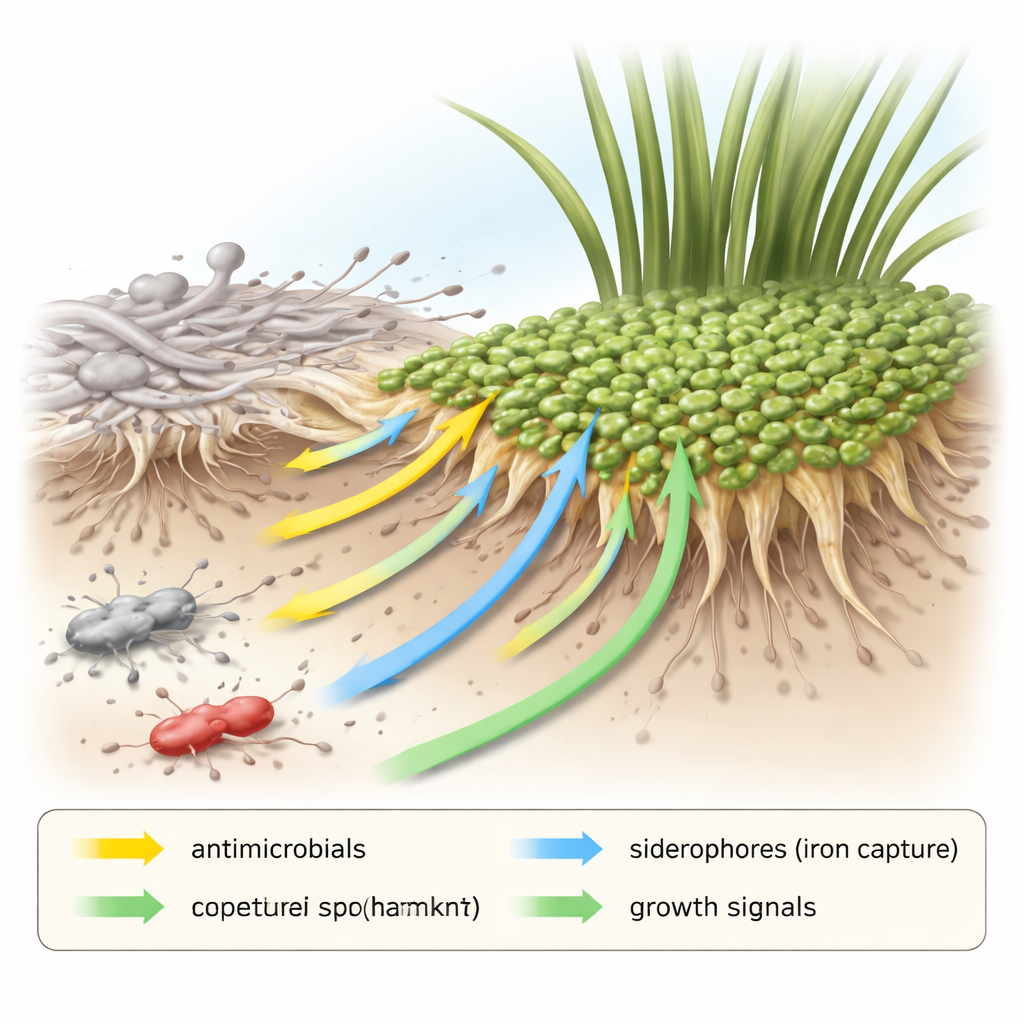
Digging into the genome, the researchers found 20 biosynthetic gene clusters—genetic “factories” for specialized small molecules. Some matched known antimicrobial and iron-scavenging compounds, such as pyrrolnitrin (a strong antifungal agent) and the siderophores pyochelin and ornibactin. Lab tests confirmed that Bmkn7 can strongly inhibit several important plant pathogens, including fungi that cause root rot and wilt, as well as harmful bacteria like Escherichia coli and Staphylococcus aureus. When the team grew Bmkn7 under low-iron conditions, it produced more siderophores, which helped starve certain pathogens of iron. Interestingly, even when siderophore production was turned down by adding extra iron, Bmkn7 still suppressed some fungi, showing that additional, siderophore-independent weapons are at work.
Unknown Molecules with Big Potential
To track down these hidden weapons, the scientists extracted chemical mixtures from Bmkn7 cultures grown under different conditions and analyzed them with high-performance liquid chromatography and mass spectrometry. They detected pyochelin only when iron was limited, confirming the genetic predictions. Yet the antifungal activity against Macrophomina phaseolina, a serious root pathogen, remained strong even when pyochelin levels dropped. Chemical fingerprints from the extracts did not match any known antimicrobial compounds in existing databases, hinting that Bmkn7 may be making entirely new molecules. The genome also contains multiple “orphan” biosynthetic clusters—regions that look capable of making complex metabolites but have no counterpart in current reference libraries—further supporting the idea that this bacterium is a rich, untapped source of novel natural products.
Feeding and Protecting the Rice Plant
Beyond fighting disease, Bmkn7 carries an impressive toolkit for helping plants cope with poor soils and stress. It harbors genes for dissolving otherwise inaccessible forms of phosphate, making this key nutrient easier for plant roots to absorb, a trait confirmed in plate assays. It produces an enzyme called ACC deaminase, which lowers stress-related ethylene levels in plants and can help them tolerate harsh conditions such as salinity. The genome also encodes systems to handle oxidative stress, move toward root exudates, attach firmly to roots, and form biofilms and cellulose-rich coatings—features that support long-term colonization of the root zone. Bmkn7 can likely make plant-related signaling compounds, including indole-3-acetic acid precursors, salicylic acid pathway components, and volatile organic compounds that are known to boost plant growth and prime immune defenses.
Safe Partner, Not a Hidden Threat
Some members of the Burkholderia cepacia complex can infect humans or damage plants, so the authors carefully checked Bmkn7 for risky traits. Comparative genomics showed that while it is closely related to beneficial, plant-associated strains, it lacks key genes linked to human and plant disease, including major toxin pathways and a full type III secretion system. Experiments with rice seedlings revealed no negative effects on germination, root length, or shoot growth, supporting its non-pathogenic nature in plants. Combined with its strong antimicrobial activity and plant-supporting traits, these findings suggest Bmkn7 is a promising candidate for development as a biological control and biofertilizer agent, though further safety testing will be needed before field use.
From Lab Insight to Greener Fields
Viewed together, the genomic and experimental evidence portrays Bmkn7 as a salt-tolerant, root-associated bacterium that both feeds and defends rice plants. It solubilizes nutrients, tempers plant stress, colonizes roots effectively, and deploys a broad chemical arsenal, including yet-unidentified antifungal molecules. This combination makes Bmkn7 a compelling natural tool for reducing reliance on synthetic fertilizers and fungicides, especially in vulnerable coastal farming systems. Future work will focus on isolating and characterizing its unknown compounds and testing whole-cell applications in real-world fields, with the goal of turning a once-overlooked soil microbe into a cornerstone of more sustainable agriculture.
Citation: Suresh, G.G., Rameshkumar, N. Genomic insights into novelBurkholderia sp. Bmkn7 from coastal saline-affected rice fields unveils potential antimicrobial metabolites and plant growth-promoting traits. Sci Rep 16, 5718 (2026). https://doi.org/10.1038/s41598-026-36398-1
Keywords: plant growth-promoting bacteria, biocontrol, Burkholderia, rice rhizosphere, siderophores