Clear Sky Science · en
Potential of jute seeds crop waste for textile applications: a novel machine-based approach for sustainable resource utilization
From Farm Smoke to Useful Fiber
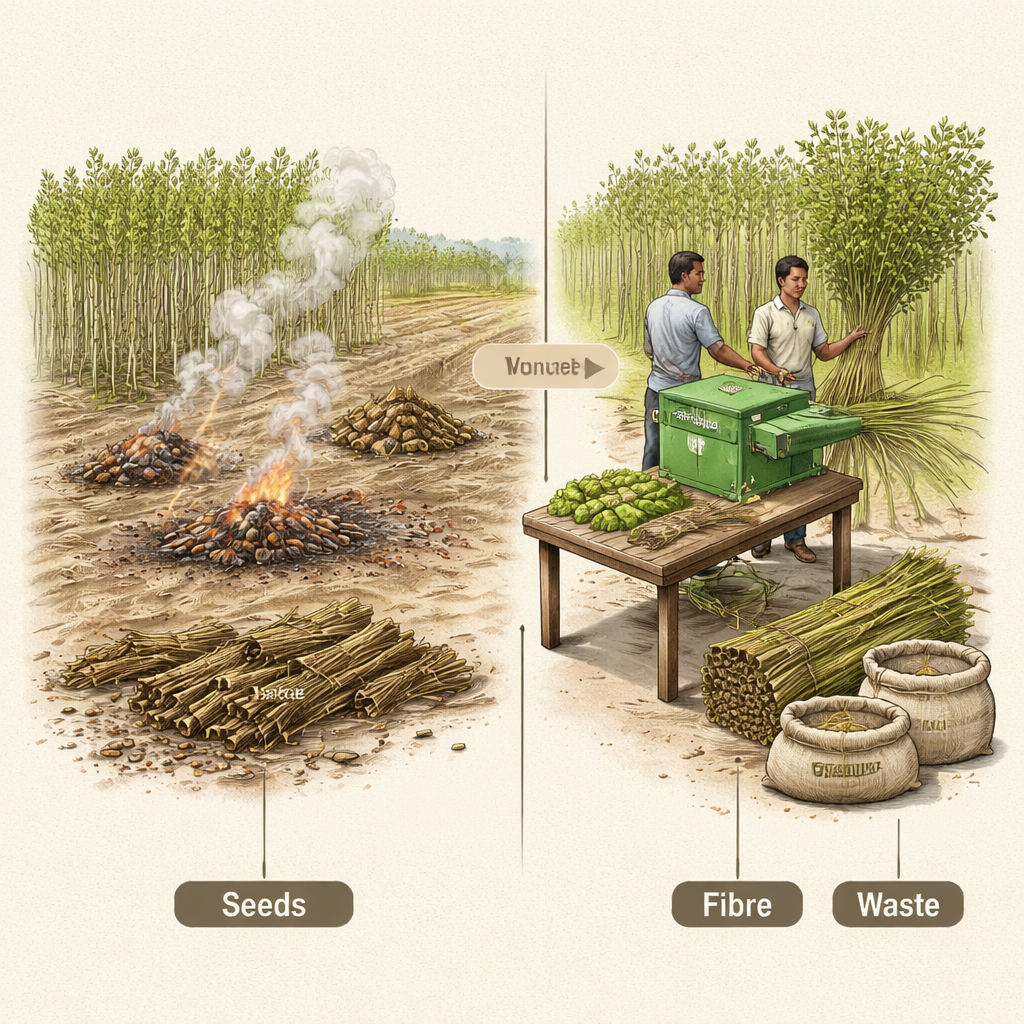
Across many farming regions, jute plants grown for seed leave behind tall, woody stems that are usually burned in the field once the tiny seeds have been collected. This smoky cleanup wastes a strong, plant‑based fiber that could replace some plastics and synthetics in bags, rugs, and upholstery. The study behind this article asks a simple but powerful question: instead of treating those stems as trash, can we design a smarter process and a simple machine so that farmers can harvest both seeds and usable fiber from the same crop?
Why Jute Stems Matter
Jute is already one of the world’s major natural fibers, used in sacks, ropes, mats, and increasingly in eco‑friendly composites. Its fibers are strong, stiff and heat‑resistant enough for a wide range of everyday products. Yet when jute is grown specifically for seed in dryland fields, almost all attention goes to the seeds while the stems—rich in the same kind of fiber used in industry—are left underused. These stems are often crushed by combine harvesters and then burned to clear land for the next planting, releasing greenhouse gases and fine particles into the air. This disconnect between what the plant can offer and how it is actually used is what the researchers set out to fix.
A New Machine to Save Stems and Seeds
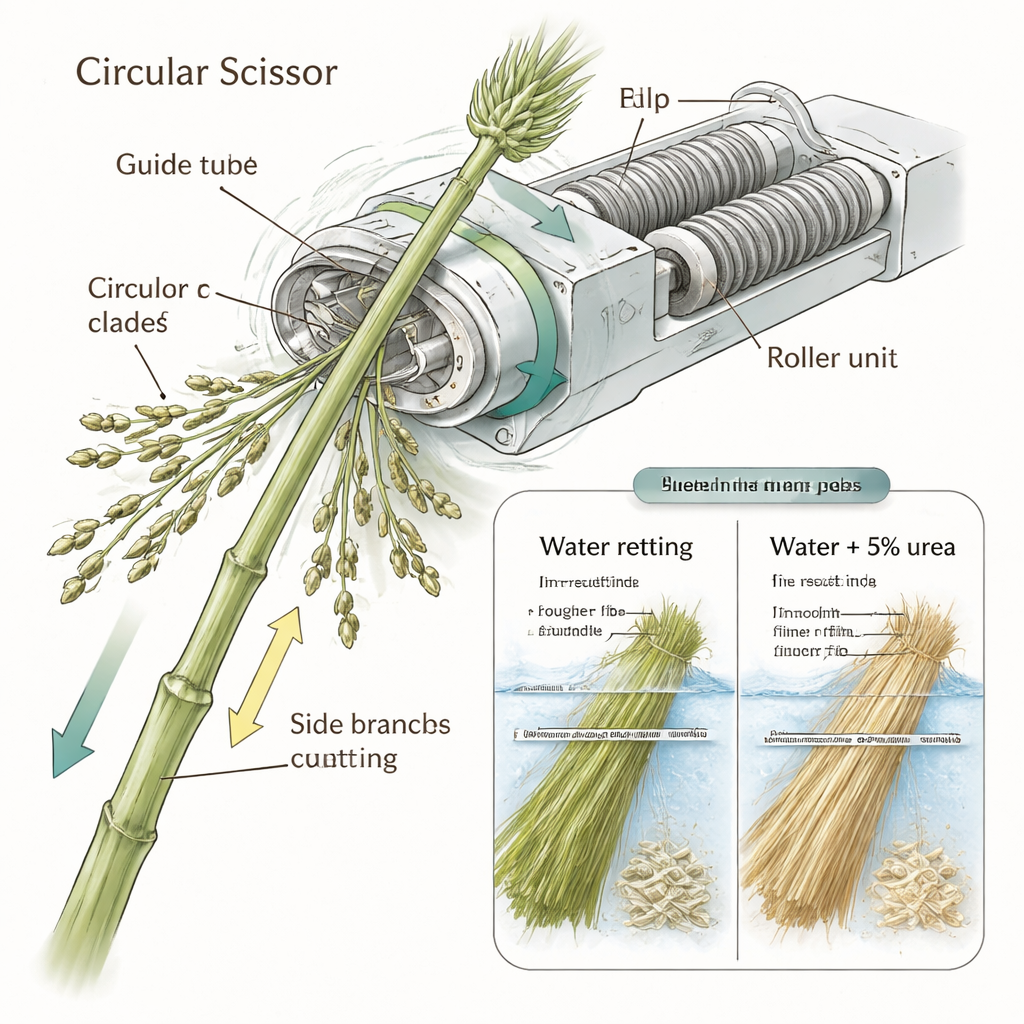
The first part of the solution is mechanical. The team designed and built a compact device they call the Circular Scissor machine. Instead of sending the entire plant into a harvester that shreds everything, farmers feed the root end of each tall jute plant into a guide tube on this machine. Inside, curved blades arranged around a rotating shaft slice off the side branches that carry the seed pods, while a set of rollers gently pulls the cleaned main stem through. Tests on many plants showed that the machine could successfully remove 70–100% of the branches while keeping the seed pods intact, and it did so with only a small electric motor that would be practical in rural settings.
Turning Tough Stems into Spinnable Fiber
The second part of the solution tackles fiber extraction. Raw jute stems are naturally held together by gummy materials such as pectin and hemicellulose, which must be broken down in a soaking step called retting. The researchers compared traditional water soaking with a mixed method that combined water and a small amount (5%) of urea, a common nitrogen fertilizer. Both methods eventually freed the fibers, but the urea‑assisted version shortened the processing time from about 33 days to 29 days. Microscopic images showed that urea‑treated fibers had cleaner, smoother surfaces and were more cleanly separated into fine strands, while chemical tests confirmed that more of the unwanted gummy material had been removed.
Fiber Quality and What It Can Be Used For
To see whether these reclaimed fibers were truly useful, the team measured how fine, strong, dense, and clean they were, and then graded them using Indian national standards normally applied to commercial jute. Even though the stems came from older, seed‑bearing plants—where some of the plant’s energy has already gone into making seeds—the recovered fibers still met the requirements for medium‑grade jute. The urea‑assisted process produced slightly finer fibers with fewer defects, better color, and much lower "root" content (the hard, coarse base section that spinners try to avoid). Overall, the fibers were suitable for coarse textiles such as affordable bags, rugs, upholstery fabrics, twines, and also as reinforcement in composite panels and insulation mats.
What This Means for Farmers and the Environment
Seen together, the new machine and improved soaking method turn what was once smoky farm waste into a second product stream. From each seed‑crop jute plant, about 8–15 grams of fiber, four to six feet long, can be recovered without sacrificing seed yield; at the scale of a single acre, that translates to roughly 4–5 quintals of extra fiber. This reduces the amount of plant material burned in the open by up to half, cuts air pollution, and adds a new source of income for growers. For readers, the takeaway is straightforward: with modest engineering and process tweaks, a familiar crop can do double duty, supplying both seeds and sustainable fiber, and helping to push textiles and packaging a little further away from fossil‑fuel‑based materials.
Citation: Pathan, Y., Singotia, P.K., Reddy, K.M.K. et al. Potential of jute seeds crop waste for textile applications: a novel machine-based approach for sustainable resource utilization. Sci Rep 16, 7407 (2026). https://doi.org/10.1038/s41598-026-36397-2
Keywords: jute fibre, agricultural waste, sustainable textiles, circular bioeconomy, retting