Clear Sky Science · en
Identification of hub genes and construction of a survival prediction model for patients with nasopharyngeal carcinoma
Why this cancer research matters
Nasopharyngeal carcinoma is a cancer that starts behind the nose and above the throat. It is relatively rare worldwide but common in parts of southern China and Southeast Asia, where it threatens many families despite advances in radiation treatment. Doctors can treat most patients, but they still struggle to predict who will live many years and who is at higher risk of dying from the disease. This study looks inside tumor cells to find molecular warning signs—and then turns those clues into a practical tool to estimate a patient’s chances of survival after therapy.
Hidden signals inside tumor cells
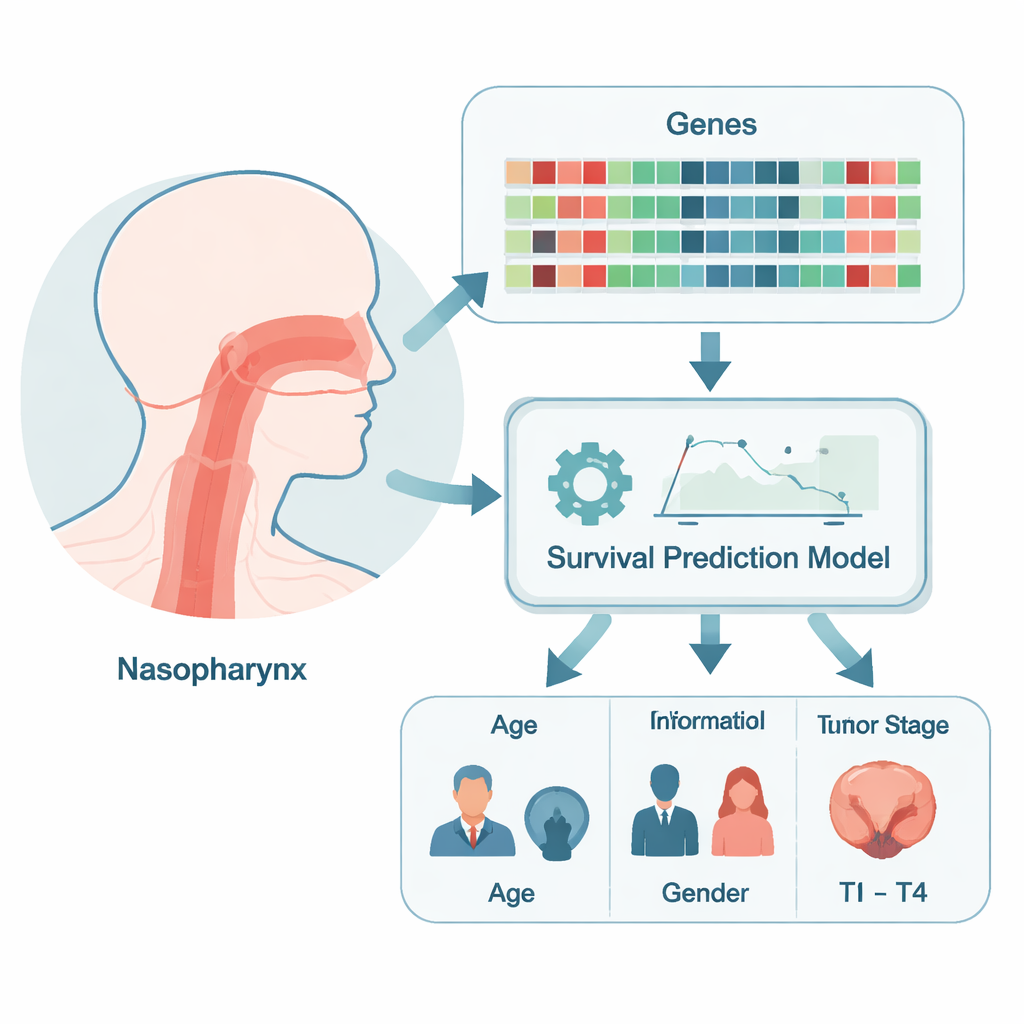
Cancer cells differ from healthy cells not just in how they look, but in which genes are turned on or off. The researchers first searched public databases for gene activity patterns in nasopharyngeal tumors and in normal tissue from the same region of the throat. They combined two datasets and corrected for technical differences so they could compare them fairly. This analysis uncovered more than two thousand genes whose activity changed markedly in cancer, with many involved in copying DNA and driving cell division—the basic machinery that allows tumor cells to multiply out of control. From this crowded landscape, the team homed in on a small cluster of “hub” genes that seemed to sit at the center of many important cellular networks.
Seven central players, three standouts
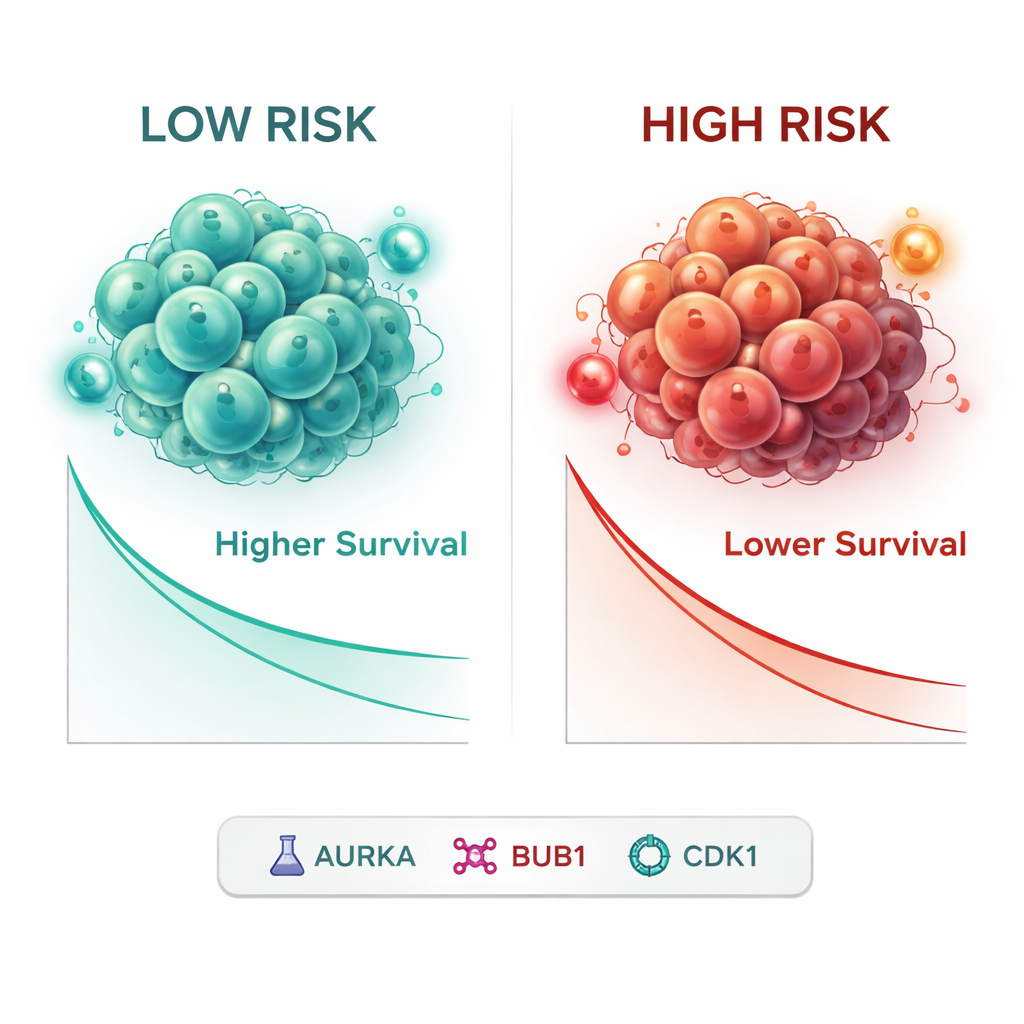
Using computer tools that map how proteins interact with one another, the scientists identified seven hub genes: AURKA, AURKB, BUB1, BUB1B, CCNA2, CCNB2, and CDK1. All were far more active in tumor samples than in normal tissue, and each is known to help control how and when cells divide. To see which of these genes truly matter for patients, the team collected tumor biopsies from 120 people with nasopharyngeal carcinoma treated at a single hospital and tracked them for more than seven years. When they stained these tumors under the microscope, three genes—AURKA, BUB1, and CDK1—stood out: they glowed much more brightly in samples from patients who later died than in those who survived.
Linking gene activity to patient survival
The next step was to test whether these bright signals translated into differences in outcome. The researchers divided patients into groups with high or low expression of each gene and plotted how many people in each group were still alive over time. Patients whose tumors had high levels of AURKA, BUB1, or CDK1 died sooner and more often than those with low levels of the same genes. In contrast, the other hub genes did not clearly separate good outcomes from poor ones. This pattern suggests that AURKA, BUB1, and CDK1 capture something fundamental about how aggressive a given tumor is—how quickly it grows and how resistant it may be to treatment.
Building a practical risk calculator
Doctors already use clinical features such as tumor size, lymph node involvement, and the presence of metastasis to stage nasopharyngeal carcinoma and to guide therapy. The team asked whether adding gene information could sharpen these predictions. They built a survival prediction model that blended standard factors—age, gender, and tumor stages known as T, N, and M—with the levels of AURKA and BUB1 in each tumor. Statistical tests showed that this combined model was highly accurate at distinguishing patients who would live longer from those at higher risk, performing better than a model based only on the usual clinical data. It was not only good at separating low- and high-risk groups but also well calibrated, meaning its predicted chances of survival matched what actually happened in the follow-up data.
What this means for patients
This work suggests that three genes involved in cell division, especially AURKA and BUB1, could serve as molecular warning lights in nasopharyngeal carcinoma. Measuring their activity in tumor biopsies, alongside routine clinical information, may help doctors estimate a patient’s survival more precisely and identify those who might benefit from closer monitoring or more intensive treatment. The study is still early—based on a single center with a modest number of patients—and it does not yet change everyday care. But it points toward a future in which a simple lab test on tumor tissue could turn complex gene activity patterns into a clear, personalized survival forecast for people facing this difficult cancer.
Citation: Zhu, J., Feng, Y., Zhu, Z. et al. Identification of hub genes and construction of a survival prediction model for patients with nasopharyngeal carcinoma. Sci Rep 16, 5299 (2026). https://doi.org/10.1038/s41598-026-36395-4
Keywords: nasopharyngeal carcinoma, cancer biomarkers, gene expression, survival prediction, AURKA BUB1 CDK1