Clear Sky Science · en
Mechanical properties of landslide slip zone soil considering over consolidation ratio and particle grading factors
Why studying sliding soil can save lives
Landslides along big rivers and reservoirs can move millions of cubic meters of earth, threaten dams, and endanger entire towns. Whether a slope creeps slowly or fails suddenly often depends on a thin, hidden layer of weakened soil called the slip zone. This study looks closely at how that layer behaves in one of China’s most closely watched slopes, the giant Huangtupo landslide beside the Three Gorges Reservoir, and shows how paying attention to the soil’s packing and loading history can greatly improve our ability to predict dangerous ground movement.
A giant hillside on the move
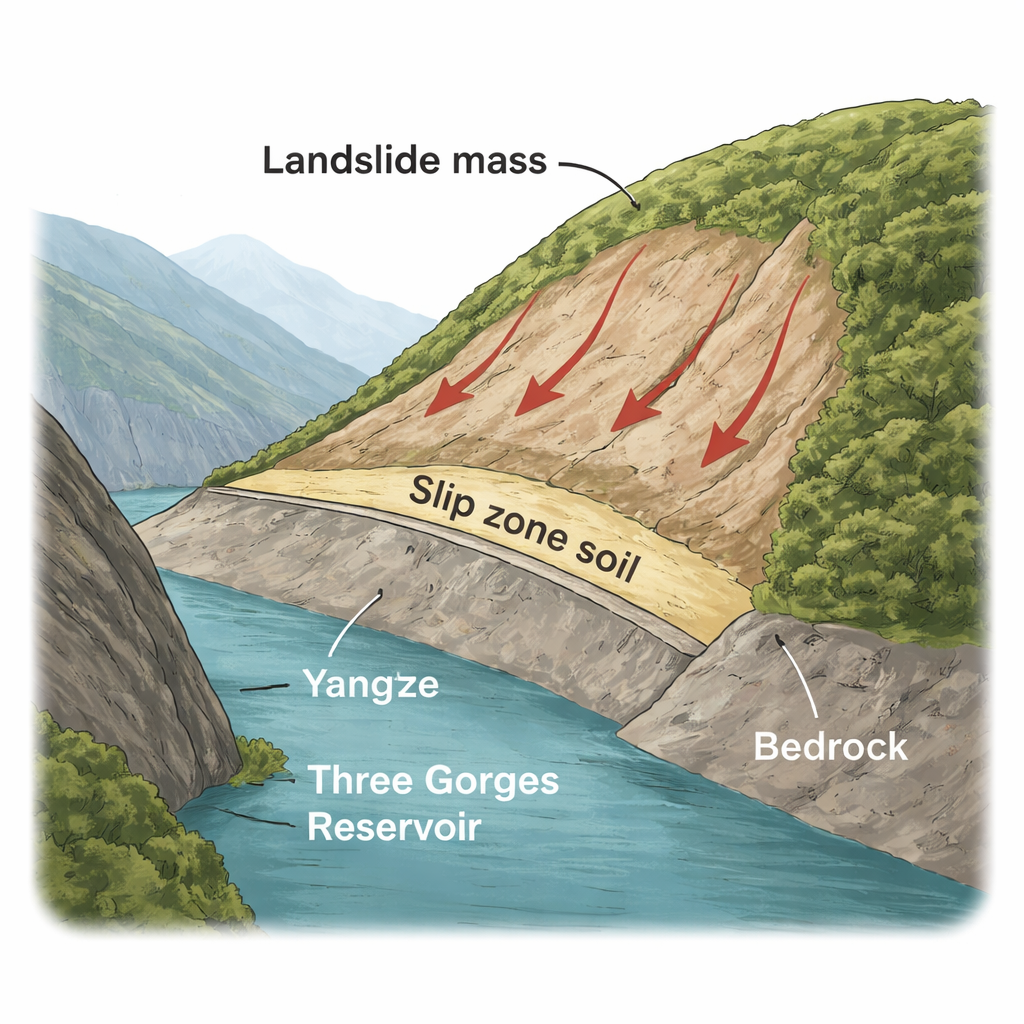
The Huangtupo landslide sits on the south bank of the Yangtze River in the Three Gorges Reservoir region. It covers about 1.35 square kilometers and contains a huge volume of rock and soil perched above the river and nearby communities. Engineers have built tunnels through this hillside to monitor its behavior and reach the narrow slip zone where movement concentrates. There, they find a mixture of silty clay, gravel, and broken rock, typically 50 to 100 centimeters thick, lying between the sliding mass above and strong limestone bedrock below. Because this layer has been squeezed by the weight of the overlying slope for a very long time, it has experienced high past pressures that strongly affect how it now responds to further loading and unloading.
How soil history and grain mix shape strength
Most lab tests on landslide soils use small samples and remove coarse fragments, which makes experiments easier but strips away the natural structure of the slip zone. Earlier studies also tended to vary only one factor at a time, such as water content or present-day pressure. In reality, the soil’s behavior depends on both its particle mix and its “memory” of how much pressure it has already carried, expressed as the over consolidation ratio (OCR). In Huangtupo’s slip zone, about 60% of the mass is gravel-size fragments and 40% is finer material. This blend creates a gravel skeleton with fine grains filling the gaps, so any change in packing, particle damage, or water distribution can sharply alter strength. The authors designed tests that, for the first time in this setting, systematically combine OCR effects with the full natural grading of grains.
Two kinds of shear tests, two kinds of behavior
The team used two main laboratory tools. Ring shear tests were run on sieved soil where particles larger than 2 millimeters were removed, so the focus was on the fine-grained matrix under different OCR values. Large direct shear tests were performed on big boxes filled with unsieved material, preserving the real mix of clay, sand, and gravel. In the ring shear tests, samples quickly reached a peak strength and then gradually weakened, a pattern called strain softening. Microscopic images showed that as the soil was sheared, pores opened, water moved locally, and clay particles lined up along a smooth sliding band, all of which reduce resistance. In contrast, the large direct shear tests on the natural, coarse-rich soil showed strain hardening: after an initial rise, strength continued to build with ongoing movement as gravel particles locked together and some weak grains crushed to fill gaps, especially when water content dropped slightly during loading.
Why past loading matters for future stability
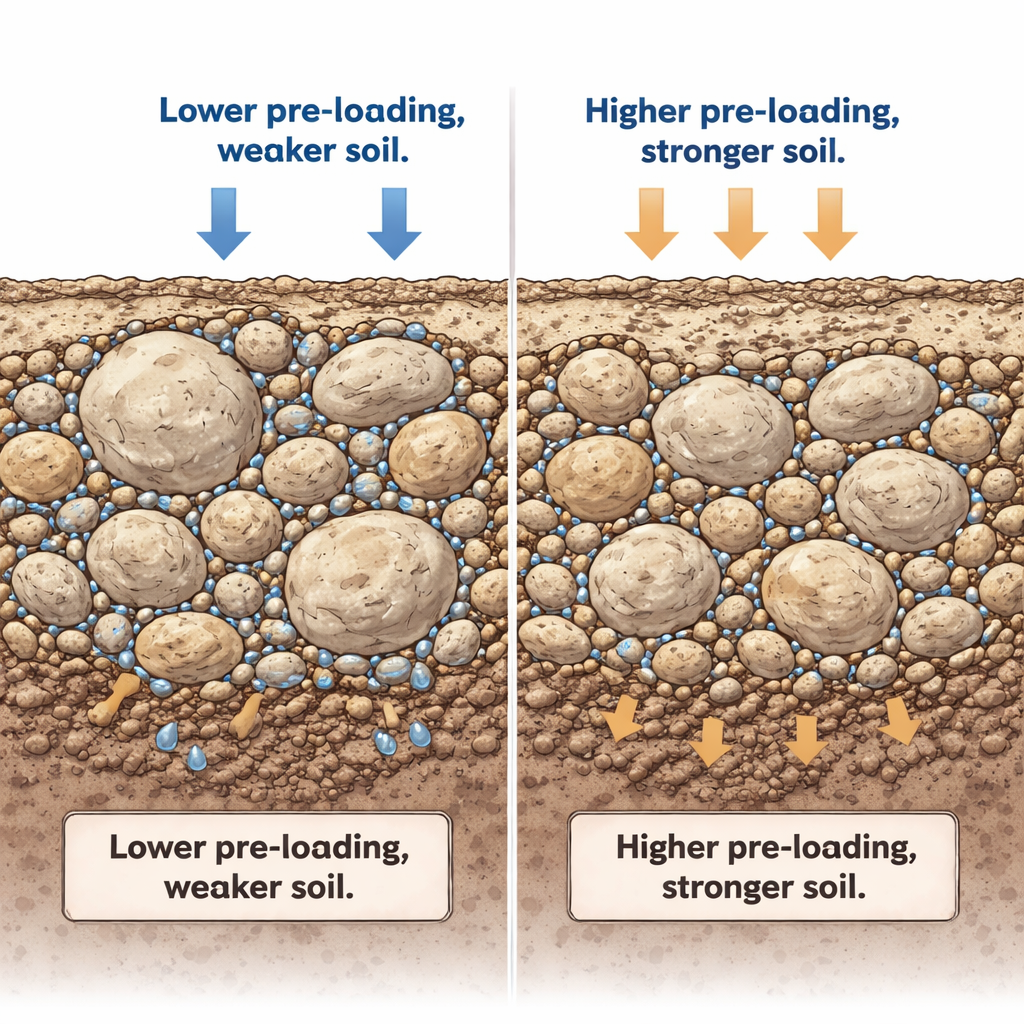
By changing the OCR in both sets of tests, the researchers showed that samples that had been pre-loaded more heavily and then sheared under a lower final pressure behaved very differently from those with equal consolidation. Greater pre-loading compacts the soil, squeezes fine particles into the spaces between large ones, and tightens the gravel skeleton, generally raising shear strength. The authors converted the measured strengths into simple parameters (cohesion and friction angle) and fed three different sets of values into a computer model of the Huangtupo landslide. They then compared the simulated ground movements with real-world monitoring from GPS points and borehole instruments over a full year of reservoir-level changes. Only the parameter set taken from large direct shear tests on the natural grading, with realistic OCR, produced deformations that closely matched the monitored slow, steady creep of the slope.
What this means for landslide risk
For engineers and planners, the study delivers a practical message: to model large landslides reliably, it is not enough to test small, fine-grained samples or to ignore how much a slip zone has been compressed in the past. Instead, both the true mix of grain sizes and the soil’s loading history must be reproduced in the lab. When this is done, as in the over-consolidated large direct shear tests, the resulting strength values lead to simulations that reflect real-world, year-by-year movements. This improved understanding of how slip zone soils strengthen or weaken under different conditions can help refine safety assessments for reservoirs, dams, and communities living below unstable slopes worldwide.
Citation: Chen, Z., Zhao, M., Jiang, S. et al. Mechanical properties of landslide slip zone soil considering over consolidation ratio and particle grading factors. Sci Rep 16, 5769 (2026). https://doi.org/10.1038/s41598-026-36391-8
Keywords: landslide, soil strength, slip zone, Three Gorges Reservoir, slope stability