Clear Sky Science · en
A probabilistic assessment of dietary heavy metal exposure and its temporal trends in Chongqing China from 2012 to 2022
Why what’s on the plate still matters
When we think about pollution, we tend to picture smokestacks and smog, not dinner. Yet tiny traces of toxic metals in everyday foods can, over many years, affect the heart, brain, kidneys and even cancer risk. This study looks at how levels of four heavy metals—lead, cadmium, arsenic and mercury—in the food supply of Chongqing, a major city in Southwest China, have changed over a decade, and what that means for the health of people who live there.
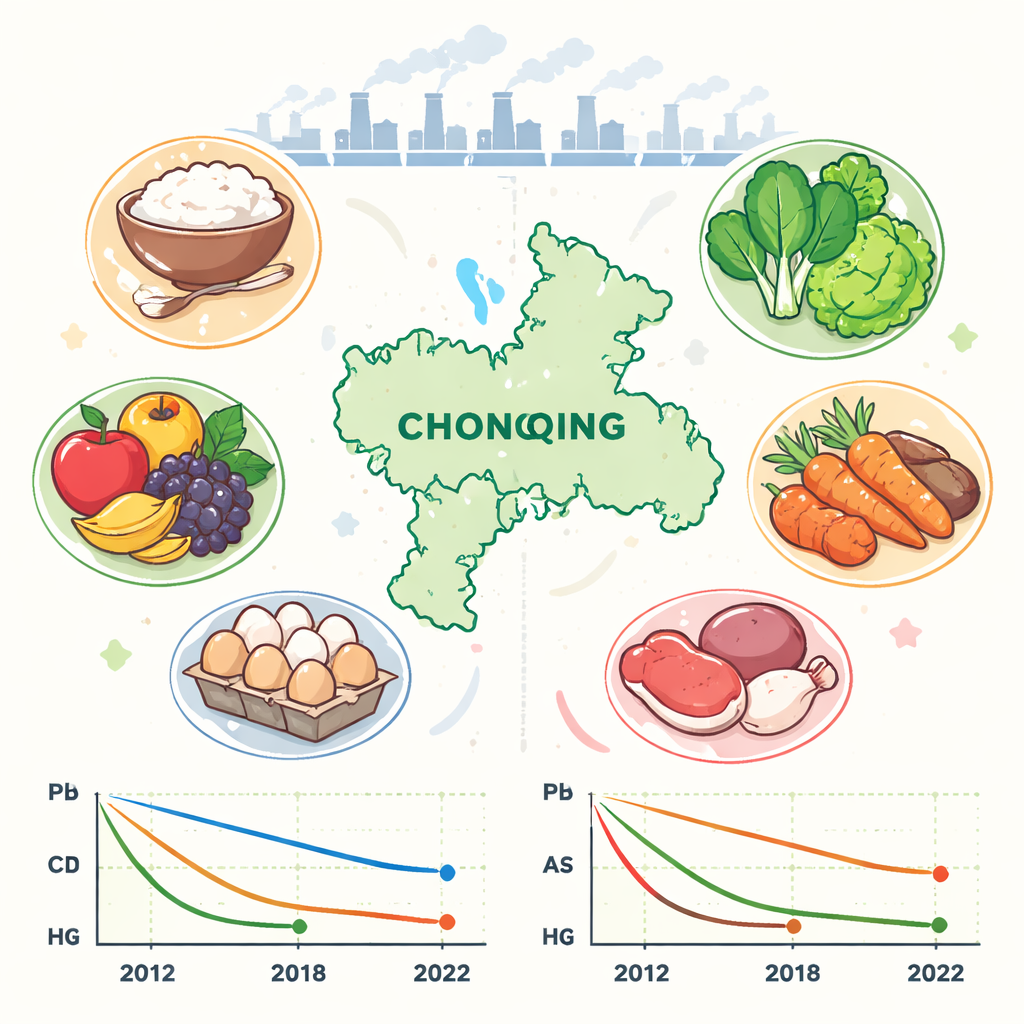
A decade-long look at food and pollution
Chongqing is both an industrial powerhouse and an important agricultural region, making it a revealing case study for how environmental policies play out on the dinner table. The researchers drew on an extensive government monitoring program that tested common foods sold in markets, supermarkets and other shops across all 38 districts and counties from 2012 to 2022. They focused on 12 staple food groups, including rice and wheat products, leafy and root vegetables, meat, eggs and fruit. To understand how much of each food people actually eat, they combined these measurements with detailed dietary surveys carried out in 2011, 2015 and 2018, covering children, adults and older adults.
Tracking toxic metals in everyday foods
Laboratories measured tiny amounts of lead, cadmium, arsenic and mercury in thousands of food samples, following strict quality controls to ensure accurate results. The team then grouped the data into three time windows—2012–2014, 2015–2018 and 2019–2022—to see how contamination changed. Across most foods, average metal levels and the frequency with which metals were detected fell over time, especially between the earliest and latest periods. For example, mean concentrations during 2018–2022 ranged from about 0.016–0.061 milligrams per kilogram for lead, 0.002–0.092 for cadmium, 0.006–0.075 for arsenic and 0.002–0.006 for mercury, generally lower than levels reported in some northern and southern industrial regions of China. These declines line up with major policy steps in Chongqing, such as moving factories away from residential areas, cleaning up soils and enforcing new national soil protection laws.
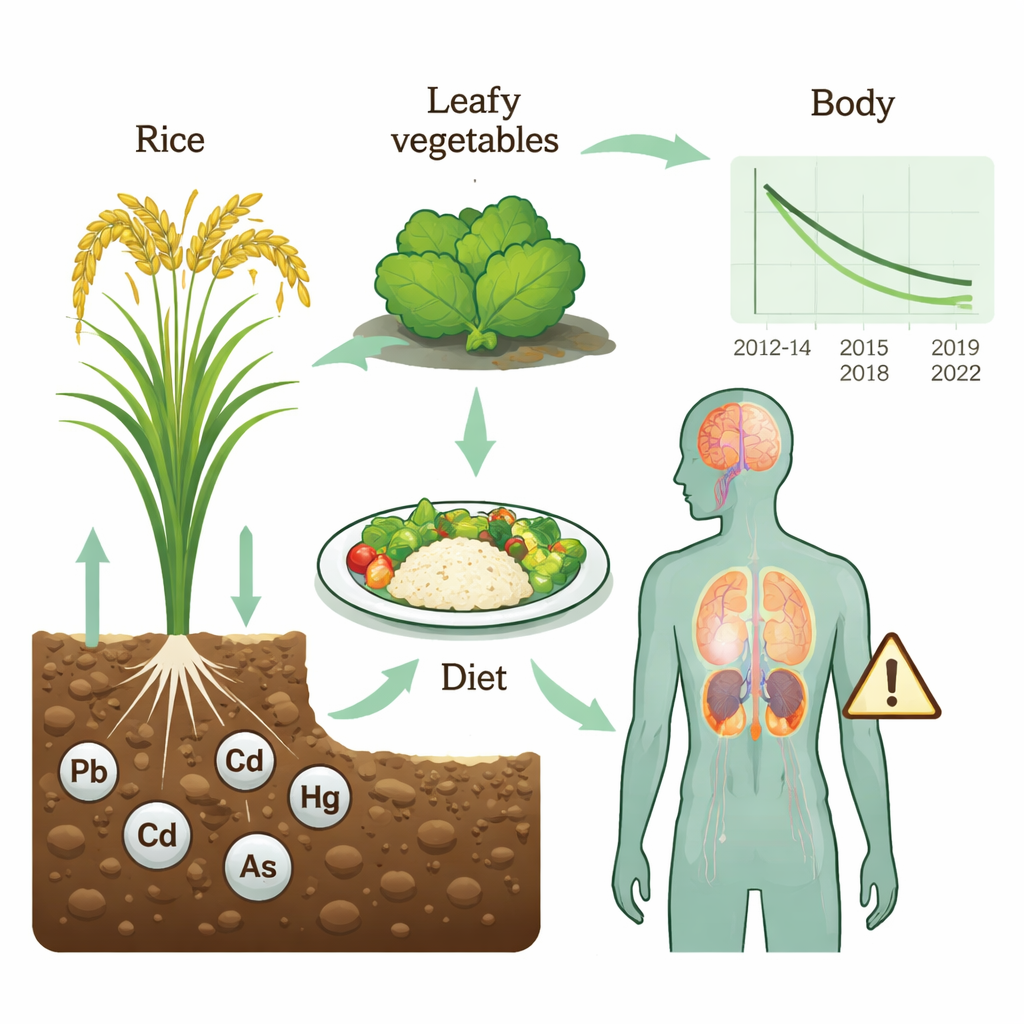
Rice and greens as the main gateways
The study found that not all foods contribute equally to metal exposure. Rice and leafy vegetables emerged as the main gateways by which these contaminants reach people. Both are eaten in large quantities in Chongqing and were more likely than other foods to carry measurable amounts of all four metals. Rice, in particular, showed relatively high levels of cadmium and arsenic, metals known to build up in paddy soils and be efficiently taken up by rice plants. Leafy vegetables, which grow close to the soil and have high water use, also tended to accumulate more metals than root or fruit-type vegetables. Because residents consume these foods daily and in substantial portions, even modest contamination translates into a major share of their total intake of heavy metals.
Estimating health risks with probability
To move beyond simple averages, the researchers used a probabilistic approach known as Monte Carlo simulation, which runs tens of thousands of scenarios combining different food intakes, body weights and contamination levels. From this, they calculated “hazard quotients” for each metal and a combined “hazard index” that reflects the total burden of the four metals together. Values below 1 suggest low concern, while values at or above 1 signal potential non-cancer health risks. For lead and mercury, typical exposures in Chongqing stayed below this threshold, and only a small fraction of residents were estimated to exceed it. Cadmium and especially arsenic were more worrisome: around 7% of residents still exceeded the safety benchmark for cadmium, and roughly half did so for arsenic in the most recent period. When all four metals were considered together, the combined hazard index remained above 1 at both average and high exposure levels, though it declined noticeably after 2018.
What this means for everyday eaters
For lay readers, the main message is mixed but hopeful. On the positive side, stronger environmental rules and soil cleanup in Chongqing appear to be working: heavy metal levels in many foods have fallen, and people’s overall dietary exposure has dropped, especially for those who used to be most exposed. On the cautionary side, the lingering risk from cadmium and arsenic—and the fact that the combined metal exposure still sits above a conservative safety line—shows that the problem is not solved. Because rice and leafy vegetables are the biggest contributors, the authors suggest focusing monitoring and control efforts there, from farming practices that keep metals out of soil to tighter limits on allowed residues in rice. In short, policy can and does make food safer, but continued attention is needed to ensure that the daily staple foods on which people rely do not quietly undermine their long-term health.
Citation: Chen, J., Chen, J., Qin, M. et al. A probabilistic assessment of dietary heavy metal exposure and its temporal trends in Chongqing China from 2012 to 2022. Sci Rep 16, 5199 (2026). https://doi.org/10.1038/s41598-026-36387-4
Keywords: dietary heavy metals, food safety, Chongqing China, rice and vegetables, environmental policy