Clear Sky Science · en
Cultural ecology perspective on mechanisms influencing the spatial morphology of traditional villages in Suichang County, China
Why village shapes matter
Across the mountains of southwestern Zhejiang in China, dozens of traditional villages have clung to steep slopes and riverbanks for centuries. Their winding lanes, clustered houses, and central ancestral halls are not random: they are the physical record of how people have learned to live with rugged land, heavy rains, and inherited customs. This study looks at 25 such villages in Suichang County to answer a deceptively simple question that matters for conservation and planning today: how do nature and culture, together, decide what a village looks like on the ground?
A living system of people and place
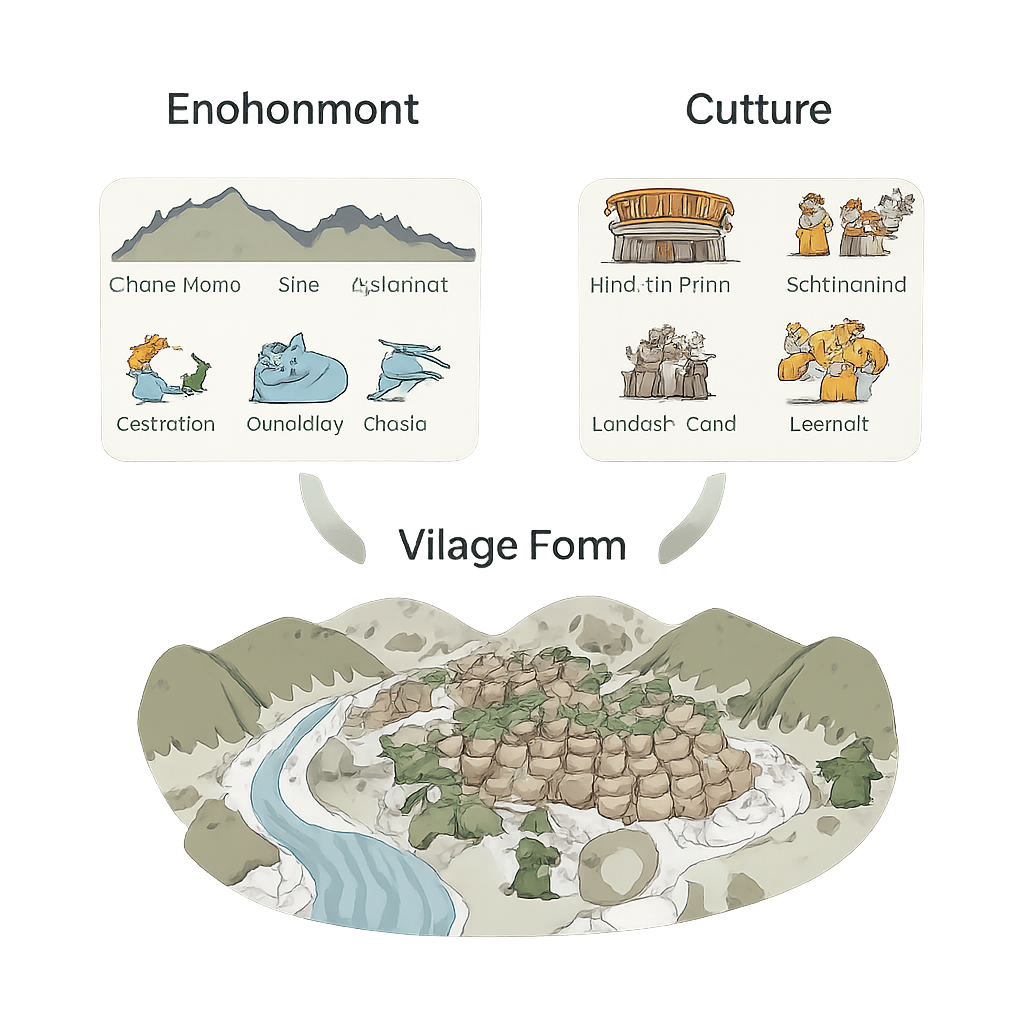
The researchers view each traditional village as a small "cultural ecosystem" where environment and culture constantly interact. Mountains, rivers, climate, roads, and population provide the basic conditions for life. At the same time, ancient roads, ancestral halls, historic houses, and local festivals express shared rules and beliefs. Instead of treating these influences one by one, the team built a combined index with 11 environmental indicators, 4 cultural indicators, and 10 ways of describing village form, such as overall outline, alley network, and how evenly houses are spaced and oriented. This allowed them to move beyond description and measure how changes in landscape and customs are linked to changes in spatial layout.
Mountains, water, and weather shape daily paths
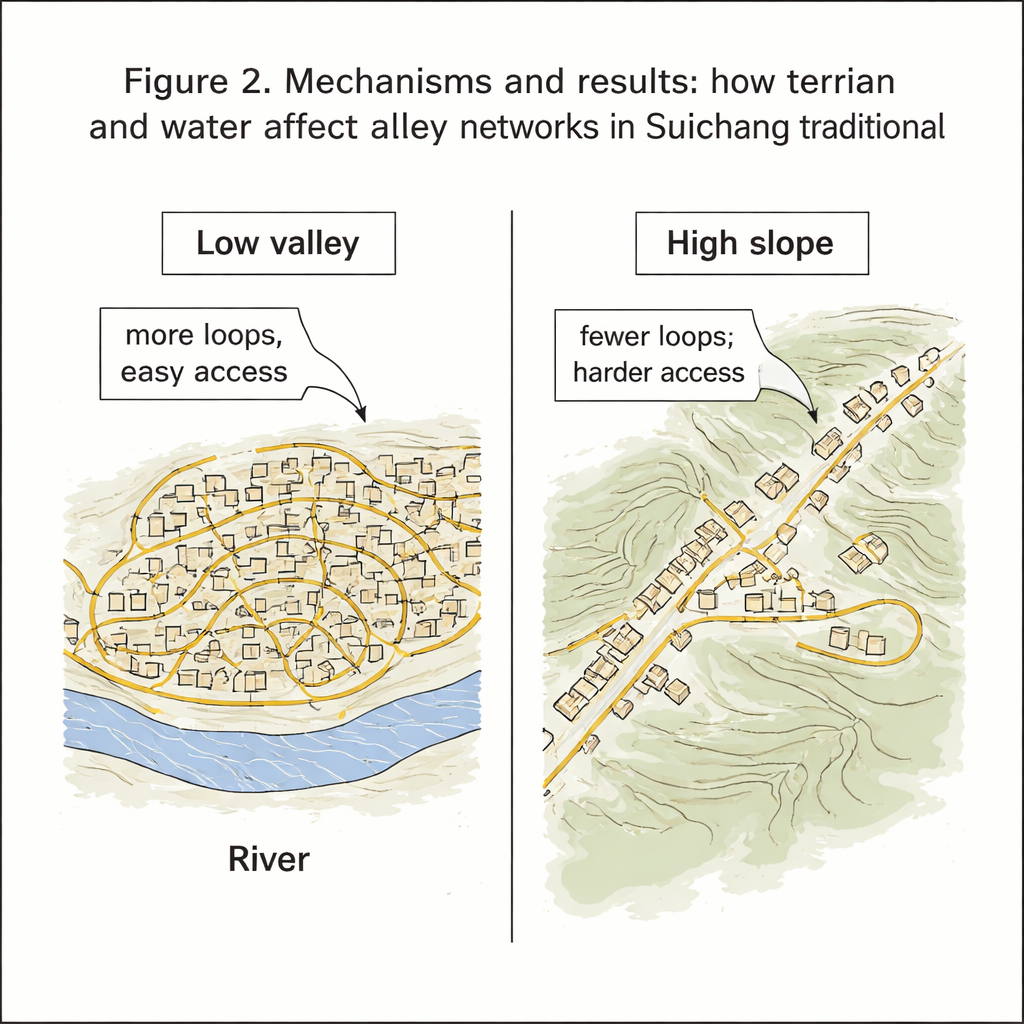
Suichang is famously described as "seven parts mountain, one part water, two parts farmland," and that rugged topography strongly affects how villages grow. High-altitude settlements tend to have more scattered buildings, fewer looping alleys, and poorer internal accessibility: paths often stretch in simple lines along slopes instead of forming dense grids. Steep or highly uneven terrain also makes village boundaries more irregular. Climate and water add further pressures. In hotter, more humid spots, villagers align houses more consistently with breezes and carve out connected alley "wind channels" that help air flow. Villages that sit roughly 200 to 1,000 meters from rivers show the richest, most connected lane networks, balancing easy access to water with safety from floods.
People, roads, and halls guide village expansion
Social and transport factors push villages in different ways. Where population density and concentration are higher, villages spread over much larger areas, reflecting the need for more homes and shared spaces. Better modern road access tends to make village outlines neater and more compact, because planning can override some of the earlier constraints of terrain. Older transport routes matter too. Villages near historic mountain roads, once the main arteries for trade and travel, develop denser, more central alley networks and often emerge as local hubs. Within each village, the ancestral hall functions as both a ritual core and a planning anchor: when it lies near the geometric center, the settlement is more regular; when it is displaced, the village edge becomes more jagged and loosely organized.
Culture as a quiet but powerful force
While environmental conditions provide hard limits—how steep, how wet, how far from the river—cultural elements give softer but still potent guidance. Clusters of protected historic buildings pull fine-grained lanes around them. Multiple forms of intangible cultural heritage, such as traditional crafts or ceremonies, focus activity into shared squares and streets, slightly raising their importance within the village network. Ancient roads draw people and goods through particular gateways, thickening the web of paths, and ancestral halls influence where the settlement grows next. The study shows that village form is not just a reaction to the land but also the accumulated outcome of many small cultural choices.
Lessons for protecting old villages today
For a lay reader, the practical message is clear: if we want to save these traditional villages, we must respect both the ground beneath them and the beliefs that shaped them. In Suichang, high mountain villages work because their scattered houses and simple alleys fit the slopes; forcing standard, straight streets could damage that delicate fit. Moving or rebuilding an ancestral hall without care could quietly unravel the logic of the entire layout. By quantifying how terrain, climate, water, population, roads, and customs combine to mold village space, this study offers local governments a scientific basis for conservation plans that keep these communities living, not just frozen as museum pieces.
Citation: Zhao, X., Shi, L. & Liu, F. Cultural ecology perspective on mechanisms influencing the spatial morphology of traditional villages in Suichang County, China. Sci Rep 16, 5311 (2026). https://doi.org/10.1038/s41598-026-36382-9
Keywords: traditional villages, cultural ecology, rural China, village spatial form, heritage conservation