Clear Sky Science · en
The link between the gender role self-concept and psychobiological stress in everyday life: an ecological momentary assessment study
How Our Everyday Sense of “Me” Shapes Stress
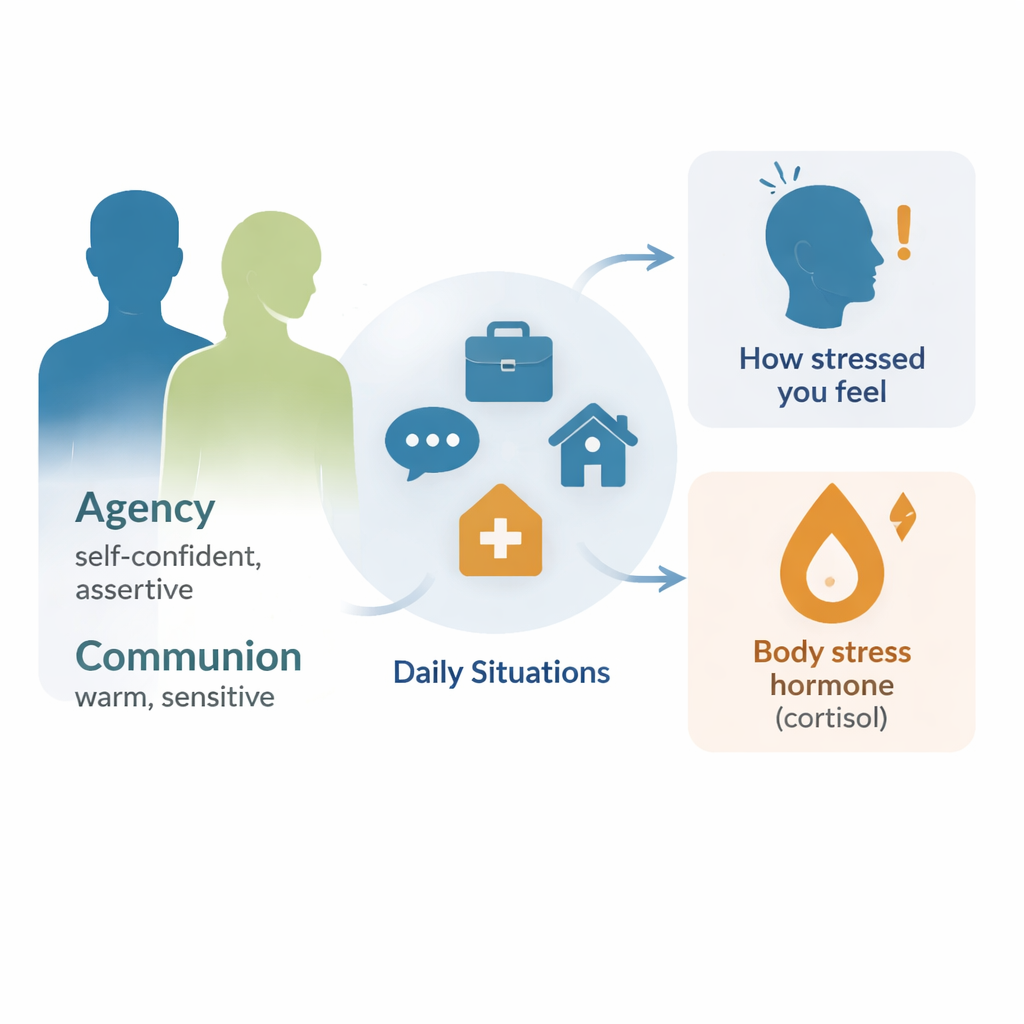
Why do some people feel calm under pressure while others are easily frazzled, even when they share the same job, family load, or health? This study suggests that part of the answer lies not only in our biological sex, but in how we see ourselves along two simple dimensions: how assertive and self-driven we feel (agency) and how warm and relationship‑focused we feel (communion). By tracking people in real time during their workdays, the researchers show that moment‑to‑moment shifts in these self‑views are closely tied to how stressful life feels and how often stressors pop up.
Two Everyday Sides of the Self
The authors focus on gender role self‑concept, a psychological way of describing how much we see ourselves in traits traditionally labeled “masculine” or “feminine,” without tying them rigidly to being male or female. Agency covers qualities like feeling self‑confident, powerful, and willing to take charge. Communion reflects feeling sensitive, emotional, and attuned to others. Instead of treating these as fixed labels, the team asked: How do these self‑views fluctuate over the day, and how do those fluctuations relate to stress in real life?
Studying Stress in the Wild
Eighty‑two adults, aged 20 to 65, carried out their usual workweek while taking part in an ecological momentary assessment study. For five consecutive workdays, their smartphones prompted them up to seven times a day. Several times daily they rated how agentic (e.g., self‑confident, fearless) and how communal (e.g., sensitive, emotional) they felt at that moment. They also reported how stressed they felt and whether anything stressful had happened since the last prompt. At each prompt they provided saliva samples so that the researchers could measure levels of cortisol, a hormone that tracks activity of the body’s main stress system.
Feeling Assertive, Feeling Frazzled
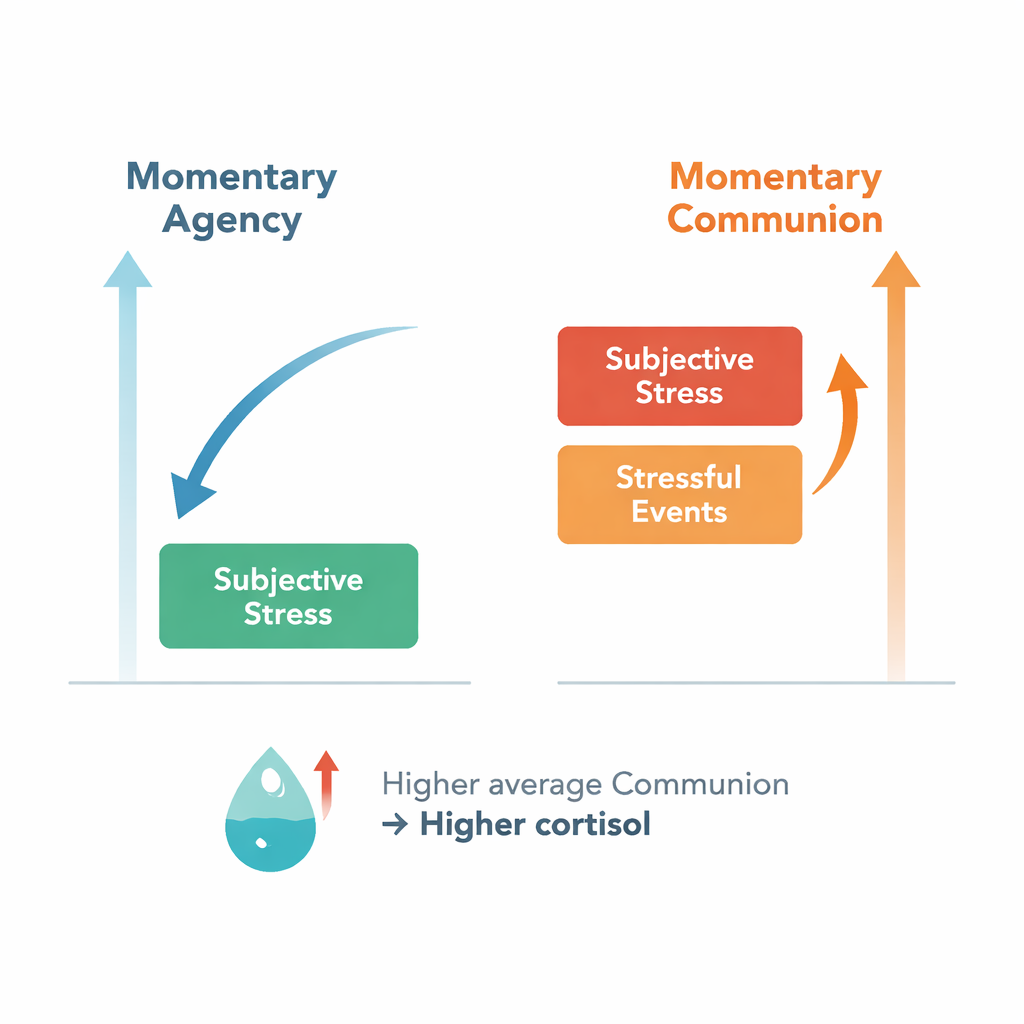
A key finding was that people’s self‑concepts were not fixed: agency and communion rose and fell within the same person across hours and days. These swings mattered. Whenever someone felt more agentic than usual for them, they tended to report lower stress and fewer stressful incidents. In contrast, when they felt more communal than their own average, they tended to feel more stressed and to report more stressors. People who, on average, felt more agentic over the week also tended to feel less stressed overall, whereas those who generally felt more communal tended to feel more stressed and encountered stressful situations more often. Interestingly, broad, trait‑level questionnaire scores—how people described themselves “in general”—did not predict daily stress feelings or stressor exposure as well as these moment‑to‑moment state ratings did.
Inside the Body: Cortisol Tells a Subtler Story
The pattern for the biological stress marker was more nuanced. Day‑to‑day ups and downs in agency and communion were not clearly tied to changes in cortisol levels in saliva. However, people who described themselves as highly communal in general had higher overall cortisol across the week than those lower in communion, even after accounting for factors like age, sleep, physical activity, and biological sex. This suggests that a strongly other‑focused, emotionally sensitive orientation may go along with a more activated stress system in everyday life, even if short‑term shifts in self‑view do not immediately spike cortisol.
What This Means for Everyday Life
For a layperson, the take‑home message is that how you see yourself from moment to moment really does shape how stressful life feels—sometimes more than whether you are biologically male or female. Feeling able to act, decide, and assert yourself tends to go with feeling less overwhelmed, while being highly tuned in to others’ needs may increase both the number of stressful situations you notice and how burdensome they feel. At the same time, being strongly other‑focused may subtly keep your body’s stress hormone system more switched on. The study suggests that paying attention to, and perhaps gently rebalancing, our mix of agency and communion—not abandoning care for others, but supporting our own assertiveness—could be one path toward lowering both perceived stress and its biological wear and tear.
Citation: Stoffel, M., Zintel, S., Schmidt, L.I. et al. The link between the gender role self-concept and psychobiological stress in everyday life: an ecological momentary assessment study. Sci Rep 16, 2630 (2026). https://doi.org/10.1038/s41598-026-36381-w
Keywords: stress, gender roles, agency, communion, cortisol