Clear Sky Science · en
Fishing-focused marine conservation planning underestimates losses of other ecosystem benefits to local communities
Why this lagoon story matters
Coastal communities around the world depend on the sea for far more than fish. Coral reefs and lagoons provide food, medicine, cultural identity, spiritual places, and simple joy from being in a beautiful environment. This study from Madang Lagoon in Papua New Guinea asks what happens when conservation plans focus only on protecting fish and fishing grounds, and quietly ignore all those other everyday benefits. The answer matters wherever people are trying to save marine life without sacrificing local livelihoods and traditions.
More than just fish on the line
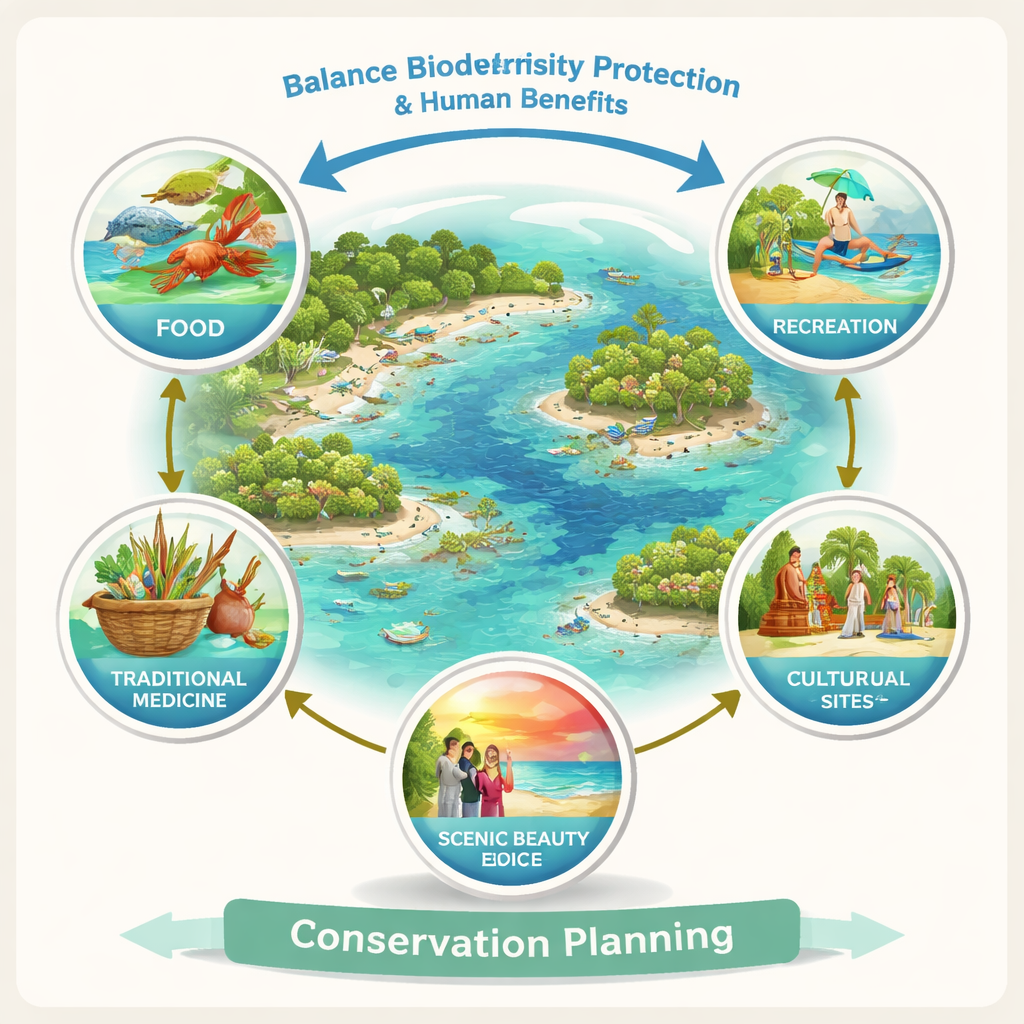
For people in the Riwo (Ziwo) community, the lagoon is a supermarket, pharmacy, playground, and sacred landscape all rolled into one. Researchers worked with local residents to list the many reasons households visit the sea. Fishing for food and income topped the list, but recreation, scenic enjoyment, traditional medicine, materials for betel nut lime, learning, spirituality, and appreciation of biological richness all ranked highly. In other words, closing an area of sea to protect nature does not just affect catches; it can alter where people swim, pray, heal, teach children, and spend time together.
Turning local knowledge into maps
To capture these connections, the team adapted simple, game-like mapping tools. In community meetings and household interviews, 52 household heads and family members used picture cards to choose the benefits important to them, then drew on satellite images to show where in the lagoon they went for each benefit. Finally, they placed tokens on their drawings to indicate which places mattered most. These hand-drawn maps were digitized into a grid of small “places” across the lagoon, allowing the researchers to measure how strongly each square contributed to different types of benefits and to see where different values overlapped or diverged.
Testing different ways to design reserves
Armed with these maps and a detailed habitat map of the lagoon, the team ran a series of computer-based planning scenarios. All scenarios were required to protect at least 20% of each reef and habitat type, but they differed in which social “costs” they tried to minimize. Some plans tried to avoid the most important fishing grounds, others tried to spare areas important for a single non-fishing benefit such as recreation or spiritual sites, and another set tried to minimize losses across all benefits at once. The researchers also compared two extreme types of reserves: “no-take” areas that stop harvesting but still allow people to visit, and stricter “no-go” areas that block all access.
Hidden losses when only fishing is considered
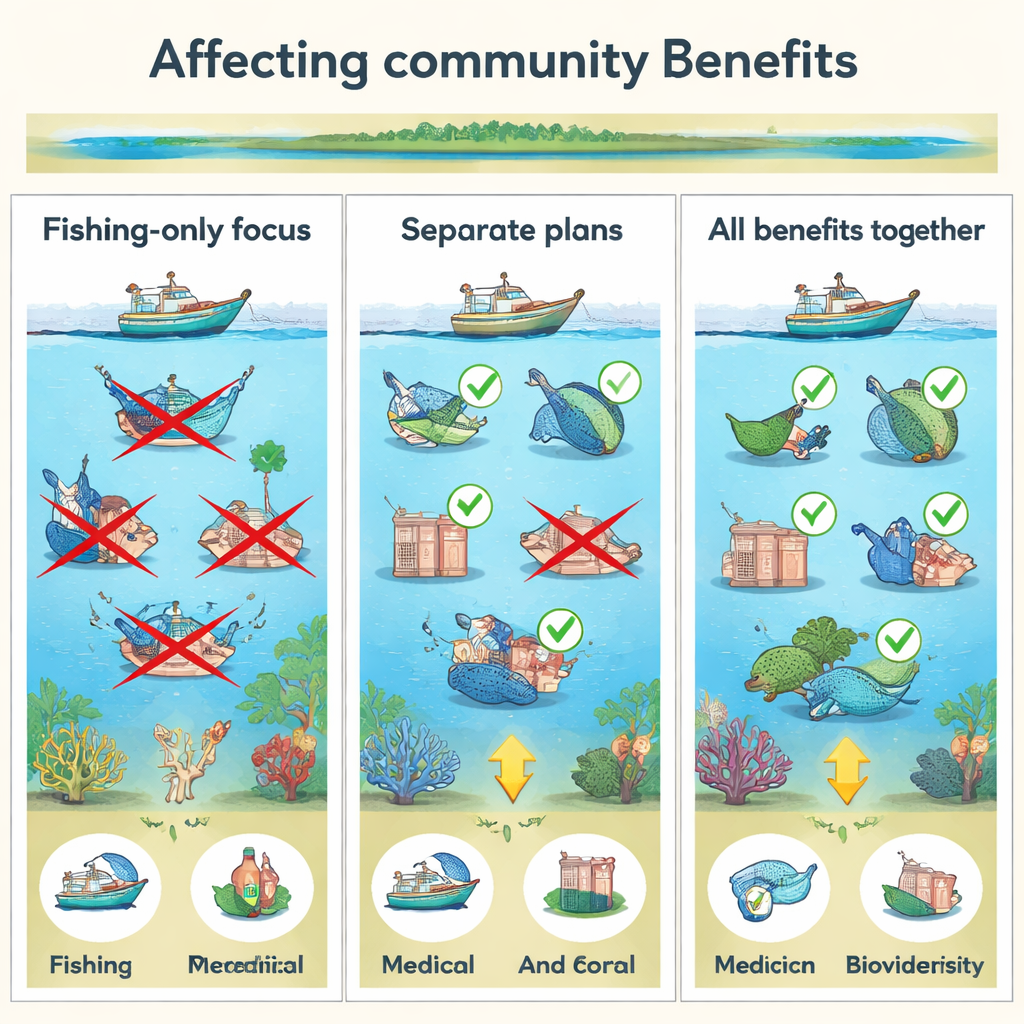
When the planning focused only on reducing impacts to fishing, the resulting reserve designs looked successful from a fisher’s perspective, with low loss of fishing value. But a closer look revealed substantial hidden costs for other benefits. Some of the best fishing-friendly designs would still close or restrict many places used for traditional medicine, lime collection for betel nut chewing, and spiritual activities, especially under stricter no-go rules. Planning separately for each benefit did not solve the problem; it simply shifted the burden from one group of users to another, often increasing overall social costs compared with plans that did not consider people at all.
Reserves that respect the whole community
The most promising results came from scenarios that treated all benefits together. When the model was asked to minimise the combined loss of food, culture, recreation, and other values at the same time, it produced reserve systems that still met habitat protection targets but caused only very small losses for most benefits. These plans also used fewer individual areas, making them simpler to manage. Some spiritual sites remained hard to avoid, but overall, the “all benefits” approach did a much better job of sharing costs fairly across the community and reducing the risk that important uses would be overlooked.
What this means for ocean protection
For lay readers, the core message is straightforward: if marine conservation plans pay attention only to fishing, they are likely to underestimate how much they disrupt people’s lives. By working directly with communities to map where and why they use the sea, planners can design reserves that protect coral reefs while keeping access to key places for food, healing, culture, and enjoyment. This study offers a practical, easy-to-understand way to bring those wider benefits into the heart of conservation planning, helping make protected areas more acceptable, more equitable, and ultimately more effective.
Citation: Hamel, M.A., Pressey, R.L., Andréfouët, S. et al. Fishing-focused marine conservation planning underestimates losses of other ecosystem benefits to local communities. Sci Rep 16, 6381 (2026). https://doi.org/10.1038/s41598-026-36378-5
Keywords: marine conservation, ecosystem services, coral reefs, community mapping, Papua New Guinea