Clear Sky Science · en
Modeling of wheat yield using plant structural biomarkers
Why Wheat Yields Matter to Everyone
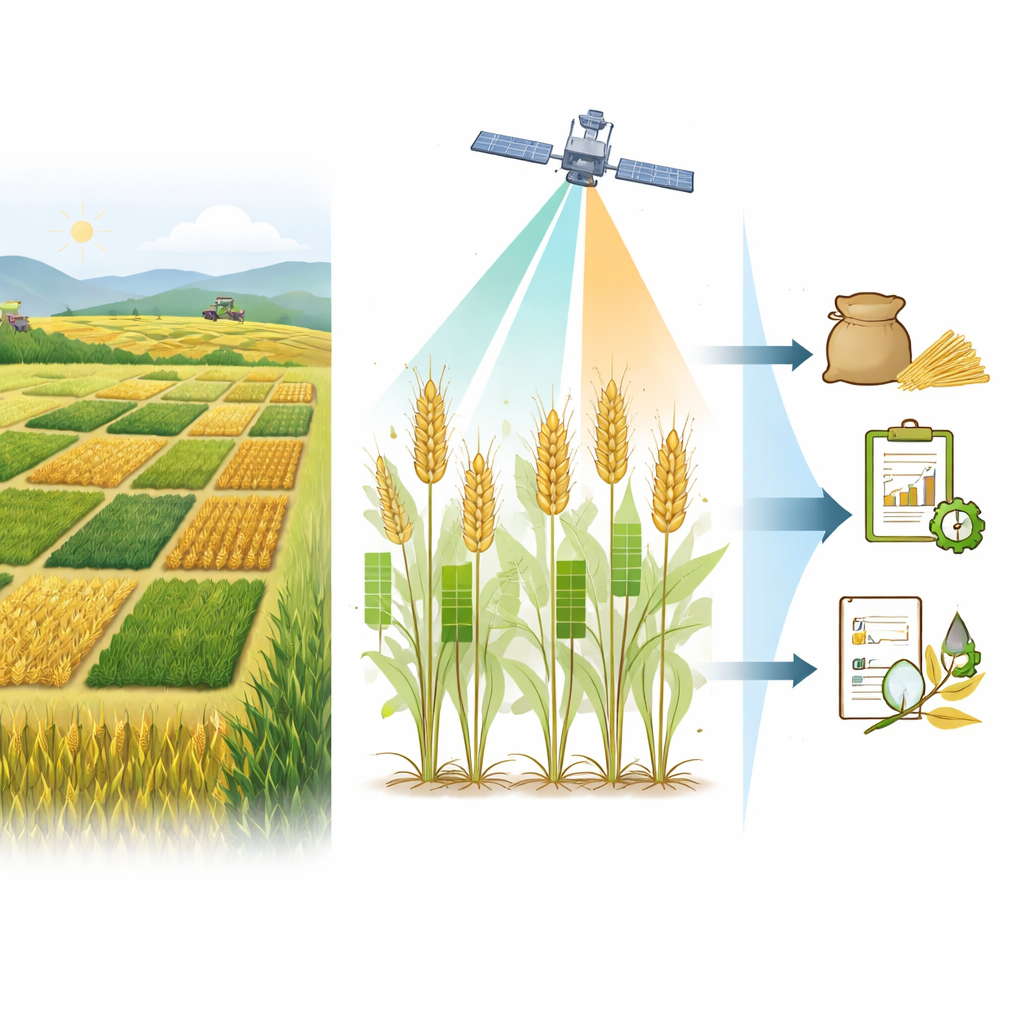
Wheat is a cornerstone of global food security, especially in regions like South Asia where populations are rising and farmland is under pressure from cities, industry, and climate change. Being able to predict how much grain a field will produce—early enough to adjust water, fertilizer, and market plans—can make the difference between profit and loss for farmers and help stabilize food supplies. This study explores a smarter way to forecast wheat yields by looking not just at how green fields appear from above, but at the structure of the plants themselves.
From Green Color to Plant Shape
For decades, farmers and scientists have relied on satellite images to gauge crop health. A popular measure, called a vegetation index, compares how plants reflect red and near‑infrared light to estimate “greenness,” which often tracks with plant vigor. While this index works reasonably well for large areas and late in the season, it can miss important details at the field scale, especially early in the crop’s life. The authors asked whether adding simple structural traits of wheat plants—how tall they grow and how much leaf area they carry—could sharpen these predictions and better capture the real differences created by fertilizer and soil conditions.
A Close Look at a Small Field
The research team carried out a carefully controlled field trial near Roorkee in northern India, a region typical of many wheat‑growing areas with hot summers, cool winters, and a strong monsoon. They divided a small experimental field into nine plots and gave each plot different amounts and types of nutrients: some received standard fertilizer doses, some more or less, and others received farmyard manure. At key points in the season—roughly two, three, and four months after sowing—they measured how tall the wheat plants were, how much leaf area they had, and how green the canopy appeared from light‑based sensors. At harvest, they weighed the grain from each plot to see which measurements best foretold the final yield.
New Ratios Reveal Canopy Efficiency
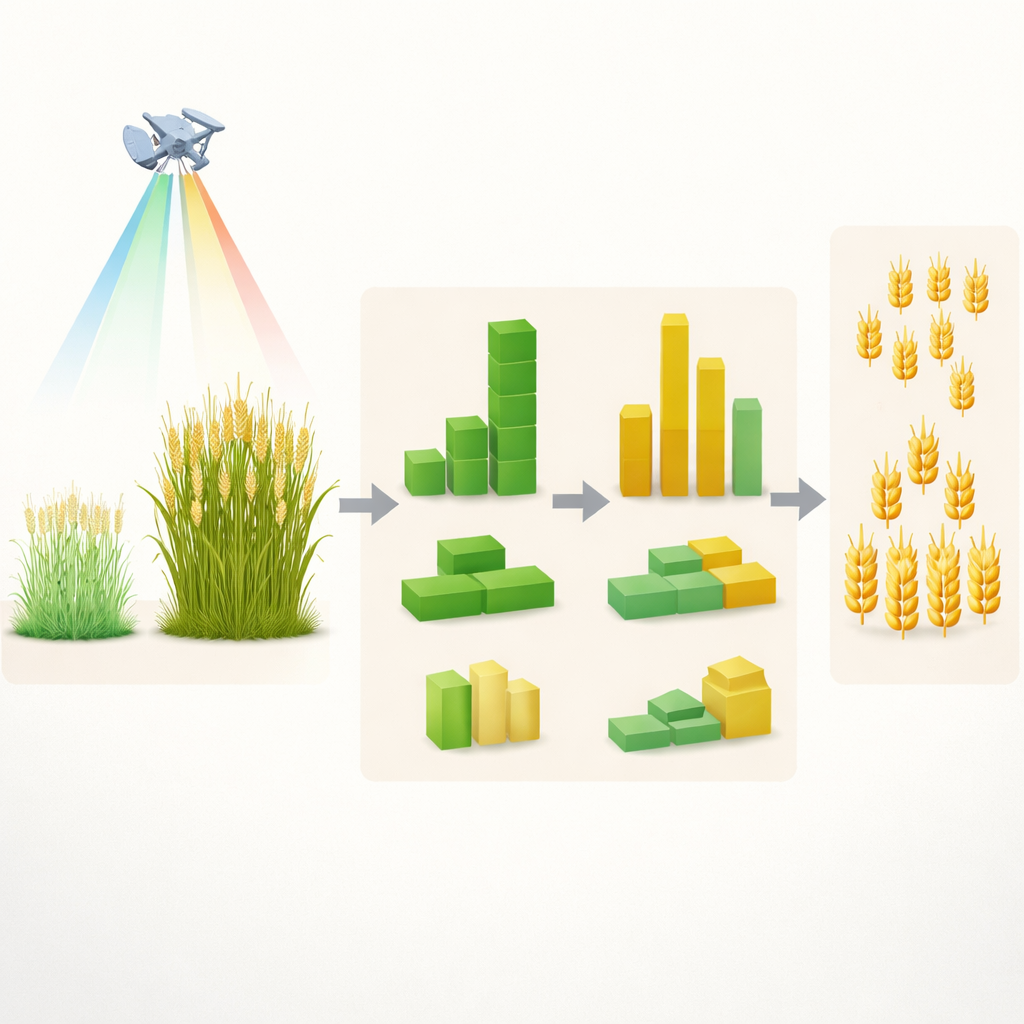
Rather than treating each trait separately, the researchers created new “structural ratios” that combine leaf area with plant height. One key ratio divided leaf area by the square of plant height. This expresses not just how many leaves a plant has, but how tightly those leaves are packed in the vertical space, which influences how efficiently the canopy captures sunlight. When they used this compactness measure alone to predict yield, it outperformed more familiar single indicators, including greenness and height by themselves. Adding greenness to these structural ratios provided only modest further gains, suggesting that plant architecture carries much of the predictive power once nutrient effects have shaped the crop.
Timing and Limits of Early Forecasts
The study also showed that when measurements are taken matters almost as much as what is measured. Early in the season, around 60 days after sowing, predictions were unreliable for some plots, especially where organic manure released nutrients slowly or fertilizers were not yet fully absorbed. By 90 and 120 days, as plant growth stabilized and canopies filled in, models based on the new structural ratios and on combinations of height and leaf area became much more accurate and stable. However, the work was based on just nine small plots in a single location and season, so the authors stress that the approach must be tested on larger and more varied fields before it can be widely applied.
What This Means for Future Farming
In simple terms, the study finds that looking at how a wheat crop is built—its height and how densely its leaves are arranged—is a stronger guide to final yield than greenness alone. By focusing on canopy structure, farmers and advisors could gain earlier and more reliable insights into which fields are on track and which need attention, supporting more precise fertilizer and water management. While this work is a proof‑of‑concept rather than a ready‑to‑use tool, it points toward a future where everyday yield forecasts blend satellite views with on‑the‑ground measurements of plant form, helping to produce more grain from limited land and resources.
Citation: Dwivedi, A.K., Ojha, C.S.P., Singh, V.P. et al. Modeling of wheat yield using plant structural biomarkers. Sci Rep 16, 11192 (2026). https://doi.org/10.1038/s41598-026-36373-w
Keywords: wheat yield, remote sensing, leaf area index, plant height, precision agriculture