Clear Sky Science · en
Variations in the technical performance of elite female volleyball: evidence from a new round model
Why this matters to fans and coaches
Volleyball rallies can look like chaos to the naked eye, but beneath the flying spikes and diving saves lies a repeatable pattern. This study on elite Chinese women’s volleyball breaks each rally into small “rounds” of ball control and shows that what players do, and how successful they are, changes from one round to the next. For anyone interested in why some attacks score and others are blocked or kept in play, this work offers a new, clearer way to look at the game.
Breaking a rally into bite-sized pieces
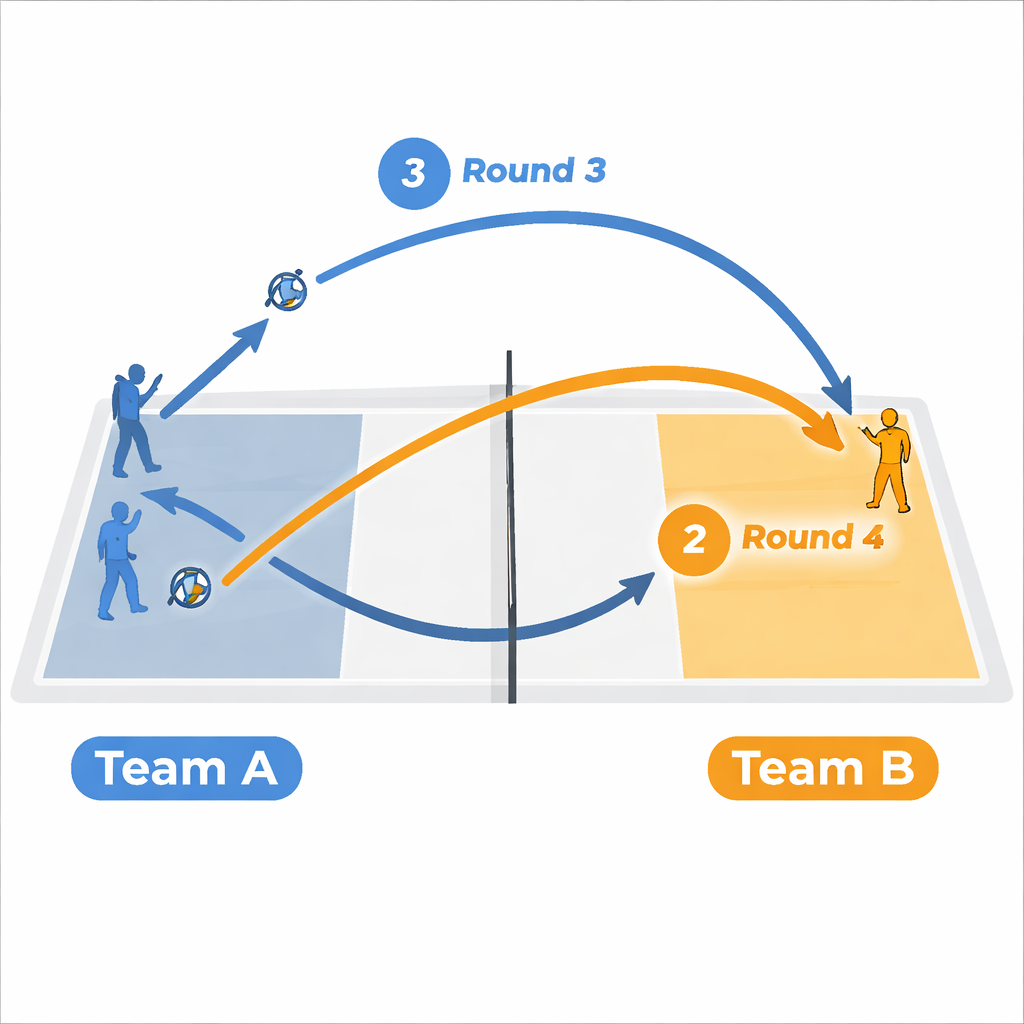
Traditional analyses of volleyball divide play into broad phases, such as serving, receiving, or counterattacking, but these phases do not always follow the true order of events during a rally. The authors introduce a revised “round model” that instead tracks the ball in the exact sequence it moves from one team to the other. A round begins when a team gains control of the ball and ends when they finish their organized play by sending it back over the net. Importantly, a block that simply deflects the ball no longer counts as a full round by itself; the round only changes when a team regains control and can actually build an attack. This process-ordered view allows researchers to compare similar moments in rallies across many matches in a consistent way.
How the study was done
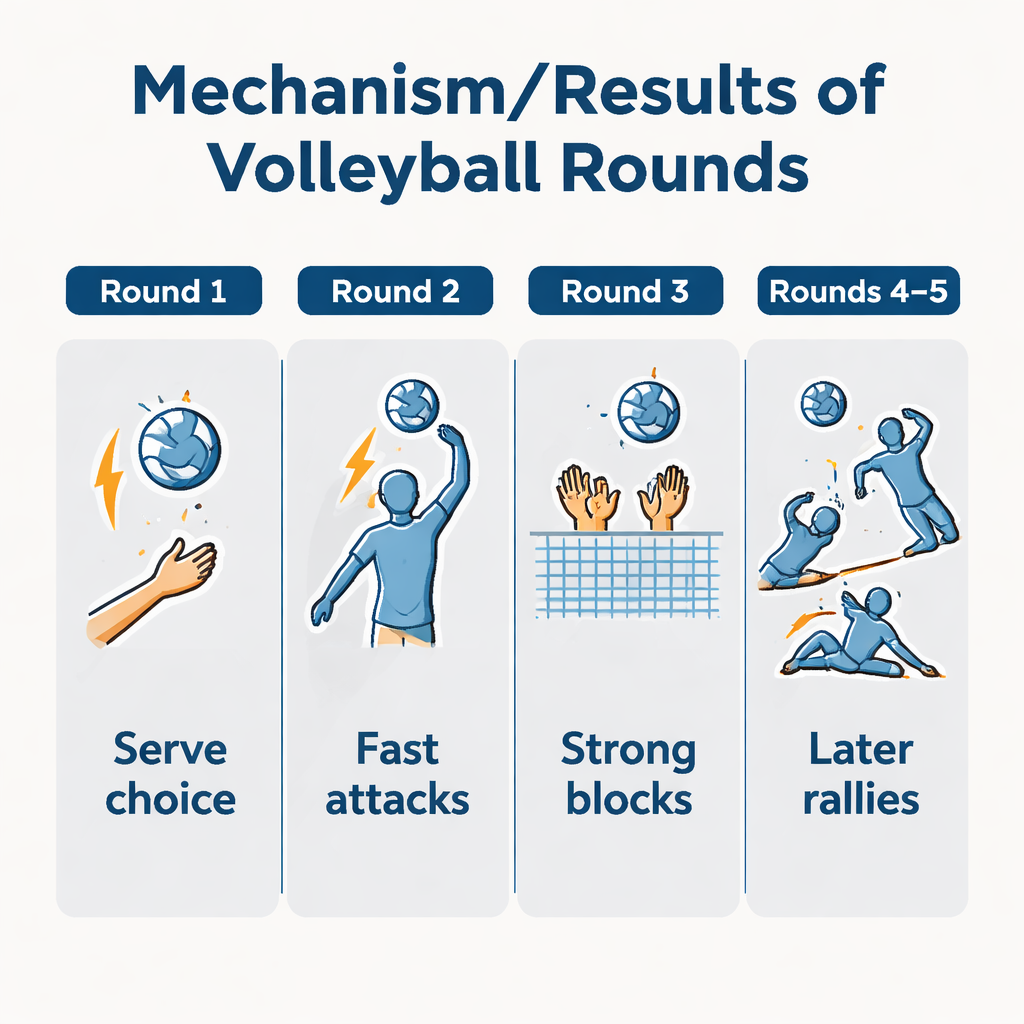
The researchers analyzed 8,915 actions from 20 matches in the 2023/2024 Chinese Women’s Volleyball Super League, featuring the top eight teams. From video of these matches, trained observers coded where on the court the ball was received, set, and attacked; how quickly attackers approached (“tempo”); how many blockers were at the net; and whether the attack scored a point, produced an error, or led to a continuation of the rally. They grouped actions into Round 1 (serve), Round 2 (first attack by the receiving team), Round 3 (the next organized attack), and a combined Round 4–5 category representing longer rallies. Statistical tests and logistic regression models were then used to see which technical choices were most strongly linked to outcomes in each round.
Different rounds, different strengths
The picture that emerged is that not all rounds are created equal. In Round 1, the serve dominated. Nearly 90 percent of serves were jump-float serves, which are easier to control but still hard to read, while powerful jump serves were used rarely and were more often tied to errors. Most serves led to continuation rather than an immediate point or error, showing that at this level the serve mainly sets the stage for what follows. In Round 2, when the receiving team has its first chance to attack, conditions were most favorable for scoring: the ball was often passed accurately to central setting zones, allowing faster attacks from the front of the court. Here, quick attack tempo was clearly linked with a higher chance of winning the point compared with slower attacks.
When rallies get messy
Round 3 told a different story. By this point, the ball had usually been recycled, reception quality was more uneven, and attacks shifted more to the backcourt. Slow-tempo attacks became more common, and opposing blocks were better organized, often involving two or more blockers. In these tougher conditions, the likelihood of scoring dropped and more plays ended in continuation. The analysis showed that block formation now mattered most: attacks facing no block or a single blocker were far more likely to stay in play rather than result in errors compared with those facing a triple block. Later rounds (4 and 5) were relatively rare but showed stable patterns similar to Round 2, with moderately fast attacks and a balance of points and continuations, suggesting that teams can re-stabilize their play after the most chaotic third round.
What this means for the game
For a lay audience, the core message is straightforward: rallies have a rhythm, and teams are not equally dangerous in every part of that rhythm. The new round model shows that serving choices shape how the rally starts, fast attacks after a good reception give the best chance to score, and once play drags into a third exchange, the defense—especially the block—gains the upper hand. Coaches can use this framework to design training that targets specific rounds: balancing serve risk and reward, sharpening fast attacks in Round 2, and preparing for slower, more predictable situations where strong blocking can turn the tide. For fans, it offers a new way to watch: by noticing which round the rally is in, they can better understand why a particular spike is more or less likely to land.
Citation: Shen, Y., Li, M. & Yang, Q. Variations in the technical performance of elite female volleyball: evidence from a new round model. Sci Rep 16, 5823 (2026). https://doi.org/10.1038/s41598-026-36371-y
Keywords: women's volleyball, match analysis, serve and attack, blocking, rally structure