Clear Sky Science · en
Predictors of reverse cardiac remodeling after sacubitril/valsartan in heart failure with reduced ejection fraction
Why this matters for people with weak hearts
Heart failure with reduced ejection fraction means the heart’s main pumping chamber has become stretched and weak, so it can’t push out enough blood with each beat. A newer medicine, sacubitril/valsartan, has been shown to help many of these hearts “remodel” back toward a healthier size and shape. This study asked a practical question that matters to patients and doctors alike: who is most likely to see their heart recover on this drug, and does it matter how soon and how much of it you take?
How the researchers followed real-world patients
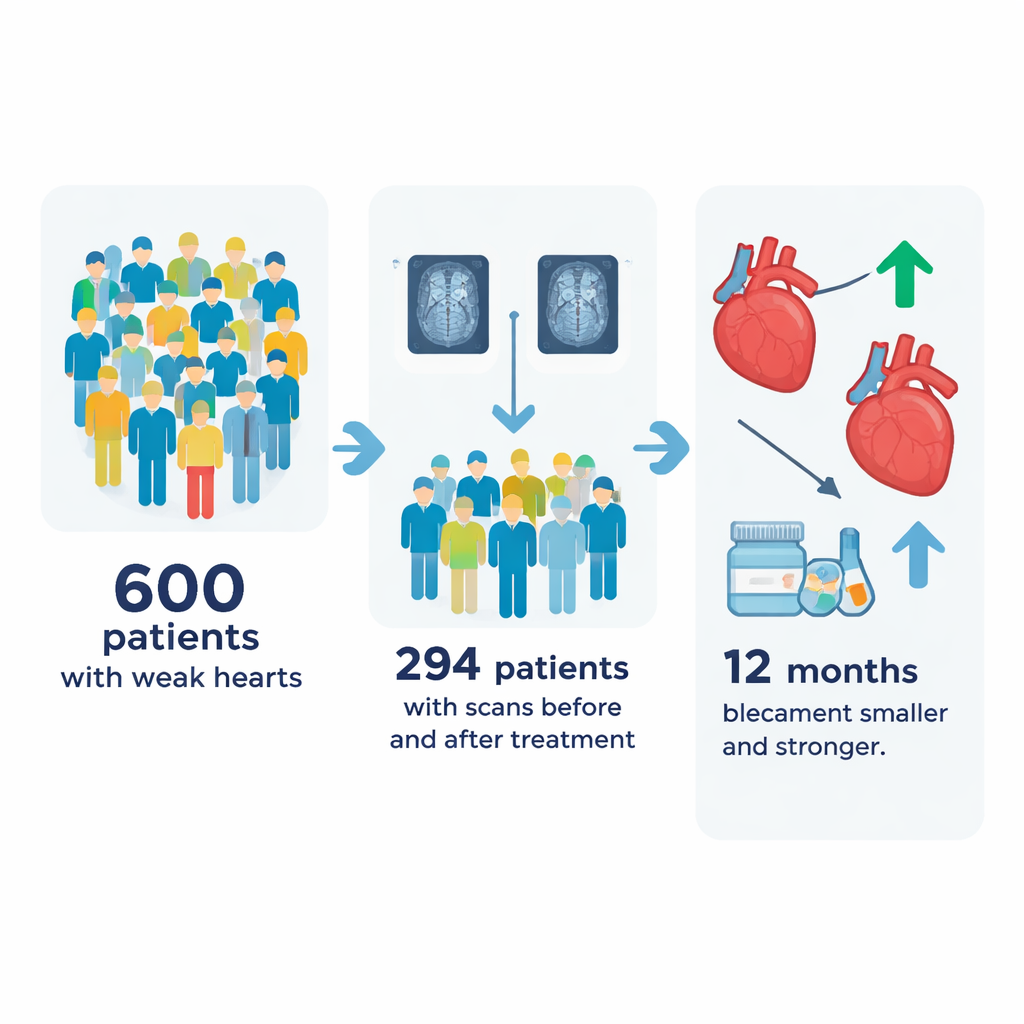
The investigators looked back at medical records from six large hospitals in Korea, focusing on adults with heart failure whose hearts pumped out 40% or less of the blood in the main chamber with each contraction. Out of 600 people who started sacubitril/valsartan, 294 had ultrasound scans of the heart (echocardiograms) both before starting the drug and about a year later. This allowed the team to measure how much the size and pumping ability of each person’s heart changed during treatment in everyday clinical practice rather than in a tightly controlled trial.
What “reverse remodeling” means in simple terms
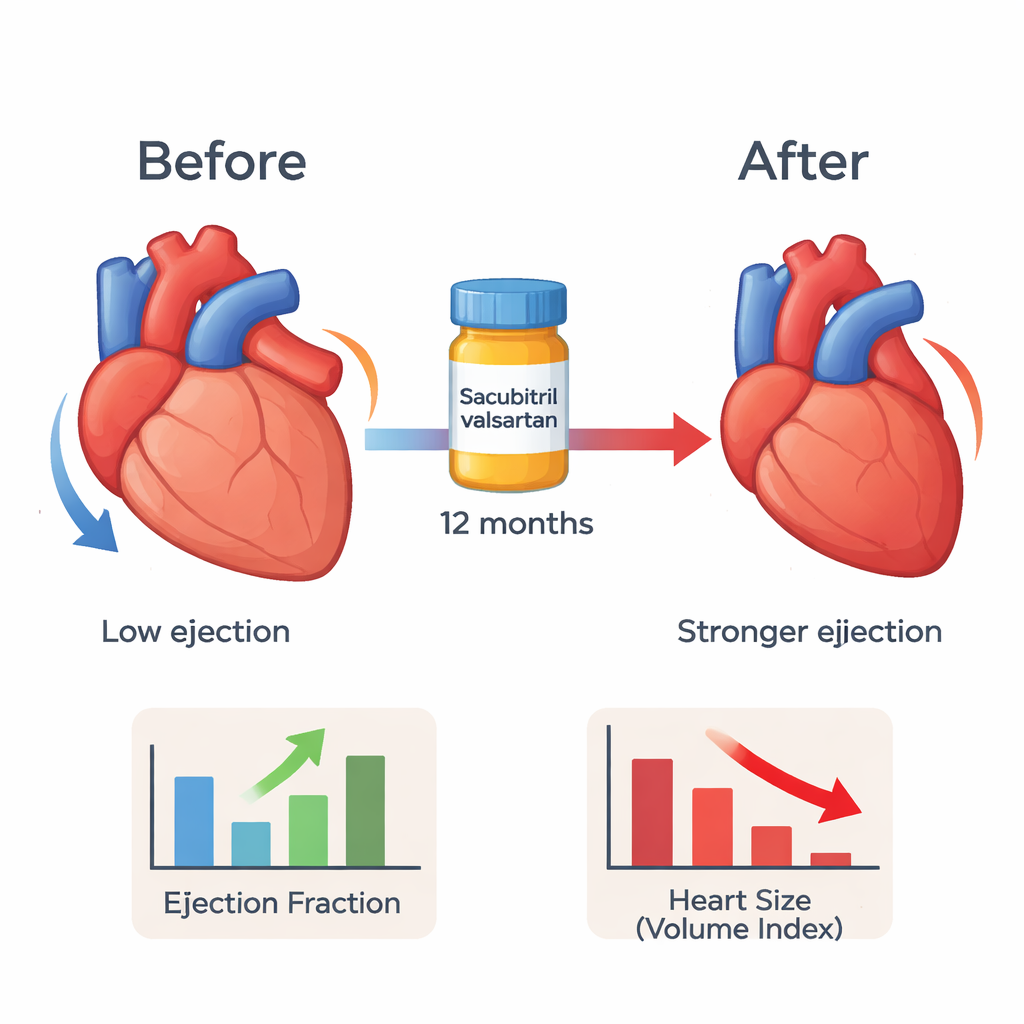
In heart failure, the left side of the heart often becomes enlarged and its squeeze weakens, much like an overstretched rubber band. The researchers defined “reverse cardiac remodeling” as a combination of two improvements: the heart’s pumping percentage (ejection fraction) had to rise by at least 10 absolute percentage points, and the size of the filled heart chamber had to shrink by at least 10%. In other words, the heart not only had to beat more strongly but also become less bloated. Using this definition, about one in three patients (36.4%) showed clear structural recovery of the heart after roughly 12 months on sacubitril/valsartan.
Timing and dose: starting early and going higher
The team then looked for patterns that distinguished patients whose hearts improved from those whose hearts did not. Two features stood out. First, people who had been living with heart failure for less than a year when they began sacubitril/valsartan were almost twice as likely to experience reverse remodeling as those whose disease had lasted longer. Second, patients who took an average daily dose of at least 200 mg over the first six months had a higher chance of improvement than those on lower doses. On detailed statistical analysis that accounted for other factors, a shorter duration of heart failure, higher doses of the drug, and a lower starting pumping percentage were all independently linked to better remodeling.
What changed inside the heart over a year
Across all 294 patients, the typical ejection fraction rose from about 27% to 35%, and the average size of the main pumping chamber shrank noticeably. But the contrast between groups was striking. In those with reverse remodeling, the pumping percentage often jumped by nearly 20 points, and the enlarged chamber volume fell by roughly a third. In patients without remodeling, gains in pumping strength and reductions in size were modest. Additional checks using stricter definitions of improvement gave similar results, suggesting the findings were robust and not just an artifact of how recovery was defined.
What this means for patients and clinicians
For people with weak hearts, these results support a straightforward message: do not wait to start modern heart failure treatment, and work with your care team to reach the highest sacubitril/valsartan dose you can safely tolerate. The study cannot prove cause and effect, and it was limited to Korean patients treated in retrospect, but it suggests that early and assertive use of this medicine gives damaged hearts the best chance to shrink back toward normal size and regain strength. In plain terms, the sooner and more fully this therapy is used after diagnosis, the more likely it is that a failing heart can partially heal itself.
Citation: Yoon, M., Lee, S.Y., Park, J.J. et al. Predictors of reverse cardiac remodeling after sacubitril/valsartan in heart failure with reduced ejection fraction. Sci Rep 16, 6731 (2026). https://doi.org/10.1038/s41598-026-36361-0
Keywords: heart failure, sacubitril valsartan, cardiac remodeling, ejection fraction, echocardiography