Clear Sky Science · en
Dynamic response of bi-directional gradient sandwich circular plates under multiple explosive loading
Why protecting thin structures from blasts matters
From armored vehicles and warships to high-speed trains and spacecraft, many critical machines rely on thin metal skins to keep people safe. These skins are often built as “sandwich” plates, with strong face sheets on the outside and a lightweight core in between. While designers usually focus on surviving a single powerful blast, real-world threats rarely happen just once. This study explores how a new, nature-inspired sandwich design can better withstand repeated explosions without adding extra weight.
A flower’s leaf as a blueprint for protection
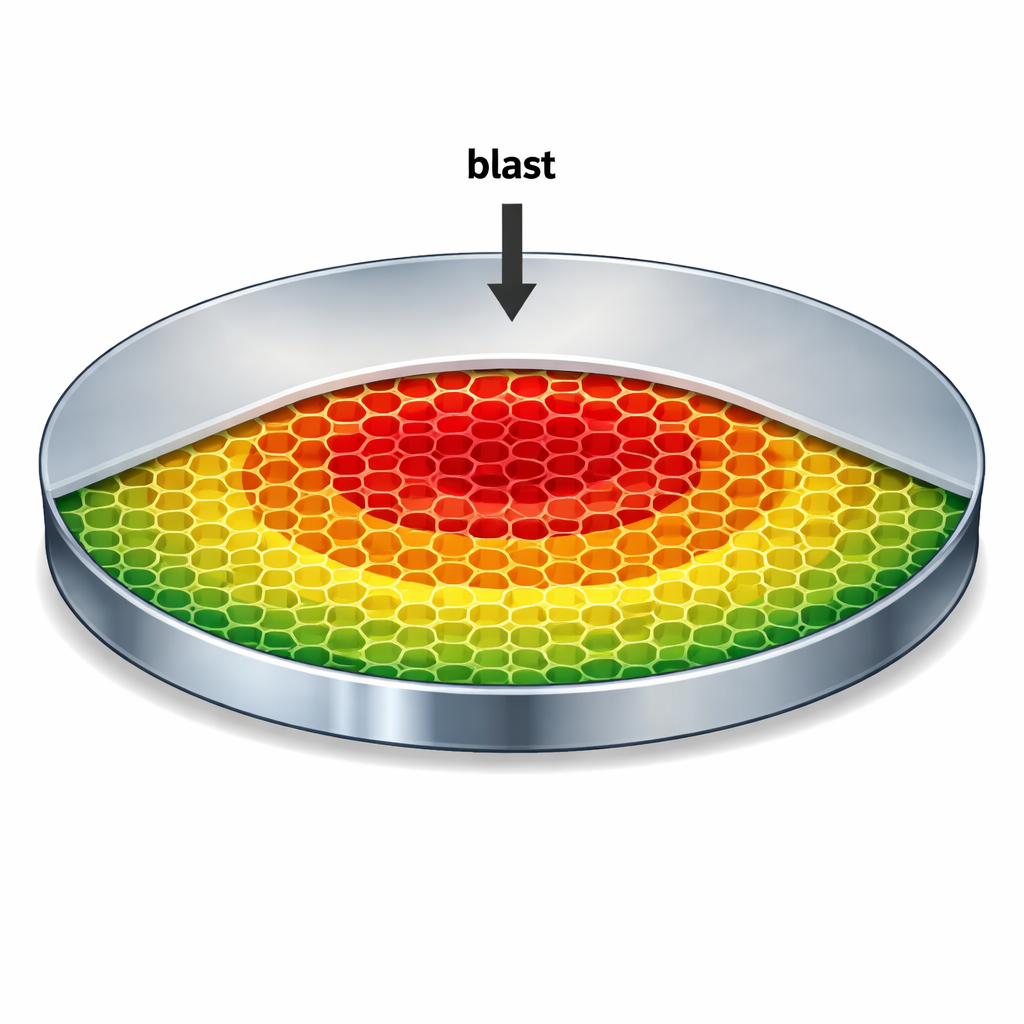
The researchers took inspiration from the Royal Water Lily, whose giant leaves can support heavy loads thanks to a smart network of veins. They translated this natural pattern into a circular metal sandwich plate: two thin aluminum face sheets separated by a honeycomb-like core. Crucially, the core is not uniform. Its cell walls gradually thicken or thin in two directions—across the plate and through its thickness—creating what the authors call a bi-directional gradient. Four different gradient layouts were designed by varying how thick the honeycomb walls are near the center versus the edge, and near the front (blast-facing) surface versus the back.
Simulating repeated explosions in the computer
Instead of physical blast tests, the team used advanced numerical simulations with the ABAQUS/Explicit finite element code. They modeled a clamped circular plate 200 millimeters away from small spherical TNT charges of 15, 25, and 35 grams. A standard blast-wave formula converted each TNT mass and distance into a time-varying pressure on the front face sheet, mimicking real shock waves. Each virtual plate was subjected to up to six separate explosions. After every blast, the remaining deformation and internal damage became the starting point for the next, allowing the researchers to track cumulative damage and how the plate gradually stiffens as the core compacts.
How the plate bends and absorbs energy
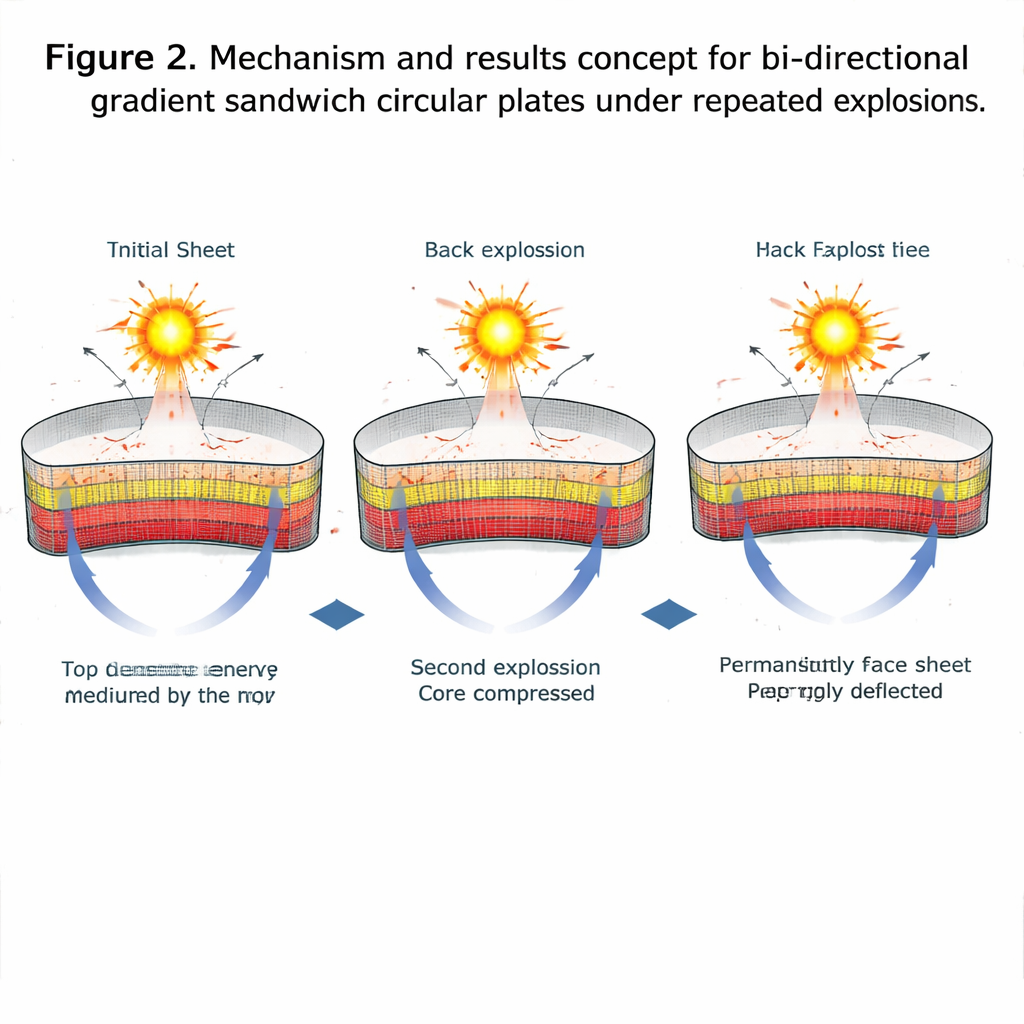
The simulations confirmed a three-stage response: first, the front face sheet is hit and rapidly accelerated; second, the core is squeezed between the moving front sheet and the still back sheet; third, the whole plate moves together and slowly comes to rest as the metal bends and stretches permanently. With each new explosion, the deflection of the back face sheet grows, but the amount of extra bending added by each blast gets smaller. This is because the honeycomb core progressively crushes and densifies, turning into a stiffer layer that absorbs more of the incoming energy before it can reach the back. Plates whose core density increased toward the edge and from the blast side toward the back generally showed smaller back-side deflections, meaning better blast resistance under repeated loads.
Design trade-offs in gradients and face-sheet thickness
The bi-directional core gradient turned out to be a powerful design lever. Without changing the overall mass, simply rearranging where thicker or thinner core material was placed noticeably altered both peak deflection and total energy absorption. Some layouts minimized back-face bending, while others maximized how much blast energy the structure could soak up, especially after several explosions. The authors also tested redistributing thickness between the front and back face sheets while keeping the total metal mass the same. A particularly promising case reduced the front face-sheet thickness and thickened the back. This adjustment boosted total energy absorption by nearly 30% after six blasts, yet left the final back-face deflection almost unchanged, offering better protection without extra weight.
What this means for safer vehicles and structures
In plain terms, this work shows that how you “stack the metal” inside a sandwich plate matters as much as how much metal you use. By grading the honeycomb core in two directions and smartly tuning the thickness of the front and back skins, engineers can build panels that handle many explosions, not just one. The right combination can keep the protected side from bending too far while forcing the core to act as a sacrificial energy sponge. These insights offer practical guidance for designing lighter, tougher blast-resistant skins for military vehicles, protective buildings, ships, and spacecraft exposed to repeated shocks and impacts.
Citation: Wang, H., Liu, Y., Lei, J. et al. Dynamic response of bi-directional gradient sandwich circular plates under multiple explosive loading. Sci Rep 16, 6056 (2026). https://doi.org/10.1038/s41598-026-36360-1
Keywords: blast-resistant sandwich panels, gradient honeycomb core, repeated explosion loading, energy absorption structures, bio-inspired structural design