Clear Sky Science · en
Experimental and numerical evaluation of the mechanical behavior of alkali-activated slag concrete with recycled waste glass and dealuminated metakaolin powders
Greener Concrete for a Growing World
Modern cities are built on concrete, but traditional cement-based concrete comes with a heavy carbon footprint and consumes vast amounts of raw materials. This study explores a new kind of “green” concrete that replaces much of the usual cement and aggregates with industrial by-products and waste, including slag from steelmaking and finely ground waste glass. By showing that such mixes can match or even outperform conventional concrete, the research points toward sturdier bridges and buildings that are also kinder to the planet.
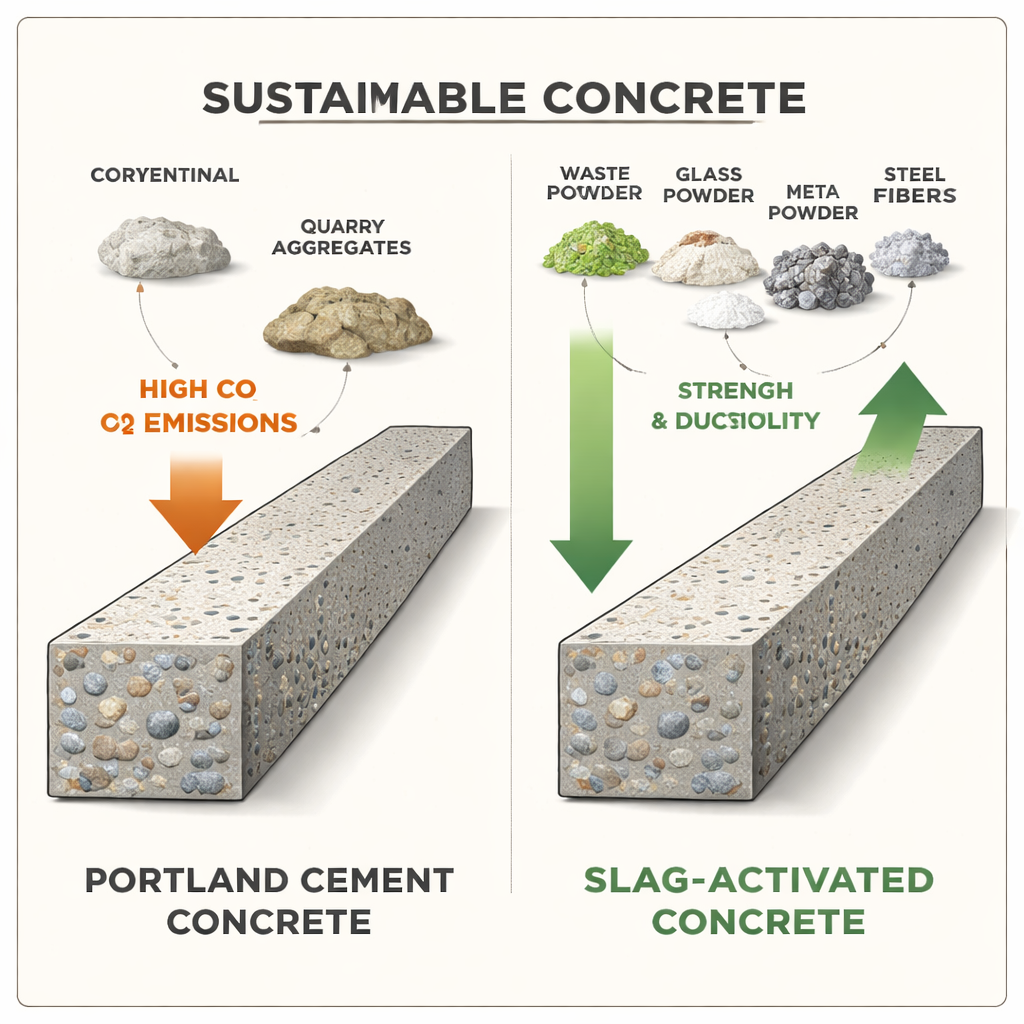
Turning Industrial Waste into Building Blocks
The concrete examined in this work is based on alkali-activated slag, a binder made by chemically activating ground granulated blast furnace slag instead of using Portland cement. The researchers partially replaced natural sand and slag with two industrial by-products: recycled waste glass powder and dealuminated metakaolin, a silica- and alumina-rich residue from aluminum extraction. They also tested two types of coarse stone—dolomite and basalt—and added short steel fibers to some mixes. In total, they created several carefully controlled recipes to see how each ingredient affected strength, stiffness, cracking, and overall behavior under load.
From Laboratory Molds to Measured Strength
To evaluate performance, the team cast and cured concrete cubes, cylinders, and beams at normal room temperature, avoiding energy-intensive heat curing. They measured compressive strength (how much squeezing the concrete can take), splitting tensile strength (how it behaves when pulled apart indirectly), bending strength, and stiffness. Across the board, mixes made with harder basalt aggregate outperformed those with dolomite. When waste glass powder or dealuminated metakaolin was added, the concrete became denser and stronger. The clear standout was a mix that combined basalt, 10% dealuminated metakaolin (replacing part of the slag), and 1% steel fibers: it showed the highest compressive, tensile, and flexural strengths, along with the greatest stiffness.
Looking Inside the Concrete’s Inner Skeleton
To find out why some mixes worked better, the researchers examined tiny slices of concrete under scanning electron microscopes and used chemical probes to map the distribution of key elements. Poorer mixes showed a porous, patchy internal structure with weak contact zones between stone and paste. In contrast, the best-performing mixes had a tightly packed, uniform network of reaction products binding everything together, especially around the basalt aggregates and the steel fibers. Dealuminated metakaolin helped form a dense, interlocking gel that filled micro-voids, while steel fibers bridged developing cracks, preventing them from opening suddenly. This refined microstructure explains the jump in strength, toughness, and resistance to cracking.
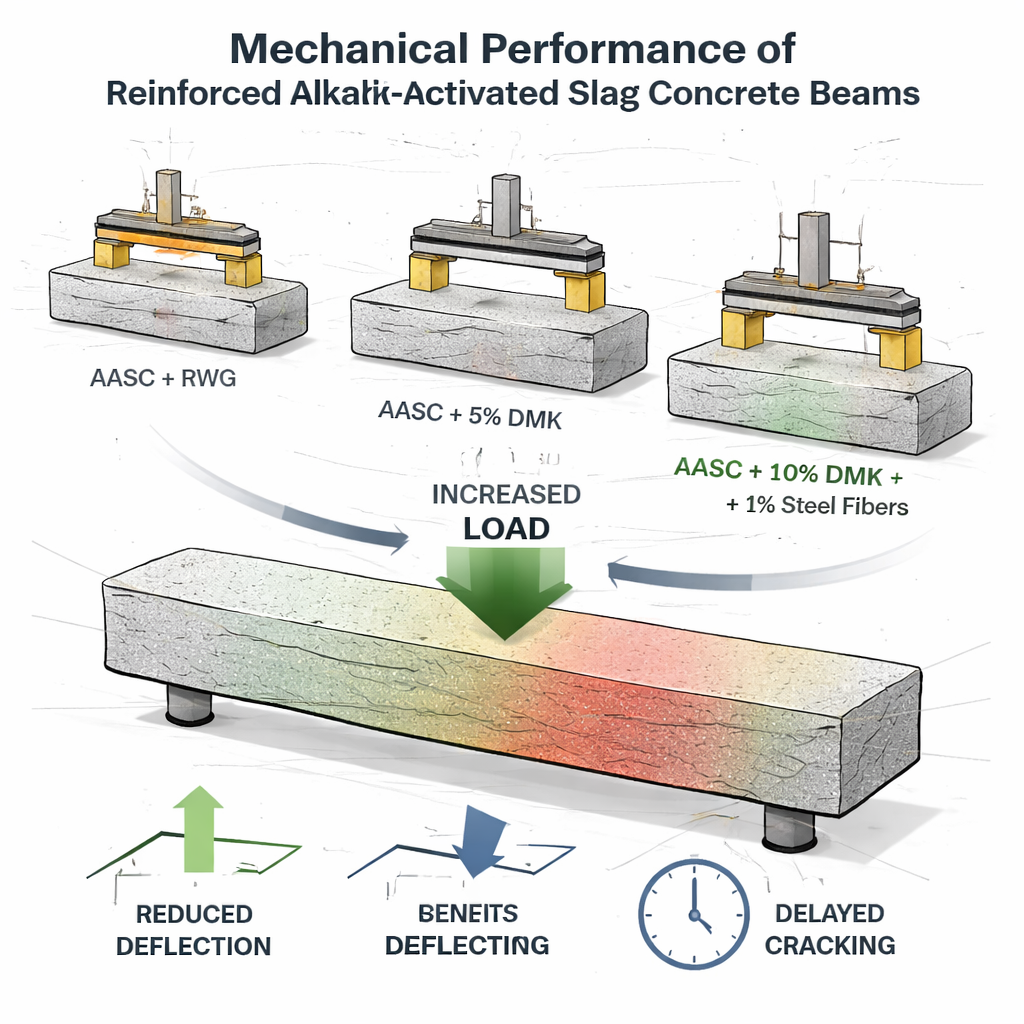
Simulating Beams Before They Are Built
Beyond small specimens, the study used advanced finite element simulations to predict how full-size reinforced concrete beams made from the different mixes would behave under bending. The researchers calibrated a damage model in the ABAQUS software so that its stress–strain curves matched those measured in the lab. Once tuned, the model accurately reproduced failure loads and crack patterns for cubes, cylinders, and prisms. They then carried out a virtual parametric study of reinforced beams. Beams made with basalt and the optimized waste-based mixes carried much higher loads, deflected less at peak load, and showed more gradual, ductile cracking. The mix containing 10% dealuminated metakaolin and 1% steel fibers increased load-carrying capacity by about 46% and cut mid-span deflection by roughly one fifth compared with a baseline mix, all without changing the steel reinforcement.
What This Means for Future Structures
For non-specialists, the takeaway is clear: it is possible to design concrete that is both stronger and more sustainable by turning industrial leftovers—slag, waste glass, and dealuminated clays—into high-performance ingredients, especially when combined with steel fibers and robust aggregates. The study shows that such green concretes can be reliably tested, understood at the microscopic level, and confidently modeled on the computer, giving engineers practical tools to design safer and more efficient beams and other elements. In the long run, this approach could help reduce the environmental burden of construction while still delivering durable roads, bridges, and buildings.
Citation: Nader, M.A., El-Hariri, M.O.R., Kamar, A. et al. Experimental and numerical evaluation of the mechanical behavior of alkali-activated slag concrete with recycled waste glass and dealuminated metakaolin powders. Sci Rep 16, 6343 (2026). https://doi.org/10.1038/s41598-026-36359-8
Keywords: sustainable concrete, waste glass, geopolymer, steel fiber reinforcement, numerical modeling