Clear Sky Science · en
Spatiotemporal dynamic and driving factors of ecological resilience during urbanization in the yellow river basin
Why Cities Along the Yellow River Matter
China’s Yellow River Basin is both a cradle of civilization and a modern engine of growth. Home to major coal and grain bases as well as fast‑growing cities, it must now juggle rapid urban expansion with fragile landscapes and scarce water. This study asks a simple but urgent question: as buildings, roads, and factories spread, is nature in these cities still able to cope, recover, and keep supporting people’s lives?
Taking the Pulse of a Vast River Region
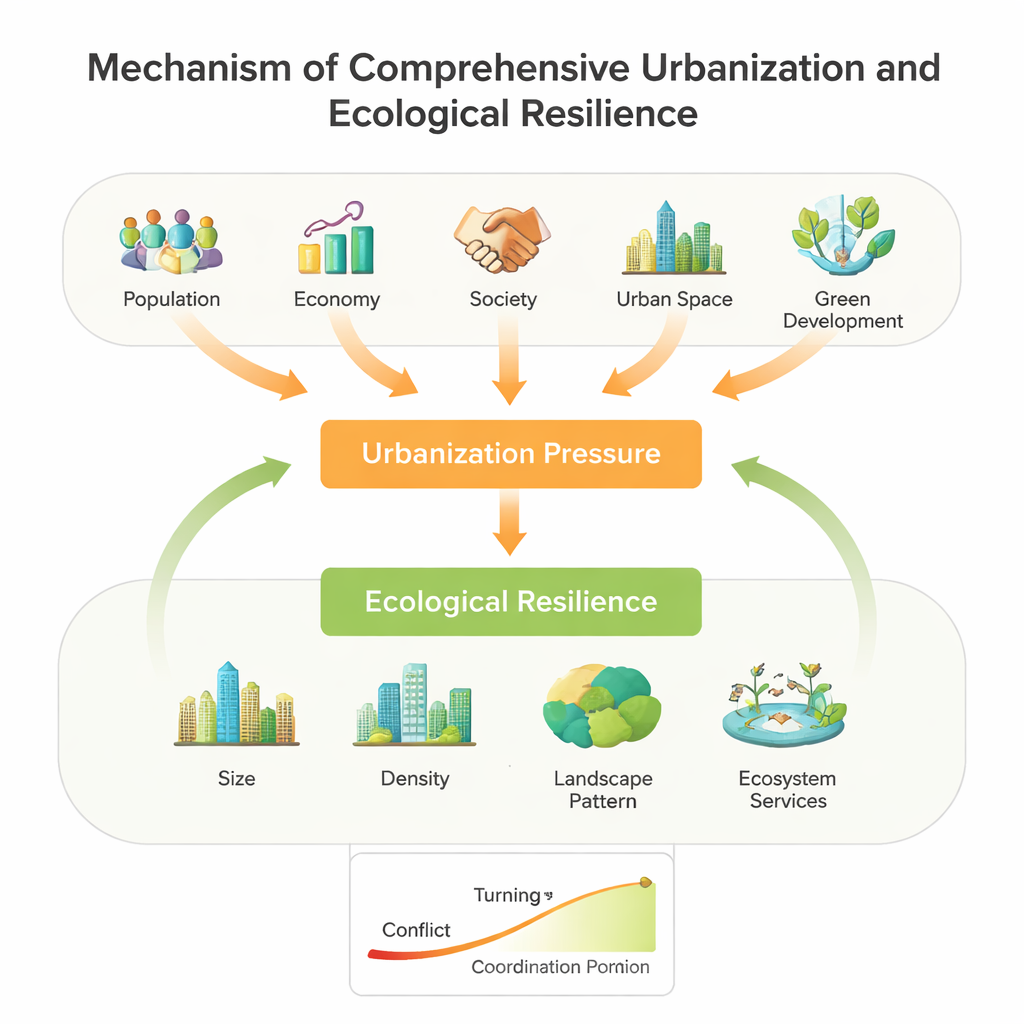
The researchers focus on 84 cities spread across the Yellow River Basin, from sparsely populated highlands in the west to dense industrial hubs downstream. Instead of treating the environment as a static backdrop, they view it through the lens of “ecological resilience” – the ability of local ecosystems to absorb shocks such as pollution, land conversion, and climate extremes, and still function. To do this, they build a four‑part framework. “Size resilience” tracks how much room remains for cities to grow without breaking ecological red lines or eating into protected farmland. “Density resilience” compares what people consume with what the land can sustainably provide. “Morphological resilience” looks at how well green and blue spaces stay connected instead of being chopped into isolated patches. “Functional resilience” measures whether forests, grasslands, wetlands and other ecosystems still deliver key services such as clean water, climate regulation and habitat.
Urban Growth Up, Nature’s Buffering Power Down
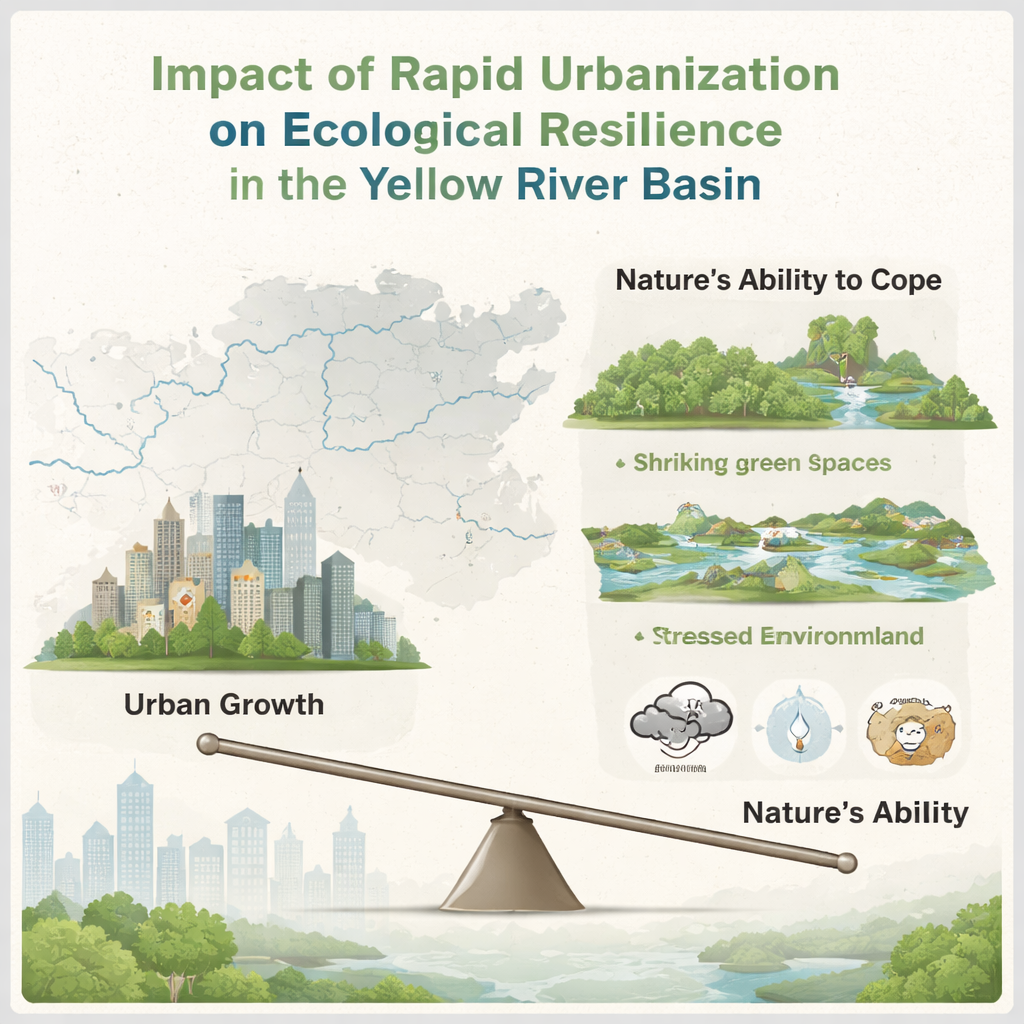
From 2010 to 2022, almost every city in the basin became more urbanized: the combined index of population, economic output, public services, built‑up area and “green” infrastructure rose steadily. Yet over the same period, ecological resilience generally declined at about 1.7% per year. The drop was sharpest in the early years, then slowed after around 2016 as China rolled out policies on “new‑type urbanization,” strict land‑use control and carbon reduction. Spatial patterns were striking. Cities in the upper reaches and northern grassland regions, with fewer people and less industrial density, kept relatively strong resilience. In contrast, booming downstream provinces such as Henan and Shandong – economic powerhouses of the basin – showed much weaker resilience. In these places, decades of sprawling construction and heavy industry have left ecosystems overstretched, with little spare capacity to absorb further pressure.
Uneven Progress and Sticky Development Paths
To capture how city development and ecosystem health move together, the authors classify each city into four types: high urbanization with high resilience, high urbanization with low resilience, low urbanization with high resilience, and low urbanization with low resilience. Over time, the number of cities with both strong economies and strong ecosystems increased slightly, suggesting that “win–win” outcomes are possible. But the dominant pattern by 2022 was high urbanization paired with low resilience: over 60% of cities had surged ahead in growth while their natural systems lagged or deteriorated. Using Markov chain models, the study shows that cities rarely “jump” between these categories. Once a city settles into a path of growth that erodes its ecological buffer, it tends to stay there. Neighboring cities also matter: those surrounded by places with weak resilience or lopsided development are more likely to follow similar trajectories, revealing clear spillover effects along the river’s corridor of towns and industrial belts.
What Drives Strain – and Where to Act
The team then asks what factors most strongly shape resilience. They find that population density and economic density – in essence, how many people and how much economic activity are packed into a given area – are the main external drivers of stress. As crowds and factories concentrate, ecological footprints grow faster than the land’s ability to regenerate. Fine particle pollution (PM2.5) emerges as a third, increasingly important influence: tighter air‑quality controls not only clean the air but also ease pressure on ecosystems. Inside the ecological system, key drivers differ by scale. At the basin and provincial levels, the balance between human demand and nature’s carrying capacity (density resilience) is most decisive. At the city level, the crucial issue is how far built‑up areas have pushed toward or beyond ecological red lines (size resilience). This means that national and provincial governments must shape overall consumption, industry mix and land quotas, while city leaders must carefully manage where and how their cities expand.
Finding a Smarter Growth Path
For non‑specialists, the message is clear: in the Yellow River Basin, more and bigger cities have not automatically translated into stronger, more resilient environments. Instead, urban growth has often outpaced nature’s ability to bounce back, especially in the densely populated middle and lower reaches. The study argues that it is still possible to shift course, but only by treating ecological resilience as a hard limit rather than an afterthought. That means channeling people and industries into more suitable locations, capping sprawl within ecological red lines, cleaning up air and water, and investing in the green and blue networks that quietly keep cities livable. Done well, such measures can turn the basin from a story of “development first, repair later” into one where thriving cities and a healthy river system reinforce each other over the long term.
Citation: Zhang, K., Zhang, Z., Qiao, X. et al. Spatiotemporal dynamic and driving factors of ecological resilience during urbanization in the yellow river basin. Sci Rep 16, 5774 (2026). https://doi.org/10.1038/s41598-026-36358-9
Keywords: urban ecological resilience, Yellow River Basin cities, urbanization and environment, sustainable land use, eco-friendly urban planning