Clear Sky Science · en
Influence of a concrete lattice–vegetation composite revetment on levee slope stability based on an improved SWCC model
Why safer levees matter for everyday life
Many towns and cities depend on earthen levees to keep rivers and lakes from flooding neighborhoods, farms, and factories. As climate change brings stronger storms and heavier downpours, engineers are searching for ways to make these man‑made embankments tougher without turning every riverbank into bare concrete. This study explores a promising solution that blends concrete frames with living grass, showing how plant roots and simple structural supports can work together to keep levee slopes from collapsing in extreme rain.
Blending concrete strength with living green cover
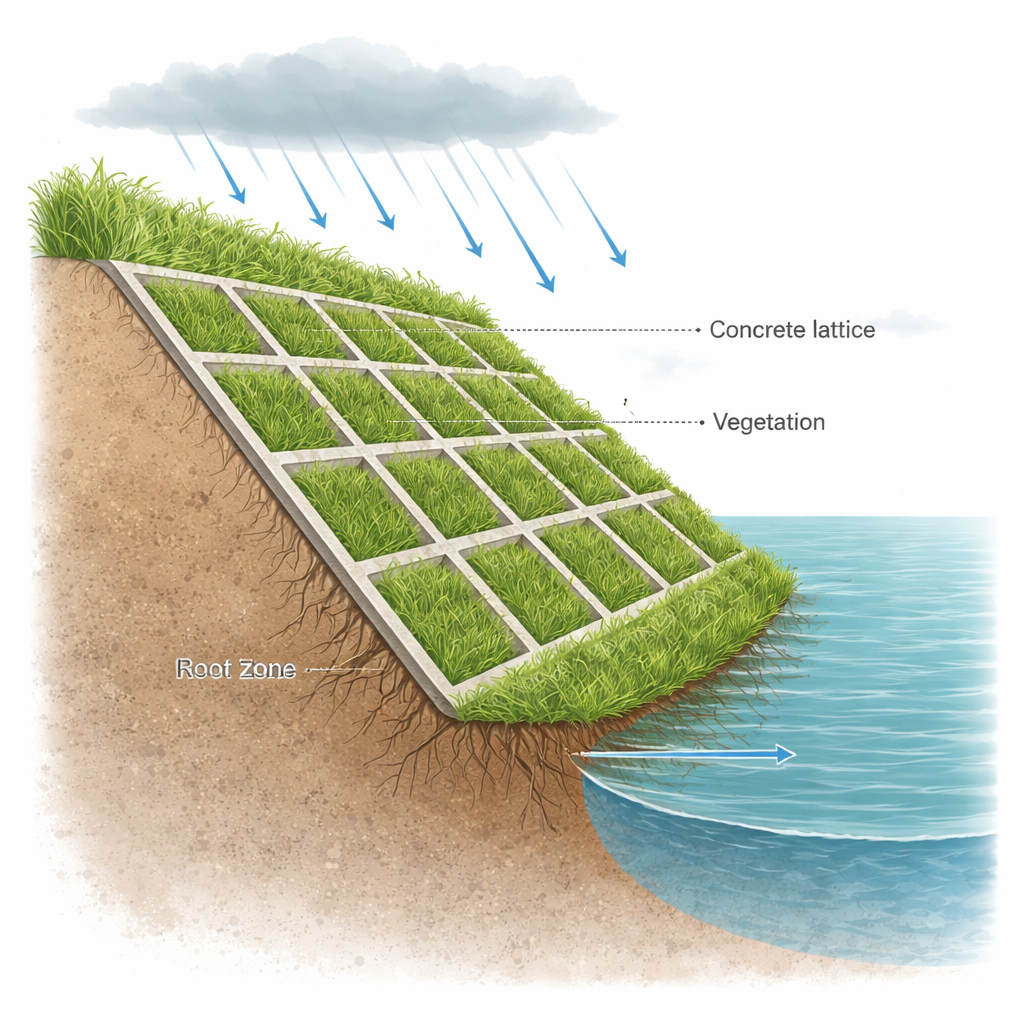
The levee protection system examined here combines a grid of narrow concrete beams, called a concrete lattice, with vegetation planted in the open cells between the beams. The concrete grid divides the slope into many small blocks, giving immediate physical support and resisting erosion from waves and runoff. The grass, once established, weaves its roots through the soil in each block, gradually adding natural reinforcement. This approach aims to join the ecological benefits of green slopes—cooler surfaces, better habitat, and a more pleasant landscape—with the reliability of traditional concrete protection.
How roots quietly reshape the soil
Although grass may look delicate above ground, its roots profoundly change the soil below. The authors developed a new way to describe how soil holds water when roots are present, by updating a widely used curve that links how wet the soil is to how strongly it sucks water in. Their key idea is that roots occupy space in the soil’s pores, leaving less room for air and water to move freely. By carefully accounting for average root thickness and how much root length is packed into each unit of soil, they created a mathematical model that predicts how vegetated soil holds onto water compared with bare soil. Laboratory tests with soil from China’s Hongze Lake levee and Bermuda grass showed that the model closely matched measured data, with errors in predicted soil wetness staying under five percent.
Testing levee safety in virtual storms
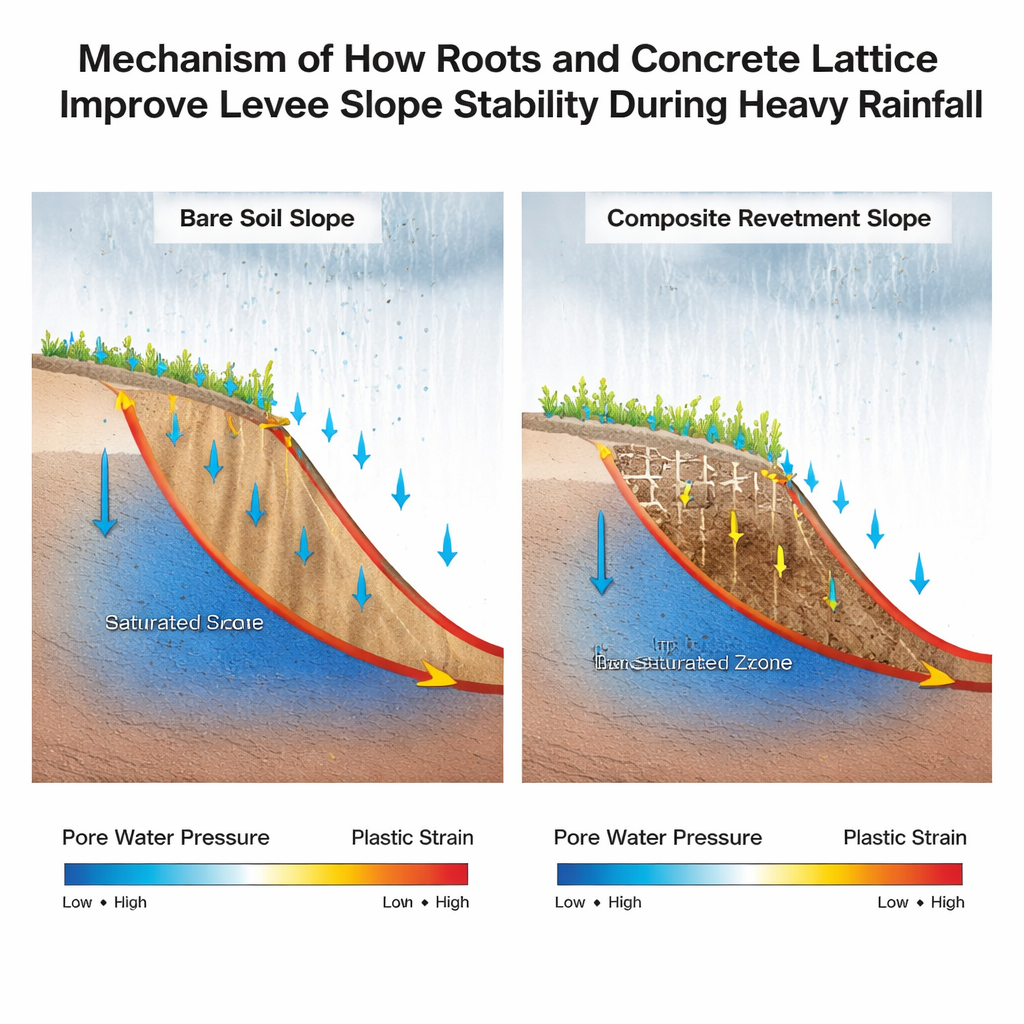
Armed with this improved description of root‑affected soil, the researchers built a detailed computer model of a real levee cross‑section from the Hongze Lake flood‑storage area. They simulated a severe six‑hour rainstorm and compared four cases: bare soil, soil with only concrete lattice, soil with only grass, and soil with the combined concrete lattice–vegetation system. They tracked how far the slope moved, how water seeped into the embankment, how large the zones of permanent deformation became, and an overall “safety factor” that indicates how close the levee is to failure. The bare slope moved the most and had the lowest safety factor. Concrete alone and grass alone each improved stability, but the combined system produced by far the smallest movements and the highest safety factor, greater than the simple sum of its parts.
Finding the sweet spot for roots and lattice size
The team then explored which design details matter most. They found that making roots thicker had only a modest effect for typical grasses, but increasing how densely roots fill the soil pores significantly boosted slope safety up to a threshold. Beyond that point, adding still more roots did little, because the soil’s ability to slow water infiltration had already nearly maxed out. The spacing of the concrete lattice, however, made a large difference: small grid sizes tightened the slope and raised the safety factor, while very large grids weakened the confining effect and cut the safety gains. These results suggest that engineers should focus on achieving a healthy, dense root network and choosing lattice spacing that balances safety with construction cost.
What this means for flood protection
For non‑specialists, the message is straightforward: combining modest amounts of concrete with well‑chosen vegetation can make earthen levees safer during heavy rains than using either approach alone. Roots help the soil hold water without becoming overly saturated and slippery, while the concrete lattice braces the surface and reduces deep sliding. By showing exactly how root properties and lattice spacing influence safety, this research offers practical guidance for designing greener, more resilient flood defenses that protect communities while keeping riverbanks alive and functional.
Citation: Liu, S., Gu, H., Shen, F. et al. Influence of a concrete lattice–vegetation composite revetment on levee slope stability based on an improved SWCC model. Sci Rep 16, 5245 (2026). https://doi.org/10.1038/s41598-026-36357-w
Keywords: levee stability, vegetation roots, concrete lattice, ecological slope protection, heavy rainfall