Clear Sky Science · en
Group learning in recommendation systems: towards adaptive and implicit group modeling
Why smarter groups matter online
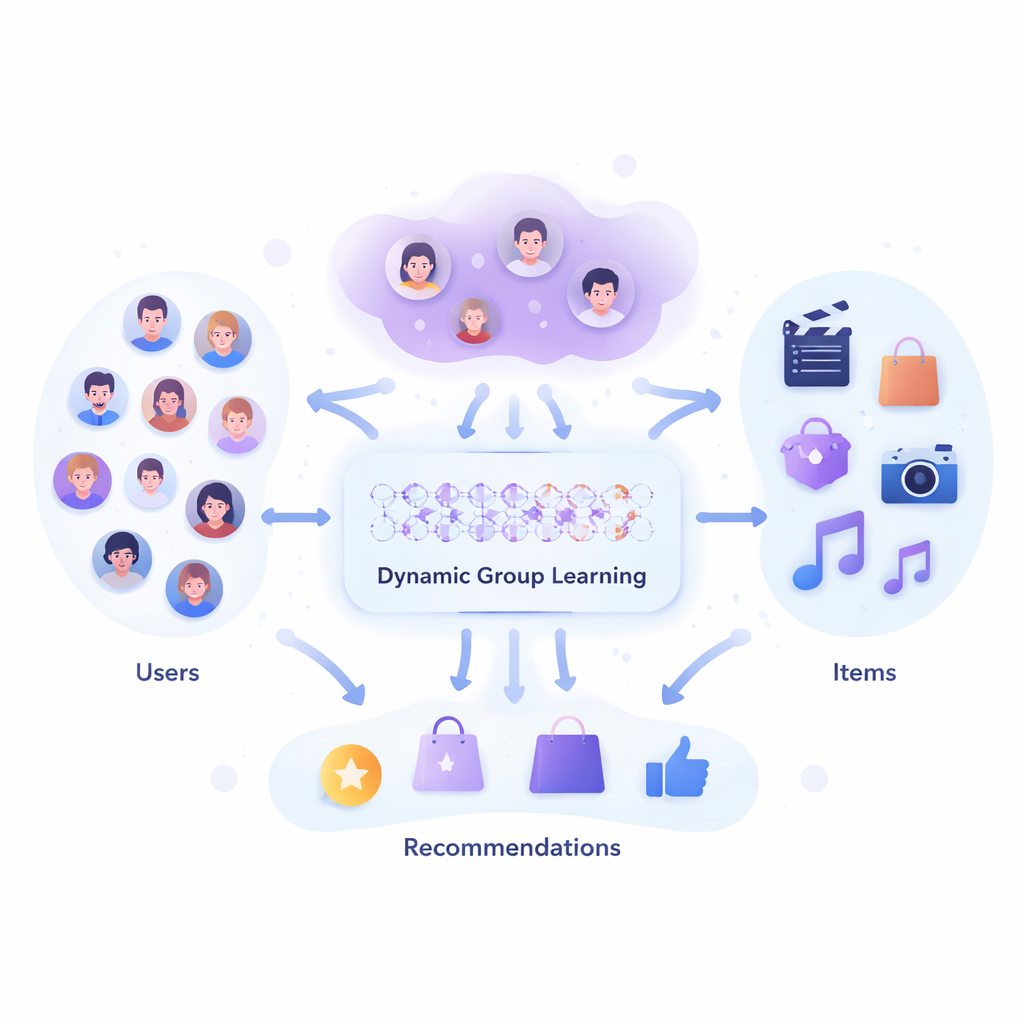
From movie nights with friends to family holidays, many of our choices are made in groups. Yet most online platforms still think in terms of individuals. This paper asks a simple question with big implications: what if our streaming sites, shopping apps, and travel portals could quietly discover and adapt to natural groups of people and items on their own, instead of relying on fixed, hand-made group lists? The authors present a new way for recommendation systems to learn such groups automatically, in service of making suggestions that feel fair and satisfying to everyone involved.
From fixed teams to flexible crowds
Today’s group recommendation tools usually start with a rigid idea of who belongs together: a predefined friend circle, a classroom, or clusters built once using a statistical tool. The system then tries to find a “good enough” item for that frozen group. But real life is messier. The set of people choosing a movie tonight may be different from the set picking a vacation next month, and the items themselves can be naturally grouped into bundles, like playlists or travel packages. The paper argues that instead of treating group formation as a separate, one-off step, it should be woven into the core of how the recommender learns from data.
A hidden map of people and things
The authors introduce a model they call the Deep Dynamic Group Learning Model, or DDGLM. At its heart, the system builds a hidden map where both people and items are represented as points in a mathematical space. Rather than assigning each person or product to a single fixed group, the model first lets them belong to several overlapping “soft” groups with different degrees of membership. A temperature control sharpens these memberships as learning progresses, so that by the time the system is used in practice, each person or item is effectively placed into the one group that fits best for the task. These learned groups are not based on visible traits like age or genre alone, but on how well they help the system predict what ratings or choices users will actually make.
Bringing individuals and groups into harmony
DDGLM goes a step further by insisting that the picture of a person as an individual and the picture of that person as part of a group must agree. It adds an extra term to its learning process that gently pulls individual and group representations closer together. This prevents group profiles from drifting into unrealistic patterns that no member really matches, while still allowing the model to capture shared tastes. Using these representations, the system can handle four common situations in a unified way: recommending a single item to one person, an item to a group, a bundle of items to one person, or a bundle to a group. In each case, recommendations boil down to simple comparisons between the relevant people and item groups inside the hidden map.
Do adaptive groups really help?
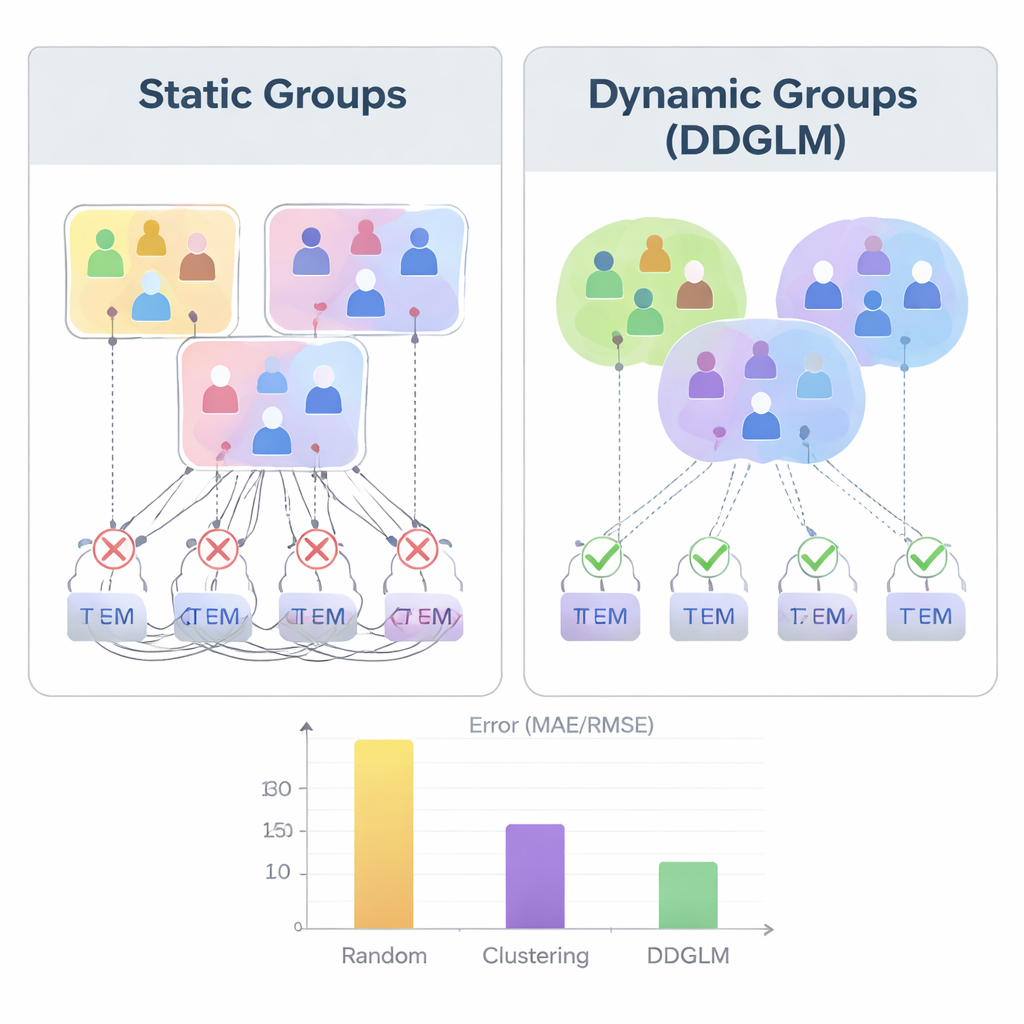
To test whether this idea works, the authors ran extensive experiments on well-known movie-rating collections called MovieLens-100K and MovieLens-1M. They compared DDGLM to methods that form groups randomly, via traditional clustering, or through earlier unified recommendation frameworks. Across all four scenarios—individual, group, package, and package-to-group recommendations—the dynamic model produced more accurate rating predictions and better top-ranked suggestions. It was especially strong when groups or bundles were involved, where static approaches struggled. Careful statistical tests confirmed that these gains were not just due to chance, and timing experiments showed that the method scales well as the number of users, items, and groups grows.
What this means for everyday users
For non-specialists, the takeaway is straightforward: recommendation systems do better when they are allowed to discover useful groupings on the fly, instead of being tied to rigid group definitions chosen in advance. By learning which people and items naturally move together in the data—and constantly updating those patterns—DDGLM can generate suggestions that better reflect shared tastes, whether it is a film for a family, a playlist for a party, or a holiday package for a tour group. The study shows that treating group formation itself as something the system can learn leads to more accurate, adaptable, and potentially fairer recommendations in the digital services we use every day.
Citation: Busireddy, N.R., Kagita, V.R. & Kumar, V. Group learning in recommendation systems: towards adaptive and implicit group modeling. Sci Rep 16, 5918 (2026). https://doi.org/10.1038/s41598-026-36356-x
Keywords: group recommender systems, dynamic group learning, personalized recommendations, collaborative filtering, deep learning