Clear Sky Science · en
Distribution of device-measured 24-h movement behaviors in older adults: cross-sectional findings from the HUNT4 study
Why How We Move All Day Matters in Old Age
As people grow older, it is not just exercise sessions that shape their health, but everything they do over a full 24 hours—walking, sitting, lying down, and sleeping. This study from the large Norwegian HUNT4 health survey used body‑worn motion sensors to map how thousands of older adults actually spend their time over an entire day. The findings reveal striking patterns in everyday movement, how these change with age, and how they differ for women and men and between people with more or less education.
Tracking a Day in the Life of Thousands of Seniors
Instead of relying on memory or questionnaires, the researchers asked more than 8,000 community‑dwelling Norwegians aged 65 to 100 to wear two small motion sensors—one on the thigh and one on the lower back—for up to a week. Using advanced computer algorithms, the devices could tell whether someone was standing, walking, sitting, lying awake, or asleep. By averaging these measurements across several days, the team built a detailed picture of how much time older adults typically spend in each of these states over a 24‑hour period.
Most of the Day Is Spent Sitting or Lying Still
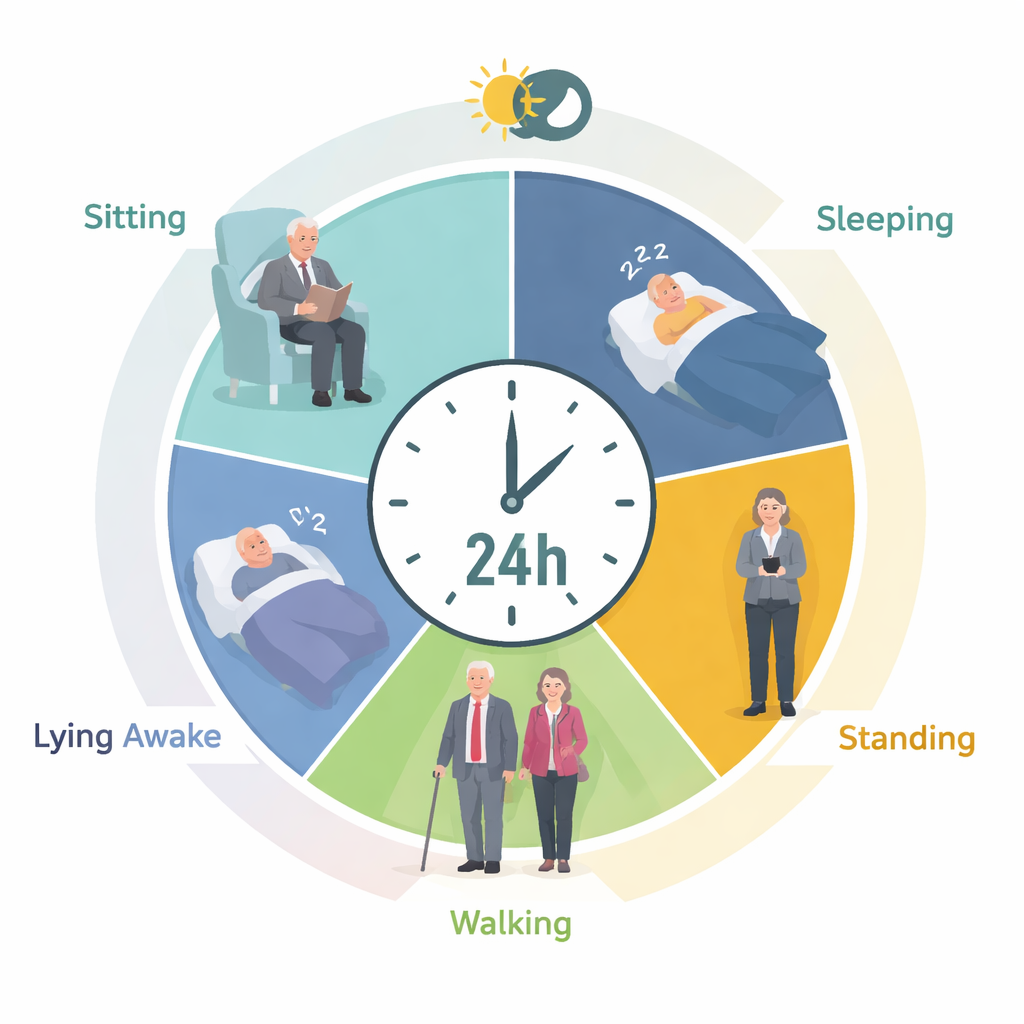
The clear message from the data is that older adults spend most of their waking hours not moving very much. On average, participants sat for about 9 hours a day and lay awake for just over 2 hours, adding up to more than 11 hours of sedentary time. They spent just over 4 hours a day standing and about 1 hour and 20 minutes walking, while running and cycling barely registered. Sleep accounted for roughly 7 hours a night, in line with current recommendations. Taken together, a typical day for these older adults was dominated by sitting and lying, punctuated by shorter periods of standing and walking.
How Age, Sex, and Education Shape Daily Movement
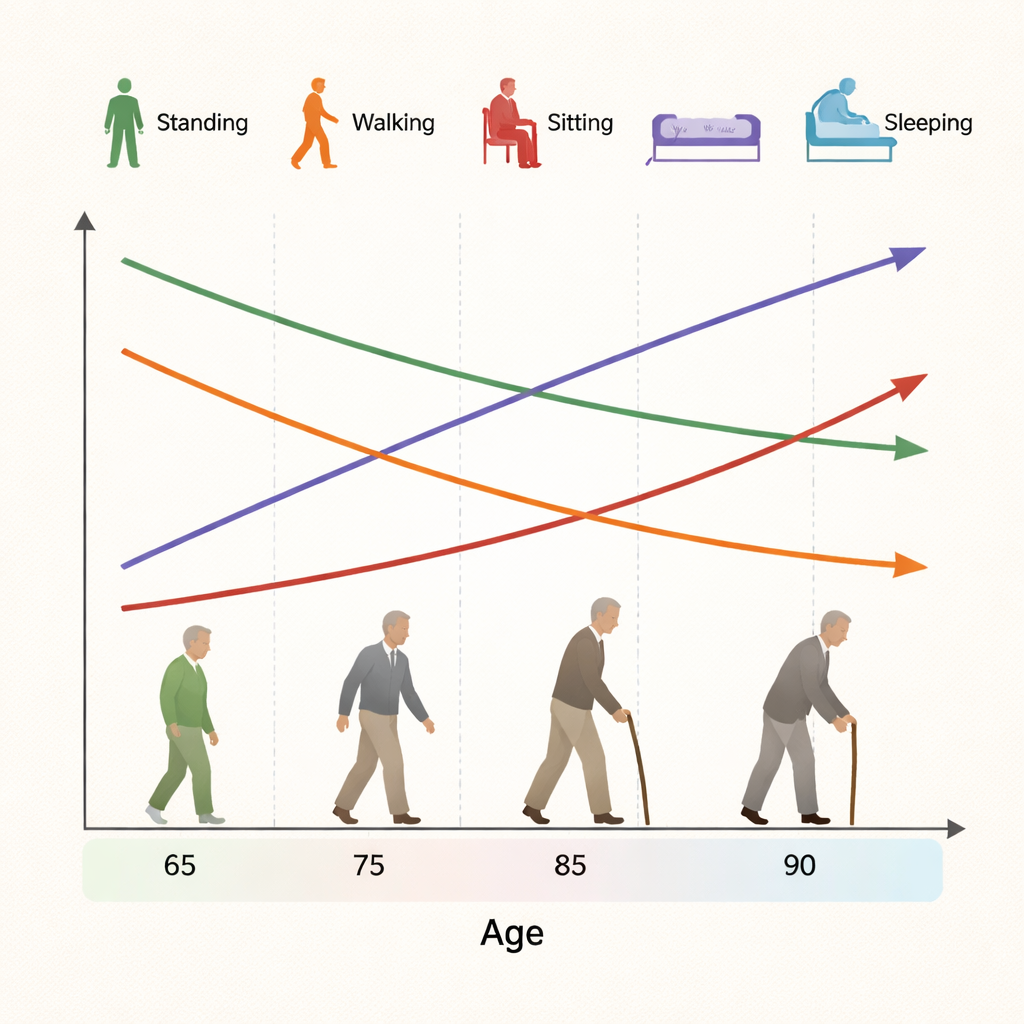
As age increased from 65 to around 90, time spent standing and walking steadily shrank, while time sitting, lying awake, and sleeping grew. Yet the starting point in the late sixties was relatively active: up to around 80 years for women and 85 years for men, average walking time remained above a level previously linked to good heart and metabolic health. Women and men showed different patterns: women spent more time standing and sleeping, but somewhat less time walking, sitting, and lying awake than men. Education mattered too. Older adults with more years of schooling tended to stand and walk more and sit less than those with primary or secondary education, suggesting that social and economic factors continue to shape activity patterns well into old age.
Sitting, Standing, and Sleep: More Than Just Comfort
Although sitting and lying both count as sedentary, the study highlights that these postures may reflect different aspects of health and daily life. Sitting may go hand in hand with socializing, reading, or hobbies, while lying awake might signal fatigue, rest, or reduced engagement. Standing has recently emerged as a distinct behavior that may help offset some harms of long sitting time, though it cannot fully replace the benefits of more vigorous movement. The researchers also distinguished sleep from quiet wakefulness more accurately than many earlier sensor studies, finding that older adults in this group generally achieved recommended sleep durations even as patterns shifted with age.
What This Means for Healthy Ageing
For non‑specialists, the study offers a concrete way to think about healthy ageing: imagine the 24‑hour day as a pie, and ask how many slices are devoted to sitting or lying compared with standing and walking. These Norwegian seniors spent most of their time off their feet, and this tendency increased with age and was more pronounced among those with less education. The authors argue that public health efforts should focus not only on formal exercise, but also on nudging older adults toward more light movement—standing up more often, taking short walks, and breaking up long periods in a chair—while paying attention to social inequalities that make active daily lives easier for some than others.
Citation: Sverdrup, K., Ustad, A., Tangen, G.G. et al. Distribution of device-measured 24-h movement behaviors in older adults: cross-sectional findings from the HUNT4 study. Sci Rep 16, 5268 (2026). https://doi.org/10.1038/s41598-026-36355-y
Keywords: older adults, physical activity, sedentary behavior, accelerometer, healthy ageing