Clear Sky Science · en
Experimental study on the compaction deformation evolution and energy dissipation characteristics of graded broken rock mass
Why crushed rock matters underground
Deep underground in coal mines, tunnels are often left partly filled with piles of broken rock. How tightly this rubble packs down and how it releases energy as it shifts can influence whether gas escapes safely or builds up into a dangerous explosion. This study explores how different mixtures of large and small rock pieces compress, how the empty spaces between them change, and how much hidden energy they release as they are squeezed—knowledge that can make mining safer and more efficient.
How the rock was squeezed and listened to
The researchers collected fine-grained sandstone from a Chinese coal mine and crushed it into particles of five size ranges, from a few millimetres up to 25 millimetres. Using a mathematical recipe called a gradation index, they created five different mixtures, ranging from ones dominated by small pieces to ones with more large chunks. Each 2.4‑kilogram sample was poured into a strong steel cylinder and compressed from above, while the sides were held rigid—similar to how broken rock in a mined-out void is squeezed by the weight of overlying rock. At the same time, sensitive acoustic sensors “listened” for tiny elastic waves produced when particles slid, rubbed, or broke, turning those signals into counts and energy values that track how the rock skeleton rearranged internally. 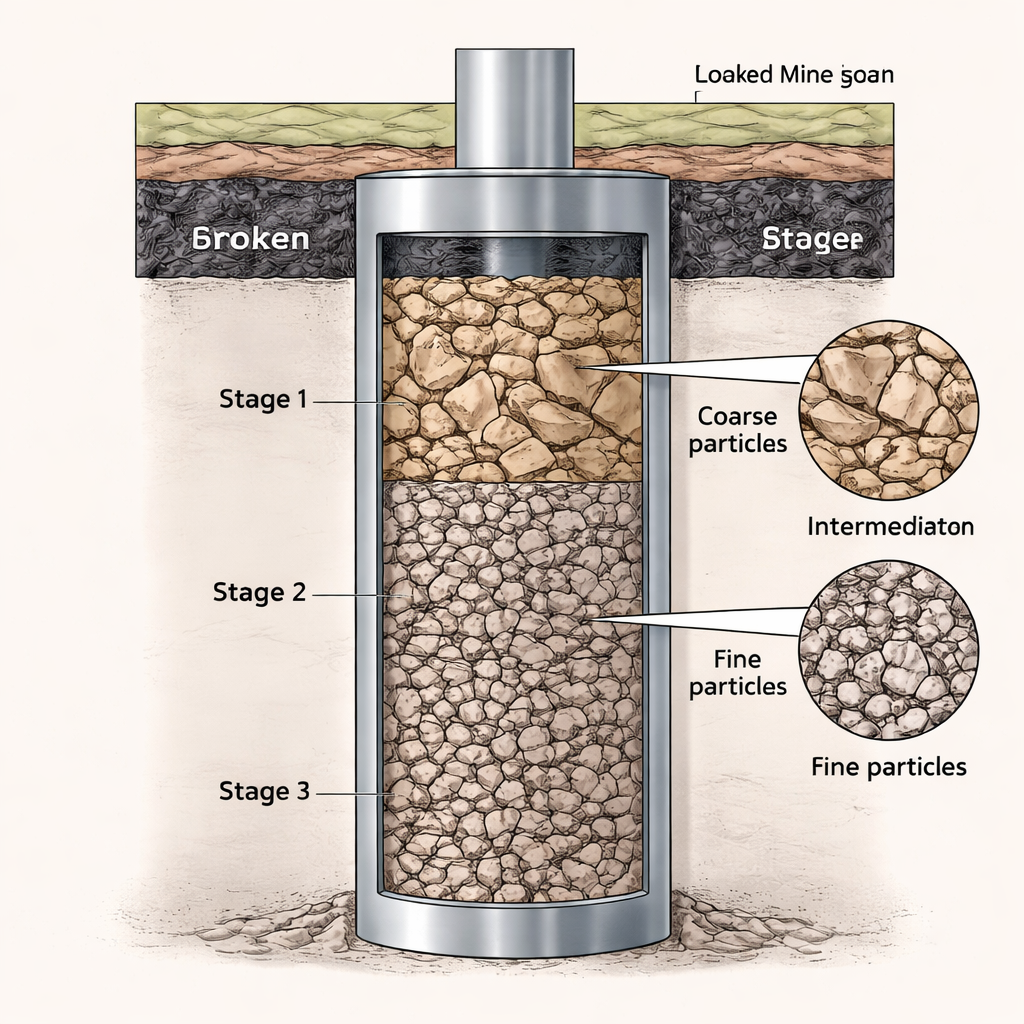
Three stages of squeezing
By tracking stress and strain, the team found that all mixtures passed through three clear stages of compaction. First came an initial stage, where loosely packed particles slid, rotated, and settled into new positions, causing rapid shortening under relatively low stress. Next was a linear stage, in which the structure became more stable and additional loading produced a nearly straight-line relation between stress and deformation; here, particle breakage and closer surface-to-surface contact between grains dominated. Finally, a plastic consolidation stage appeared, where the rock mass became stiff and resistant to further shortening: additional stress caused only small extra deformation but more intense local crushing. Mixtures rich in fine particles reached these later stages sooner and stayed longer in the final stiff phase, while coarse-rich mixtures needed higher stresses to achieve the same shortening.
How empty space and particle sizes evolve
The voids between particles shrank in a three-step pattern that mirrored the deformation stages: a rapid drop, a slower decline, and then a near-plateau as the material approached its densest state. Samples with more large particles started with more empty space and lost more void area overall, but their void ratio fell faster at low stresses. After compression, sieving showed that all mixtures had produced many new tiny fragments smaller than 2.5 millimetres, while the share of the largest particles dropped sharply. A fractal measure of particle-size complexity increased for every sample, and the final values clustered into a narrow range, meaning that compaction tended to smooth out initial differences between mixtures. Coarse-rich mixes, however, still ended with slightly simpler (less fragmented) size distributions than fine-rich ones. 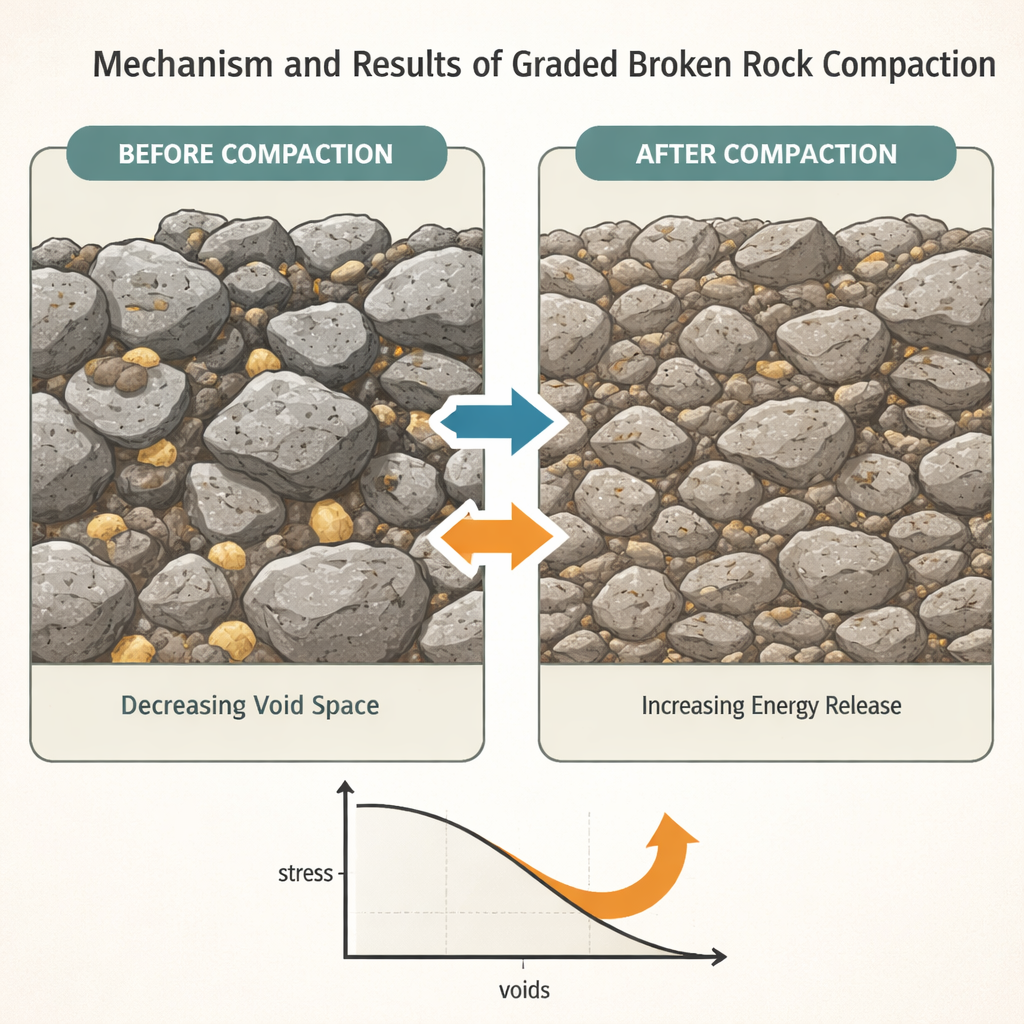
Energy whispers and bursts inside the rubble
The acoustic measurements revealed that energy release patterns also followed the three stages. In the early stage, signals were frequent but weak, reflecting friction and small adjustments between grains. During the linear stage, both the number of events and their total energy grew strongly as larger particles began to crack and the internal structure reorganized. In the final stage, the number of events dropped, but individual bursts of energy became much stronger, linked to occasional breakage of remaining large fragments inside an already stiff framework. Mixtures with more fine pieces produced many more low-energy events, whereas coarse-dominated mixtures generated fewer but far more energetic bursts, showing a switch from “many small whispers” to “rare loud pops” as the particle mix changed.
What this means for mine safety
Overall, the study shows that the way broken rock is graded—how much fine material versus coarse chunks it contains—strongly controls how it compacts, how its void spaces close, how side pressures develop, and how stored energy is released. Over time, different starting mixtures tend to converge toward similarly dense, finely fragmented states, but they travel very different mechanical and energetic paths to get there. For mine engineers, understanding these paths helps in predicting how goaf zones tighten up, how gas pathways open or close, and when dangerous stress and energy concentrations might arise, providing a scientific basis for better gas drainage layouts and improved control of rock and gas disasters in deep coal mines.
Citation: Peiyun, X., Wuyi, Y., Shugang, L. et al. Experimental study on the compaction deformation evolution and energy dissipation characteristics of graded broken rock mass. Sci Rep 16, 6606 (2026). https://doi.org/10.1038/s41598-026-36352-1
Keywords: broken rock compaction, coal mine goaf, granular materials, acoustic emission, gas disaster prevention