Clear Sky Science · en
Towards reliable elastic characterization of glass bead reinforced thermoplastic composites using impulse excitation and conventional testing
Why measuring stiffness matters
From lighter cars to longer-lasting bridges, many modern products rely on plastic composites—plastics that are strengthened with tiny solid particles. To design such parts safely, engineers must know exactly how stiff these materials are: how much they bend, stretch or twist under load. This study asks whether a fast, non-destructive “tap test” can measure those properties of glass bead–reinforced plastics as reliably as slower, more traditional mechanical tests.
A new look at a simple tap test
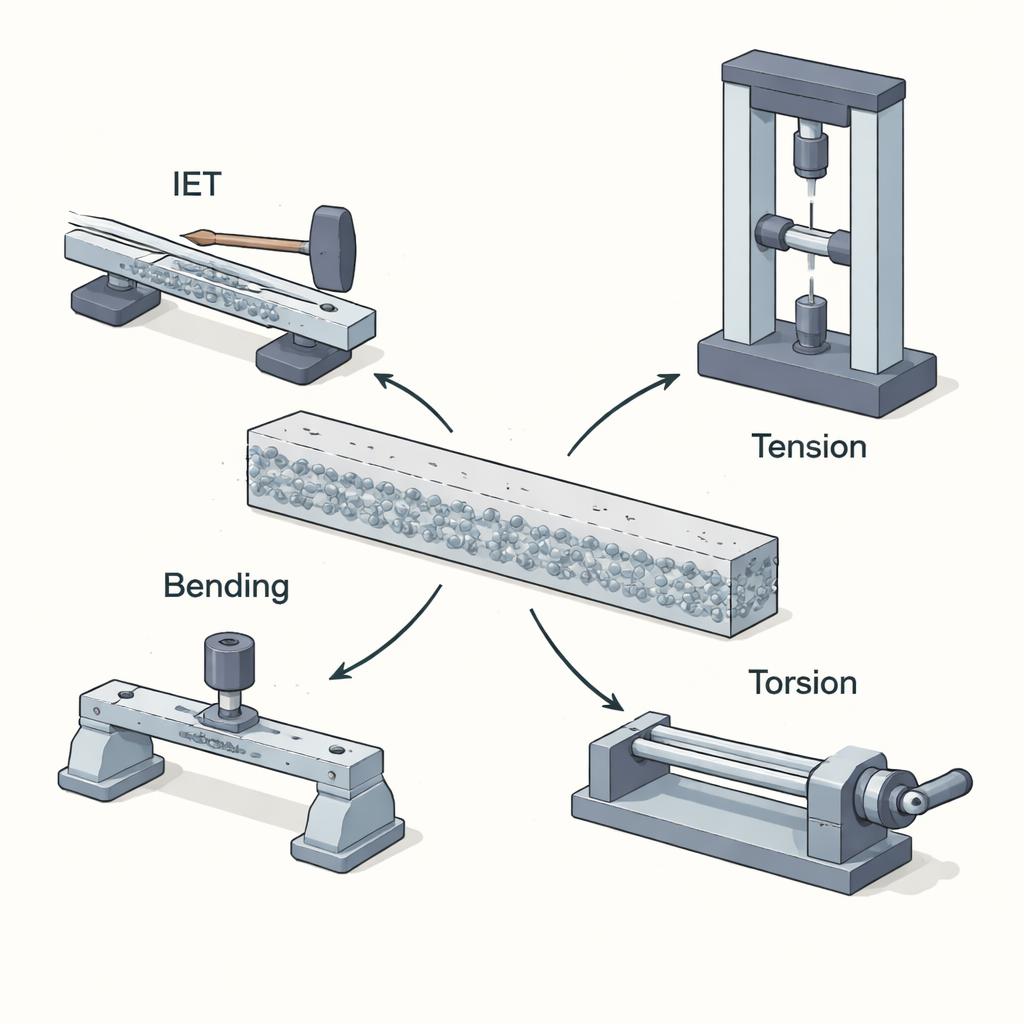
The work focuses on two widely used engineering plastics, polyamide 66 (PA66) and polybutylene terephthalate (PBT), each filled with up to 40 percent tiny glass beads. Instead of relying only on standard tests that pull, bend or twist samples until they deform, the researchers explored the impulse excitation technique, or IET. In IET, a small bar-shaped specimen is supported at specific points and gently tapped; the sound and vibration frequencies are then analyzed. Because the way an object rings depends on its stiffness, density and shape, these resonant frequencies can be converted into key elastic properties, including how easily it bends, stretches along its length, shears in torsion and how its width changes when it is pulled.
Peering inside the plastic
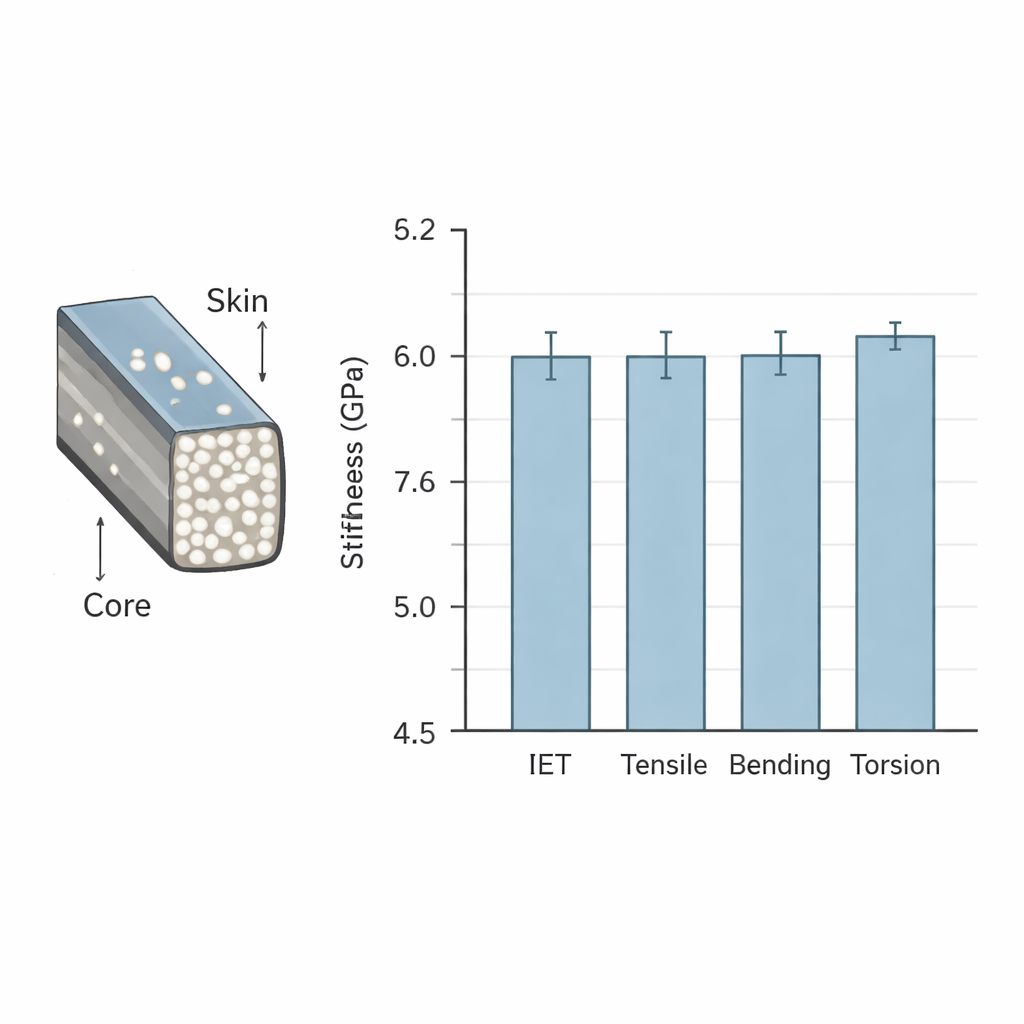
Before comparing methods, the team examined how the glass beads and the plastic itself were arranged inside the molded bars. Microscopy revealed a typical “skin–core” structure: the outer skin cooled faster, contained slightly fewer glass beads and had a lower degree of crystallinity (more disordered polymer), while the inner core cooled more slowly, was more crystalline and held a slightly higher bead concentration. Calorimetry confirmed that even after a careful heat treatment meant to even out the thermal history, the skin remained a bit less stiff than the core. This layered structure matters because bending mainly stresses the outer skin, while stretching along the length loads skin and core more evenly; that difference can subtly shift the measured stiffness from one test type to another.
Putting test methods head-to-head
The researchers then measured the same sets of specimens using four approaches: IET, standard tensile testing, dynamic mechanical analysis in three-point bending, and oscillatory torsion. In every case, adding glass beads made both plastics significantly stiffer—by roughly 60–70 percent for filled PA66 and 40–60 percent for filled PBT compared with the neat materials. Crucially, the stiffness values from impulse excitation agreed very well with those from the three conventional methods when the material was tested within its purely elastic range. Flexural stiffness from IET matched bending results from the dynamic analyzer once the bending oscillations were large enough to overcome small setup artefacts, revealing a threshold beyond which the contact conditions in the bending rig became stable and trustworthy.
Subtle differences reveal the material’s structure
Although the various methods lined up closely, they were not identical. Longitudinal stiffness from the tap test was a few percent higher than values from tensile tests, and bending stiffness was slightly lower than longitudinal stiffness. These differences can be explained by two main factors. First, the tap test operates at much higher vibration frequencies than the slow tensile pulls, and viscoelastic plastics tend to appear a bit stiffer at higher frequencies. Second, the skin–core structure means that bending “feels” more of the softer outer layer, whereas stretching distributes strain through the stiffer core. The study also compared how each technique estimated the shear stiffness and Poisson’s ratio—a measure of how much a material narrows when stretched—finding consistent trends but somewhat larger scatter in methods that rely on clamping or complex motion, like torsion and conventional tensile tests.
What this means for real-world designs
For engineers and designers, the takeaway is that a quick, non-destructive tap test can provide nearly the same elastic constants as time-consuming mechanical tests for these glass bead–reinforced plastics, as long as the material is tested in a simple, small-strain regime. IET delivered reliable values for bending, stretching, shearing and Poisson’s ratio, with smaller measurement uncertainties than many traditional setups. That makes it a promising tool for rapidly characterizing composite materials, screening new formulations or feeding accurate stiffness data into computer models used to design load-bearing plastic parts in cars, electronics or construction. The authors note that more complex conditions—such as long-term aging, large deformations or different filler types—still need further study, but this work lays a solid foundation for using impulse excitation as a practical, everyday measurement method.
Citation: Rech, J., Dresbach, C., van Dorp, E.R. et al. Towards reliable elastic characterization of glass bead reinforced thermoplastic composites using impulse excitation and conventional testing. Sci Rep 16, 5979 (2026). https://doi.org/10.1038/s41598-026-36346-z
Keywords: polymer composites, glass bead reinforcement, impulse excitation, elastic properties, mechanical testing