Clear Sky Science · en
Mechanical and durability performance of optimized geopolymer concrete with manufactured artificial aggregates using a tailored mix design method
Turning Construction Waste into Strong New Buildings
Concrete is everywhere around us, but making it the traditional way releases a lot of carbon dioxide and uses up high‑quality sand and stone. This study explores how to turn industrial leftovers and demolition debris into a new kind of concrete—called geopolymer concrete—that can be just as strong and more durable, while also helping clean up waste piles and cut the climate impact of construction.
Building Blocks from Trash, Not Quarries
The researchers set out to replace almost every traditional ingredient of concrete with waste-based materials. Instead of ordinary cement, they used fly ash from coal power plants and finely ground waste glass as the binding ingredients. Rather than relying on river sand and crushed rock, they made their own coarse stones in the lab from fly ash and glass, cut into sharp, angular shapes that lock together better than rounded pebbles. For the sand-like component, they crushed concrete from demolished buildings. These powders and aggregates were activated using a concentrated alkaline solution so they would harden into a rock‑like mass. 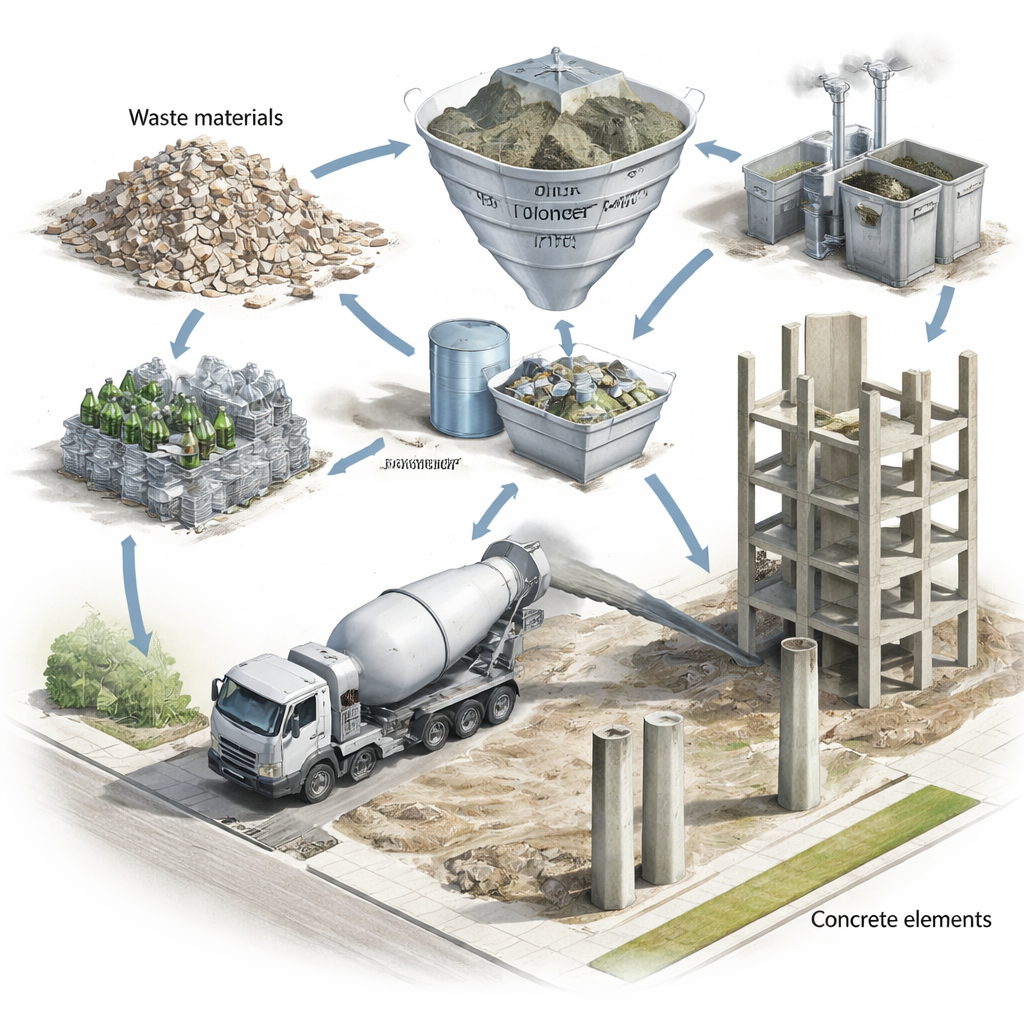
Designing the Right Recipe, Not Guessing
Rather than trial and error, the team used a statistical approach called response surface methodology—similar in spirit to trying many recipe tweaks in a controlled way, then using math to find the best combination. They varied the amount of liquid activator relative to fly ash, and adjusted the doses of two chemicals, sodium hydroxide and sodium silicate. Twenty different mixes were produced and tested for how easily they flowed when fresh, how strong they became in compression and bending, and how well they stood up to water and acid. A special "central composite" test plan allowed the researchers to map out how these ingredients interacted, then build equations that predict performance for mixes they never physically cast.
Stronger Concrete with Less Cracking
The optimized mix emerged at an activator‑to‑fly‑ash ratio of 0.6. At this point, the concrete reached a compressive strength of about 44 megapascals—comfortably within the range used for structural members—and a flexural strength of about 5.2 megapascals, slightly better than the conventional comparison mix. When the ratio was pushed higher, strength actually dropped because too much chemical liquid created a more porous internal structure. Ultrasonic tests, which send sound waves through the hardened concrete, showed that the best mixes were dense and well bonded. Mathematical models linking bending strength and splitting tensile strength to compressive strength were so accurate (with a statistical fit above 0.99) that future designers can estimate several properties from just one type of test.
Surviving Harsh Chemical Environments
Because many real structures are exposed to aggressive environments, the team checked how their geopolymer mixes behaved in sulfuric acid, a severe test for any concrete. Specimens were first cured in water, then submerged in a three percent acid solution for four more weeks. The best geopolymer mix showed only modest drops in wave speed and in resistance to chloride penetration, both indicators of internal damage. Its performance clearly surpassed that of the ordinary concrete control. Microscopic imaging revealed why: in the optimized mix, a dense gel wrapped tightly around the manufactured angular aggregates and recycled fines, leaving fewer voids where cracks and chemicals could grow. The waste glass contributed extra silica, which helped form this tight network. 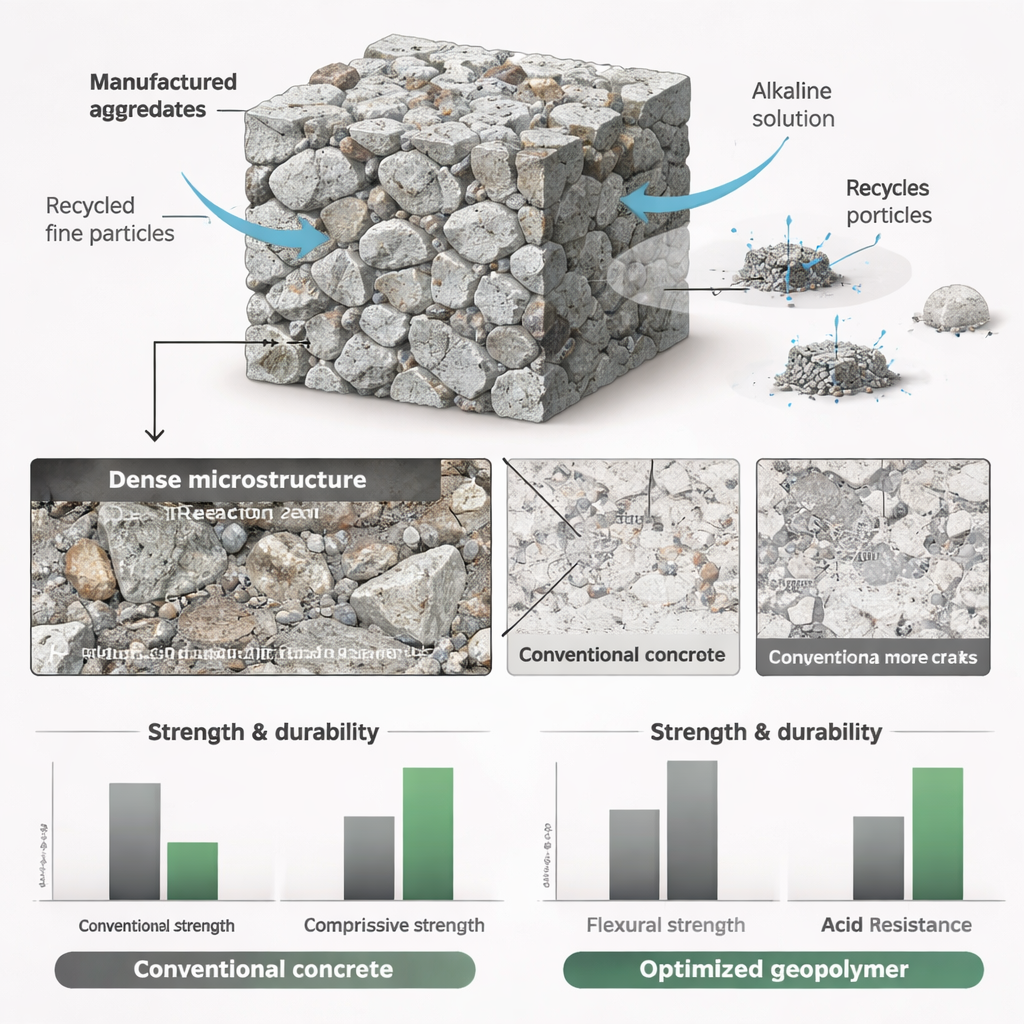
From Lab Charts to Real‑World Structures
Looking inside the material at high magnification, the researchers found a robust transition zone where the man‑made stones meet the surrounding binder; this region is often the weak link in traditional concrete. Here, however, both the aggregates and the matrix participate in the same geopolymer reaction, creating a semi‑monolithic body with fewer microcracks. The study concludes that this tailor‑made mix—built from fly ash, ground glass, fully artificial coarse aggregate, and demolition‑waste sand—can replace standard concrete in many non‑prestressed structural elements, pavements, precast blocks, and infrastructure that must resist acids and salts. At the same time, it diverts waste from landfills, eases pressure on natural sand and gravel, and trims the embodied carbon of construction, pointing toward sturdier and more sustainable cities.
What This Means for Future Buildings
For a lay reader, the takeaway is simple: it is possible to turn yesterday’s rubble and industrial by‑products into tomorrow’s buildings without sacrificing strength or durability. By carefully tuning the “recipe” and understanding how the tiny internal structure behaves, engineers can design concretes that last longer in harsh conditions while relying far less on virgin raw materials. This work moves sustainable concrete a step closer to everyday use in real projects.
Citation: Kurzekar, A.S., Waghe, U., Ansari, K. et al. Mechanical and durability performance of optimized geopolymer concrete with manufactured artificial aggregates using a tailored mix design method. Sci Rep 16, 6853 (2026). https://doi.org/10.1038/s41598-026-36345-0
Keywords: geopolymer concrete, construction waste, artificial aggregates, sustainable materials, durable infrastructure