Clear Sky Science · en
Root system architecture profiling for aluminium tolerance in maize seedlings using an optimized high-throughput phenotyping
Why roots in sour soils matter
Across the world, huge areas of farmland sit on “sour,” or acidic, soils that quietly limit harvests. In these soils, aluminium, a common element in the earth’s crust, dissolves into a form that is toxic to plant roots. For maize, one of the planet’s most important cereals, this hidden stress can stunt young plants before they ever break into strong growth. This study explains how researchers built a fast, precise way to test hundreds of young maize plants in water-based systems, so they could find which lines keep their roots growing in the face of aluminium and which ones quickly fail.
When soil turns sour
Acidic soils make up nearly half of the world’s potentially farmed land, including large tracts in India. In such soils, aluminium shifts from a harmless mineral into a charged form that interferes with root growth. The first victim is the root tip, the region that drives downward growth and creates fine side roots. When these tips are damaged, plants struggle to reach water and nutrients, even if the upper soil looks fertile. Farmers often see the end result—a poor maize harvest—without any obvious disease or pest, because the real damage is hidden below ground.
Growing maize in water to see hidden damage
To watch root damage develop in a controlled way, the researchers used hydroponics—growing seedlings in a nutrient solution instead of soil. They adjusted aluminium levels and the length of exposure to mimic acidic field conditions while keeping everything else constant. After testing seven established maize lines at several aluminium doses, they found that a moderate level of aluminium applied for 11 days after germination clearly separated sensitive from tolerant roots. At this setting, key root features such as total length, surface area, volume, thickness and number of tips could be measured accurately using digital imaging, revealing how each plant responded to stress. 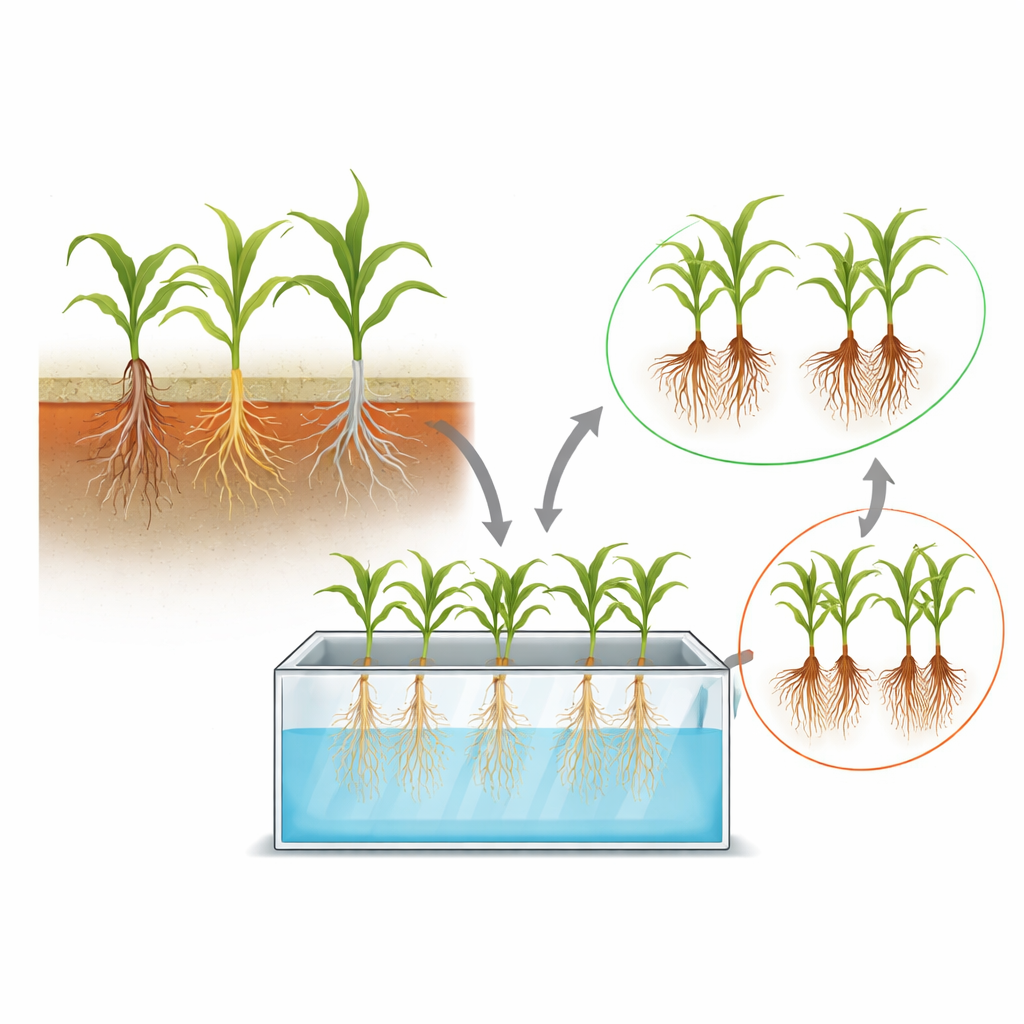
Measuring what makes a strong root system
With the test conditions fixed, the team screened 250 diverse maize inbred lines. First, they looked at how each line’s roots grew without stress, so they could discard weak performers that would do poorly for reasons unrelated to aluminium. A selected set of 150 vigorous lines was then grown with and without aluminium. For each line, the researchers calculated a relative root tolerance index, comparing root traits under stress to those in normal conditions, and also the percentage loss in each trait. These paired measures showed that aluminium usually cut root length, surface area, and tip number by 10–40%, but some lines maintained long, highly branched roots while others almost stopped growing.
Finding winners and losers among hundreds of lines
Because root traits are interconnected, the team used multivariate tools—statistical methods that look at all traits together—to group lines by their overall response. Principal component analysis and a multi-trait index called MGIDI helped them distinguish genuinely tolerant lines from those that looked good in only one dimension. A small group of lines, including IMR292, IMR534, IMR463, IMR621, IMR546, IMR629, IMR395 and IMR592, consistently kept much of their root length, surface, and branching under aluminium. In contrast, lines such as IMR33, IMR58, IMR388, IMR349 and IMR446 showed drastic reductions across several traits, marking them as highly susceptible checks for future studies. 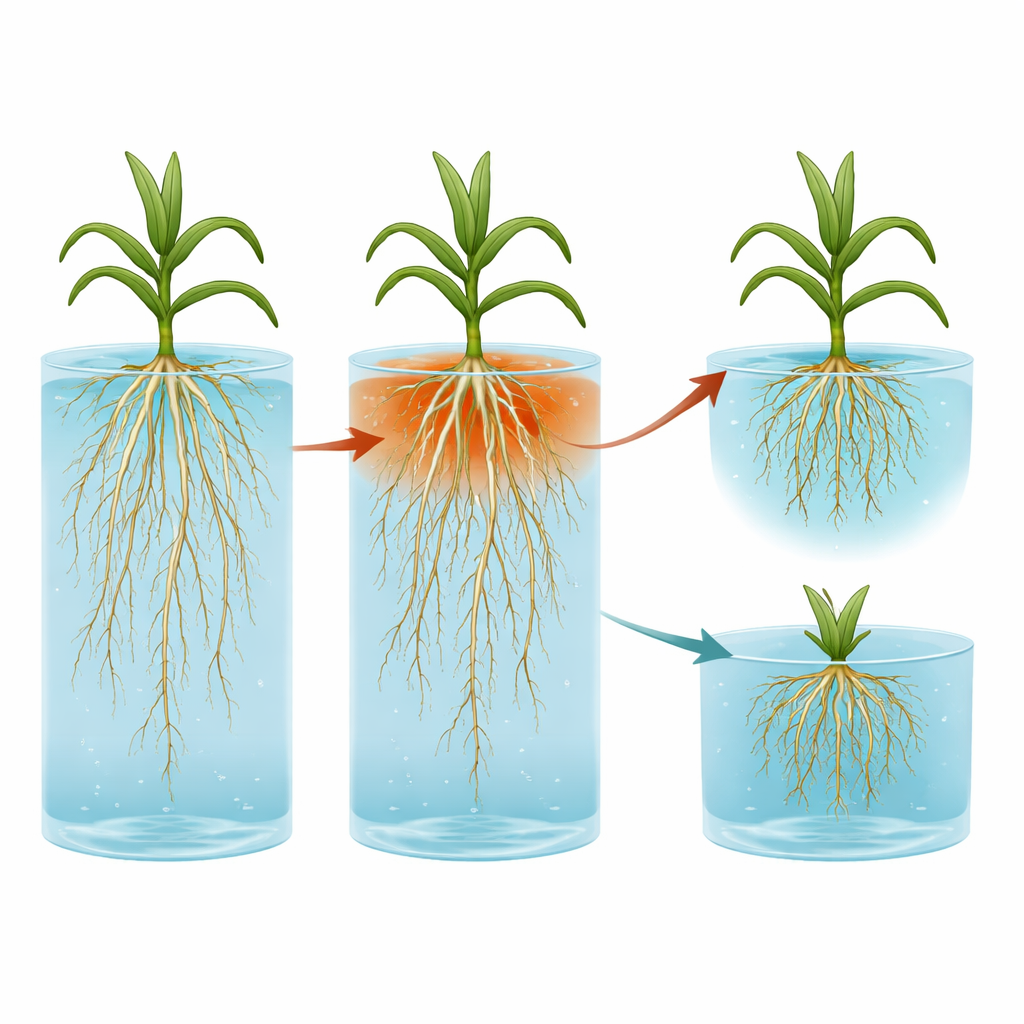
What this means for future maize harvests
In simple terms, the study shows that aluminium-tolerant maize is defined not by a single “magic” root feature but by a coordinated ability to keep roots long, well branched and active, even in sour soils, while modestly thickening roots as a backup. The newly refined hydroponic protocol makes it possible to test large numbers of lines quickly and reliably, and the identified tolerant and susceptible lines give breeders clear starting points. The next step is to confirm these root advantages in real acidic fields and to link them to specific genetic markers. If successful, this approach will help breeders develop maize varieties that thrive where acidity now holds yields back, improving food security in many vulnerable regions.
Citation: Channapur, A.M., Kumar, S., Abhijith, K.P. et al. Root system architecture profiling for aluminium tolerance in maize seedlings using an optimized high-throughput phenotyping. Sci Rep 16, 8352 (2026). https://doi.org/10.1038/s41598-026-36343-2
Keywords: maize, acidic soils, aluminium toxicity, root traits, hydroponic screening