Clear Sky Science · en
Long-term apple orchard cultivation drives selective accumulation and moderate ecological risk of heavy metals in loess Plateau, China
Why soil under apple trees matters to your plate
Apples are a daily staple for millions of people, and China is the world’s largest producer. But the same fertilizers and sprays that help orchards deliver high yields can also leave behind invisible traces of toxic metals in the soil. This study looks beneath the trees of a major apple-growing region on China’s Loess Plateau to see how decades of intensive cultivation have changed the soil, how much heavy metal has built up, and what that might mean for long-term environmental safety and sustainable fruit production. 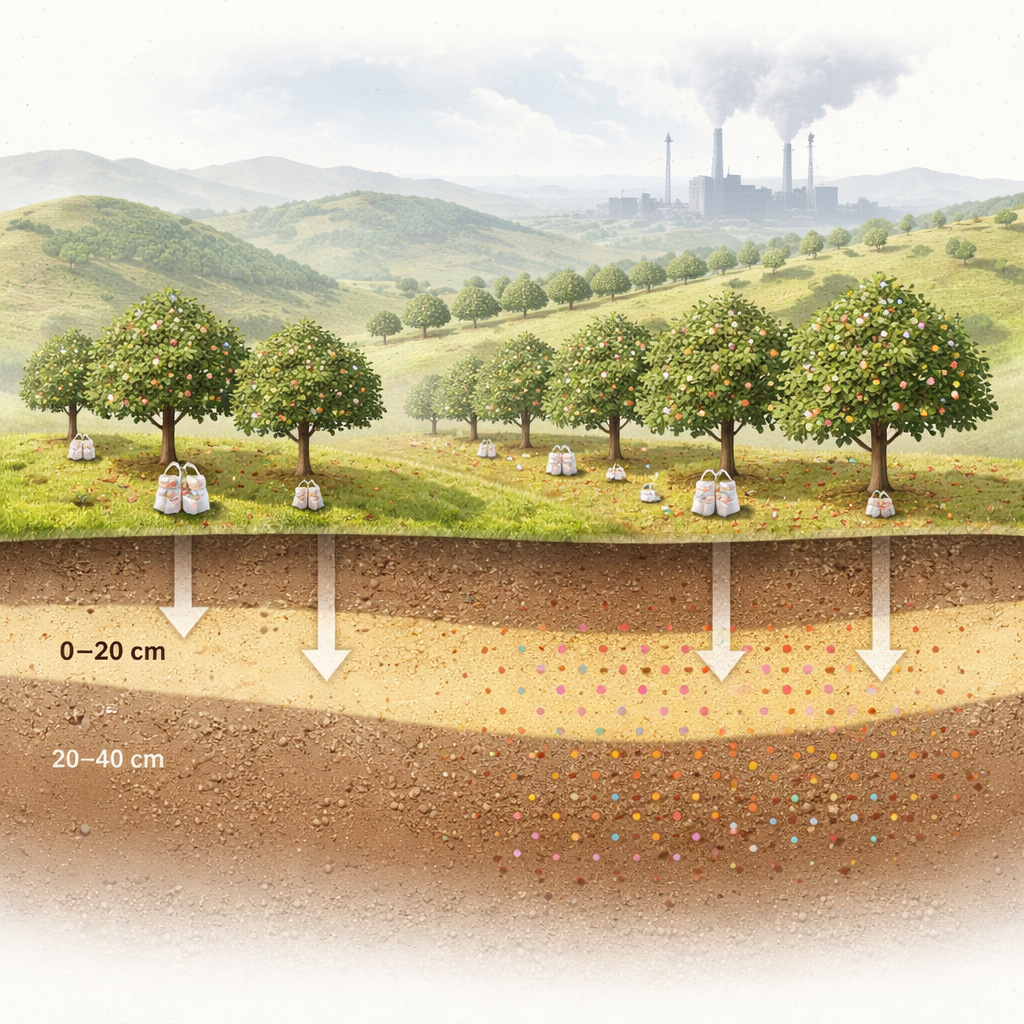
Digging into decades of orchard growth
The researchers worked in Luochuan County, a core apple-producing area in Shaanxi Province, where orchards have expanded rapidly over recent decades. Instead of taking a single snapshot of surface soil, they built a careful “timeline” of orchards ranging from newly planted to 30 years old, all on the same type of loess soil. At each site they sampled two layers, from 0–20 centimeters and 20–40 centimeters deep, and compared them to deeper, relatively untouched soil at 110 centimeters, which served as a local background. They measured common heavy metals—mercury, copper, zinc, arsenic, lead, and chromium—along with basic soil properties like pH, organic matter, and nutrients.
What is building up in the soil—and what is not
The soils were alkaline and rich in organic matter and nutrients, typical of heavily managed orchards. All measured metals were higher in the surface layer than below, but only three—mercury, copper, and lead—showed clear increases with orchard age. Over 30 years, mercury rose by about 4.3% per year relative to its background level, while copper and lead increased more slowly. Zinc, arsenic, and chromium stayed roughly constant over time, suggesting that not all metals respond the same way to long-term farming. Overall, the combined pollution index for the six metals fell in the “moderate” category at both depths: not catastrophic, but clearly above natural levels and trending upwards, especially for certain elements.
Tracing metals back to their sources
To understand where the metals were coming from, the team used a statistical tool that teases apart overlapping signals in the data. The pattern that emerged was striking. For copper, lead, zinc, arsenic, and chromium, most of the added burden could be traced to fertilizers and organic amendments such as manures and composts, which often carry small but persistent amounts of these elements. By contrast, mercury told a different story. At both depths, around three-quarters of the mercury in the soil was linked to atmospheric deposition—pollution carried in the air from coal burning and industrial activity, then deposited onto fields and slowly locked into the soil. 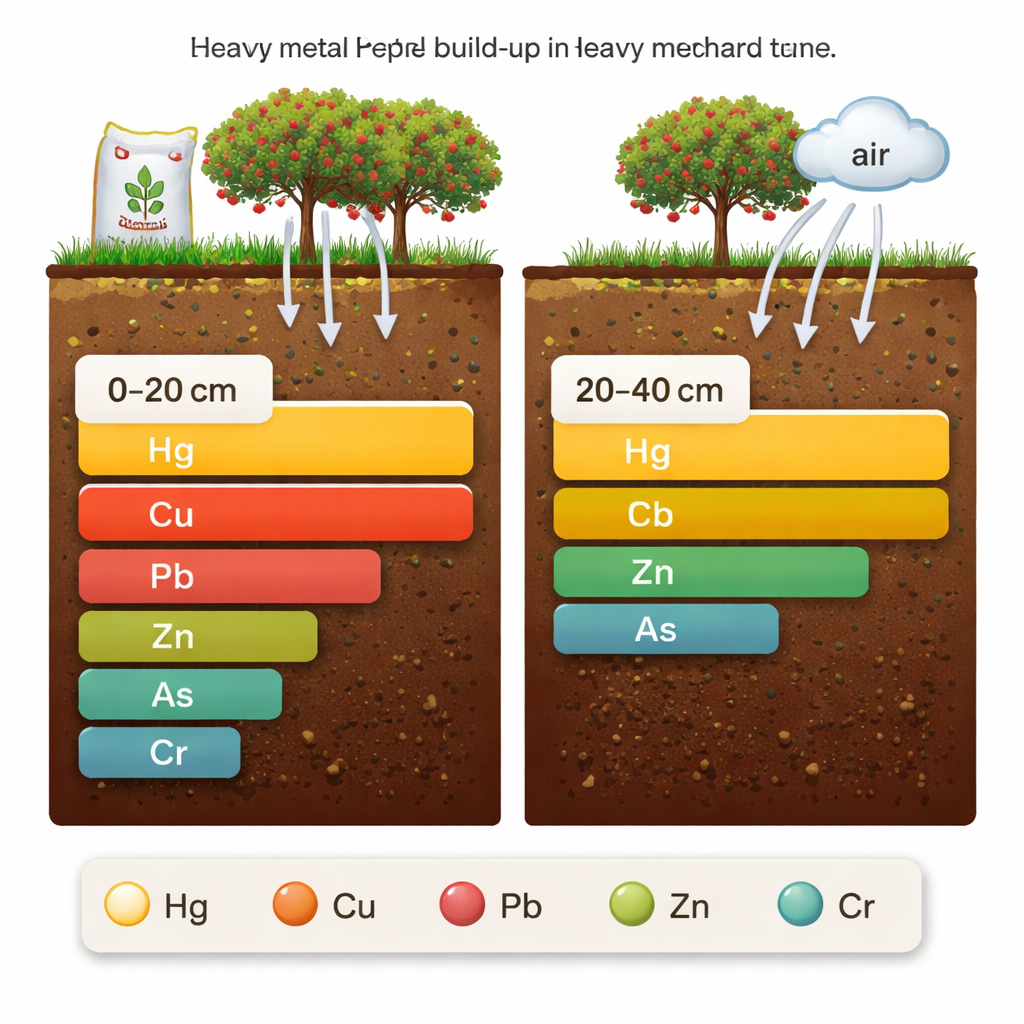
Risks for ecosystems, not just numbers on a chart
The study did more than count total metal concentrations; it also estimated how these levels translate into ecological risk. When weighted by toxicity, mercury again dominated. The combined ecological risk from all metals was rated “considerable” in both layers, even though most individual metals besides mercury still posed only low risk on their own. Importantly, the analysis focused on total amounts in soil, not how easily plants or organisms can actually take them up, so the findings should be viewed as a warning signal rather than proof of direct harm to consumers. Still, the presence of localized “hotspots” and the steady accumulation over time highlight the danger of letting these trends continue unchecked.
What this means for apples and the environment
For orchard managers and policymakers, the message is clear: long-term apple cultivation on the Loess Plateau is quietly loading soils with certain heavy metals, especially mercury, copper, and lead. While current levels are not extreme, they already represent moderate pollution and a non-trivial ecological risk. Because fertilizers are the main source for most metals, smarter fertilizer choice and lower application rates could slow or reverse the buildup of copper, lead, zinc, arsenic, and chromium. Mercury, driven mainly by air pollution, will require broader controls on emissions from coal and industry. Together, these changes can help ensure that the soils feeding China’s apple trees remain healthy, productive, and safe for future generations.
Citation: Pan, H., Chen, Z., Jing, G. et al. Long-term apple orchard cultivation drives selective accumulation and moderate ecological risk of heavy metals in loess Plateau, China. Sci Rep 16, 5699 (2026). https://doi.org/10.1038/s41598-026-36342-3
Keywords: apple orchards, heavy metals, fertilizer pollution, atmospheric deposition, soil ecological risk