Clear Sky Science · en
Low tumoral Trefoil Factor 1 expression relates to aggressive tumor features and poor survival in young women with breast cancer
Why a tiny protein matters for young women
Breast cancer is often thought of as a disease of older women, yet it is also a leading cause of death in women under 50. Younger patients tend to have more aggressive tumors and worse outcomes, and doctors still lack good tools to identify which young women are at highest risk. This study focuses on a small protein called Trefoil Factor 1 (TFF1) and asks a simple but important question: can the amount of this protein in a tumor help explain why some young women fare worse than others—and could it become a useful warning sign?
A search for better warning signs
The researchers analyzed tumor samples from 319 women diagnosed with breast cancer before age 50 in western Norway, along with matching lymph node metastases when available. They measured TFF1 protein in the tumor tissue and also examined TFF1 gene activity (mRNA) in large international datasets that track thousands of patients and breast cancer cell lines. They then compared TFF1 levels with patient age, standard tumor markers such as estrogen and progesterone receptors, molecular subtypes of breast cancer, and how long patients lived after diagnosis.
Low TFF1 and tougher tumors
Across both the Norwegian and international cohorts, tumors with low TFF1 stood out as more dangerous. Young women with low TFF1 in their primary tumors were more likely to be under 40, to have high-grade cancers (cells that look very abnormal under the microscope), and to lack estrogen and progesterone receptors. These low-TFF1 tumors overlapped strongly with “basal-like” and triple-negative breast cancers, two subtypes known for fast growth and limited treatment options. Patients whose tumors had low TFF1 generally had poorer breast cancer–specific survival, especially in the 40–49 age group.
What low TFF1 tells us about tumor behavior
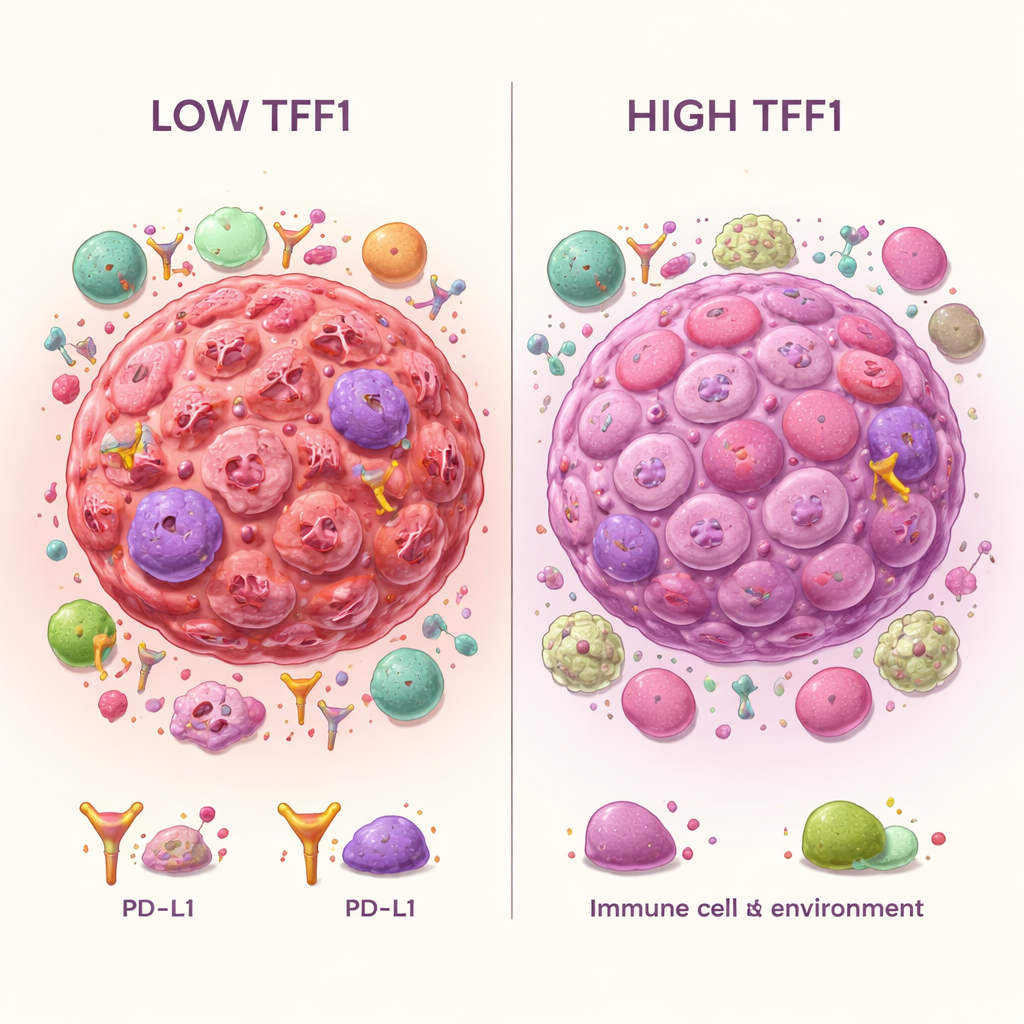
To understand why low TFF1 tumors were so aggressive, the team looked at patterns of gene activity. Tumors with low TFF1 showed gene signatures linked to stem-like cells, which can more easily adapt, spread, and resist treatment. They also displayed high scores for cell division, confirming that these cancers were actively proliferating. At the same time, low TFF1 tumors had elevated levels of immune checkpoint and inflammatory markers such as PD-L1 and CTLA4, suggesting that they may be particularly skilled at hiding from the body’s immune defenses while continuing to grow.
Clues from spread to lymph nodes
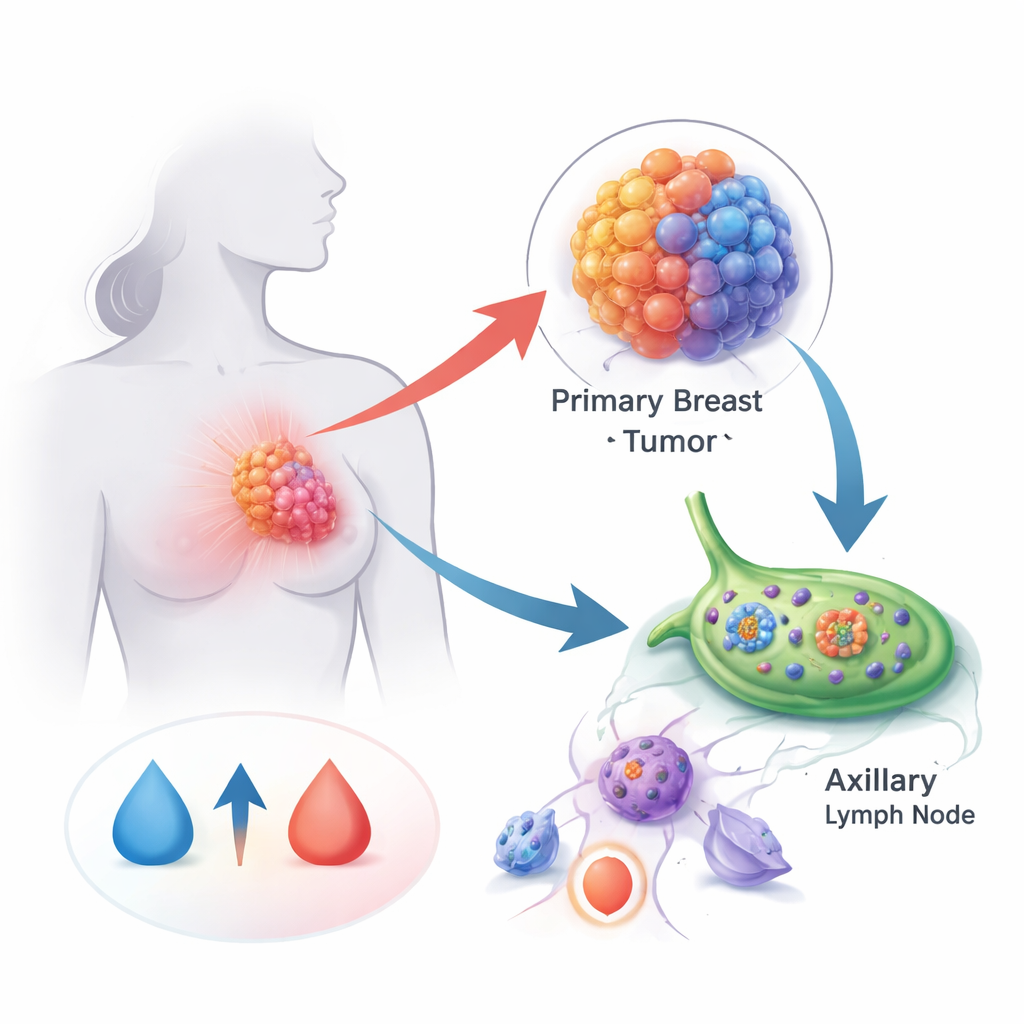
Because spread to the lymph nodes is a key step in worsening disease, the researchers also examined TFF1 in 145 axillary lymph node metastases taken near the time of diagnosis. In most cases, TFF1 levels were similar between the original tumor and its lymph node deposit, and low TFF1 in nodes tended to track with other aggressive features. However, a striking age-related pattern emerged: among women younger than 40, those whose lymph node metastases showed high TFF1—despite their primary tumors being low—had worse survival than those who stayed low in both places. This suggests that changes in TFF1 during tumor spread may have special meaning in the very youngest patients.
What this means for patients
For a layperson, the takeaway is that TFF1 behaves like a molecular barometer of risk in young women with breast cancer. Low levels in the primary tumor signal cancers that are more primitive, faster growing, and better at sidestepping the immune system, especially within the basal-like and triple-negative groups. High TFF1 in lymph node metastases of some very young patients may mark an even more worrisome pattern of disease spread. While TFF1 is not ready to be used alone to guide treatment, this work shows that it captures aspects of tumor biology that current markers miss and could become part of future tools to identify which young women need the most intensive follow-up and therapy.
Citation: Kvamme, A.B., Hugaas, U., Sæle, A.K.M. et al. Low tumoral Trefoil Factor 1 expression relates to aggressive tumor features and poor survival in young women with breast cancer. Sci Rep 16, 5612 (2026). https://doi.org/10.1038/s41598-026-36341-4
Keywords: young breast cancer, TFF1 biomarker, basal-like subtype, triple-negative breast cancer, tumor aggressiveness