Clear Sky Science · en
The STS test and its correlation with common clinical indicators for an Argentinian population sample
Why getting out of a chair matters
Standing up from a chair is something most people do dozens of times a day without thinking. Yet this simple action quietly reflects how strong our leg muscles are, how well we keep our balance, and how independent we can remain as we age. In this study, researchers in Argentina used the common Sit-To-Stand (STS) test to explore how leg power changes from young adulthood to old age and how it relates to other health measures such as grip strength, leg press force, and muscle quality seen on ultrasound.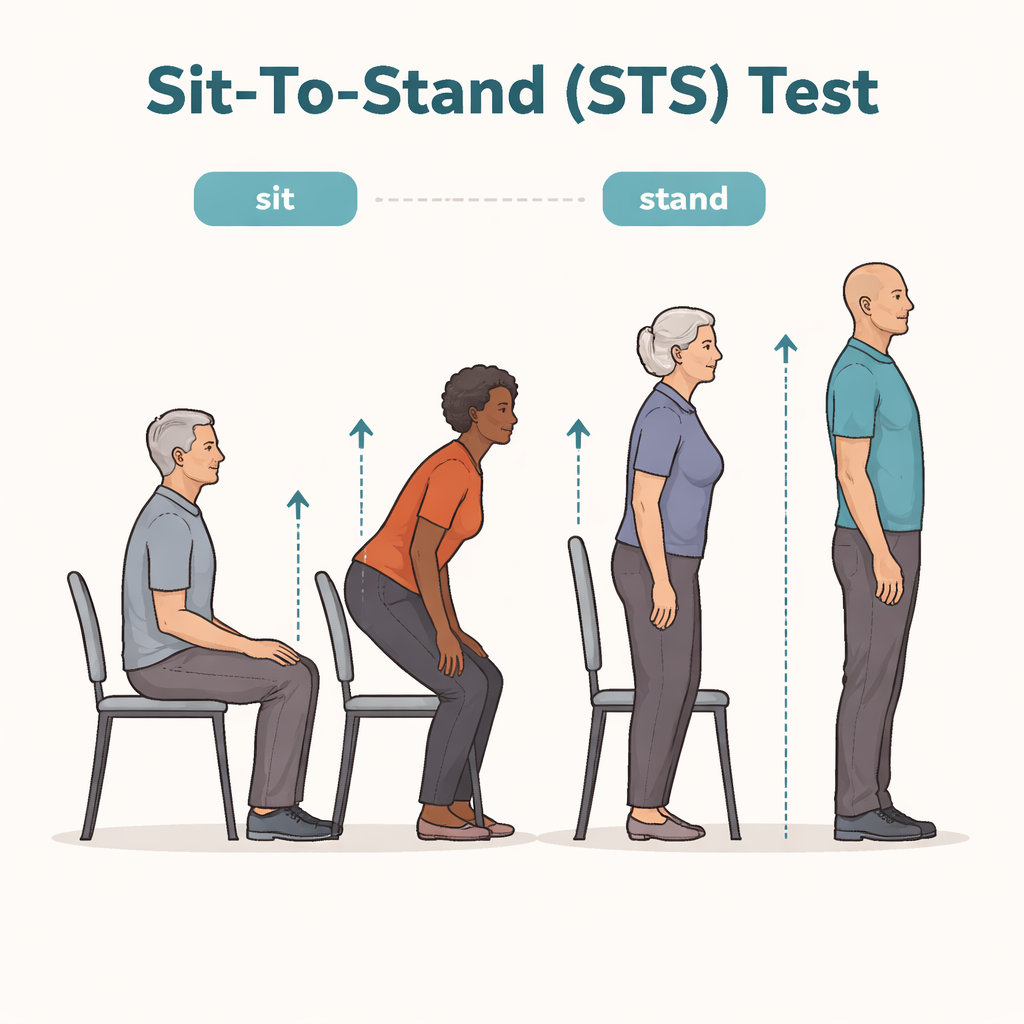
A simple test with hidden physics
The STS test times how quickly a person can stand up and sit down several times from a standard chair. Clinicians often convert this time into an estimate of “power” – how fast the body can produce force – using simple equations based on body weight, leg length, and chair height. The authors revisited the basic physics behind these equations. They modeled the body as three linked segments (lower leg, upper leg, and upper body) and showed that popular formulas used worldwide are simplified versions of a more complete biomechanical model. Despite their shortcuts, these existing equations turned out to track very closely with the more detailed model in real people.
Average power versus real muscular effort
One debate in the field is whether the usual calculation of average power truly reflects the effort our muscles make during standing up, because it largely ignores the extra work needed to speed up and slow down body segments. To tackle this, the researchers introduced a second measure called root mean square (RMS) power, which better captures all bursts of effort, including accelerations and decelerations. Using their model, they computed both average power and RMS power for each participant. They found an almost perfect correlation between the two: people who scored high on average power also scored high on RMS power. RMS values were typically about 30% higher, suggesting extra hidden effort, but in practice the two measures told very similar clinical stories.
How leg power changes across adulthood
The team tested 159 adults aged 18 to 90 years. On average, STS power peaked around the mid‑30s and then declined steadily with age. This pattern appeared for both the standard power estimate and RMS power. After about 65 years of age, power loss accelerated, at several percent per year, echoing what is known about age‑related muscle loss and slower nerve responses. Men produced higher absolute power than women, largely because they tend to have more muscle mass, but these sex differences shrank when power was adjusted for body weight. The study also confirmed that people who took longer to complete the five STS repetitions were generally older and less powerful. Leg press strength and the speed at which force could be generated in the leg press showed the strongest links with STS power, underscoring the importance of rapid leg strength for everyday tasks.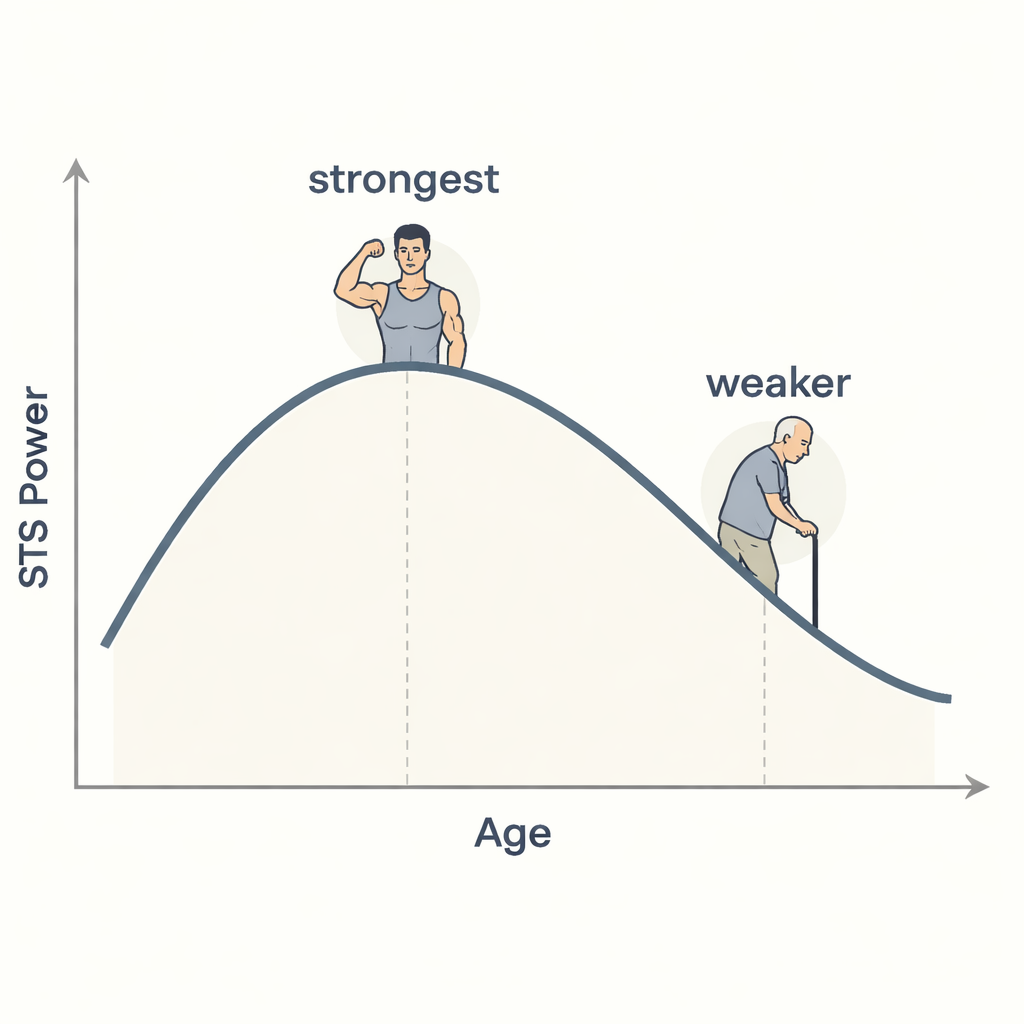
What grip strength and muscle scans reveal
The researchers compared STS power with handgrip force, another quick test often used as a marker of overall strength. STS power and grip strength were related, especially in men, but not strongly enough to treat them as interchangeable; each captured slightly different aspects of physical capacity. Ultrasound scans of the quadriceps muscle showed that thicker thigh muscles were clearly associated with higher STS power, while an image feature called echogenicity – which reflects fat and connective tissue within muscle – did not line up with STS power in this sample. This suggests that visible loss of leg muscle size and quality does not always march in lockstep with the ability to stand up quickly, so both mechanical performance and muscle structure should be checked independently.
What this means for everyday health
For clinicians and app developers alike, the main message is reassuring: the simple equations already used to estimate STS power seem good enough for most real‑world purposes, even though they gloss over some biomechanical fine points. The more complex RMS approach appears to describe muscular effort more fully, but it did not provide dramatically different insights in this study. More importantly, the work confirms that leg power peaks in early midlife and then declines, with sharper drops in later years, and that this decline is tied closely to leg strength and the ability to produce force quickly. For the average person, maintaining strong, powerful legs through regular activity and resistance exercise may be one of the most effective ways to preserve independence – starting not in old age, but as early as the 30s.
Citation: Intelangelo, L., Peñalba, A., Arcuri, G. et al. The STS test and its correlation with common clinical indicators for an Argentinian population sample. Sci Rep 16, 5682 (2026). https://doi.org/10.1038/s41598-026-36340-5
Keywords: sit-to-stand test, muscle power, aging and mobility, leg strength, sarcopenia