Clear Sky Science · en
Evidence for fluorescence-supported species recognition in syntopic harvestmen
Glowing Signals in the Night Forest
Walk through a tropical rainforest after dark and you might never notice the tiny, spindly harvestmen—relatives of spiders—moving over the leaf litter. But under ultraviolet (UV) light, some of these creatures suddenly blaze with bright, ghostly patterns on their backs. This study looks at what those glowing marks might be for, arguing that they help harvestmen tell friend from stranger in the dim light of the forest night.
Bright Marks on Look‑Alike Bodies
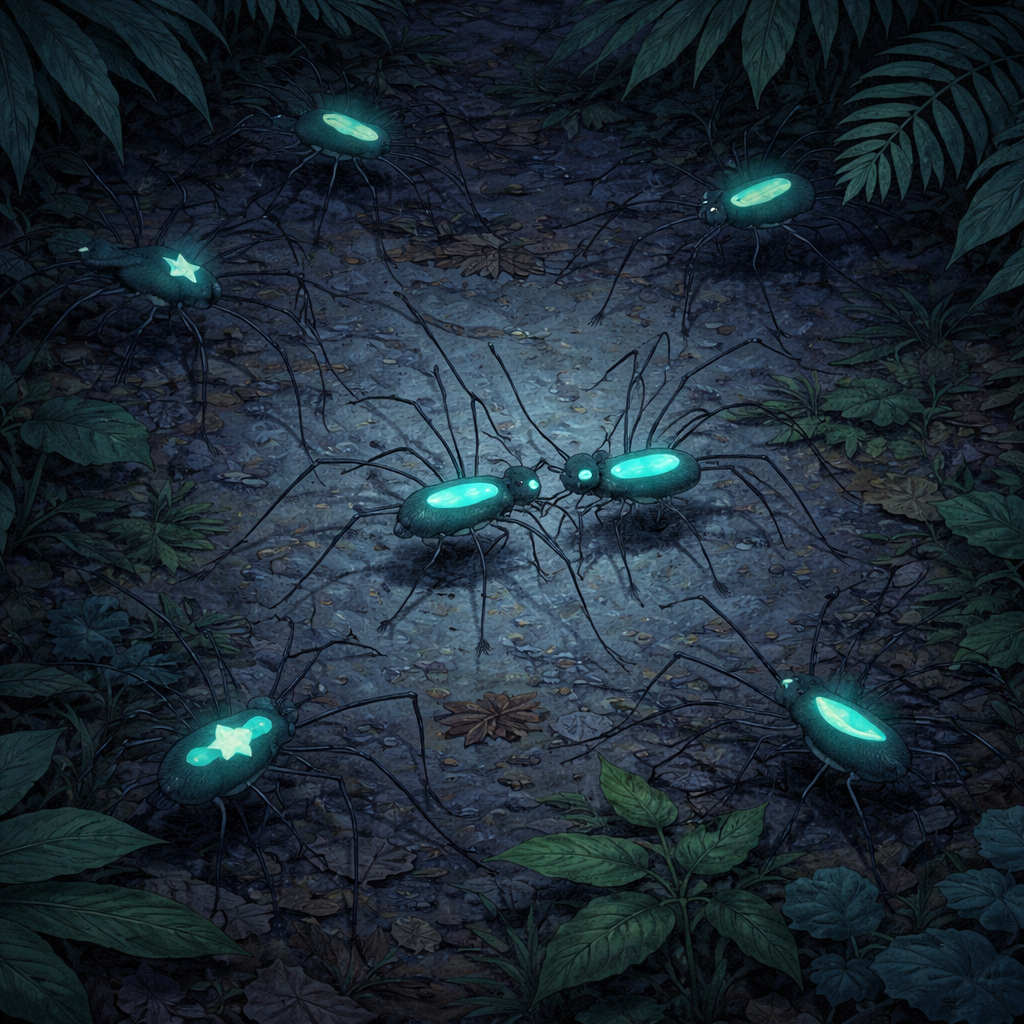
The researchers worked in an Amazonian rainforest reserve in Peru, where five closely related harvestman species live side by side on the forest floor. At first glance, they look almost identical: small brown bodies with very long legs. The striking exception is a pale patch on the back, called the equuleus, which acts almost like a logo. Each species has its own sharply defined equuleus shape—such as stars, bars, or ovals—that stays remarkably constant within a species and does not differ between males and females. Under UV light, these patches glow an intense greenish‑blue, making each animal stand out clearly against the dark forest background and allowing quick identification of species in the field.
Inside the Glowing Patch
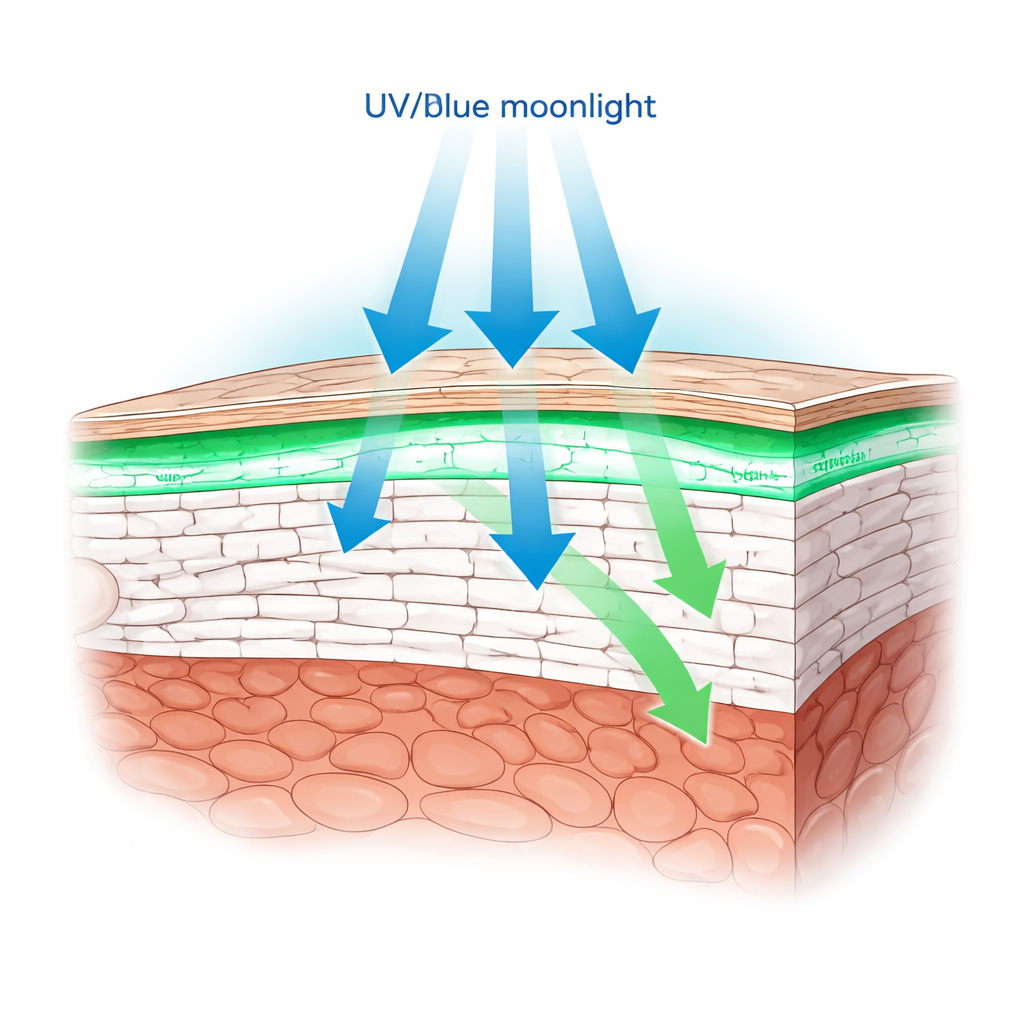
To understand where the fluorescence comes from, the team examined thin slices of the equuleus from the most common species, Vononana adrik, under light and fluorescence microscopes. They found that the outer body shell (the cuticle) is thickened in the equuleus region and is itself the source of the glow. Just beneath this layer lies a stack of tiny, plate‑like crystals made of guanine, the same molecule that helps many animals excrete nitrogen and that often serves as a natural mirror in eyes and reflective skin. These crystals form a multi‑layered “mirror” directly under the fluorescent cuticle. Experiments showed that while the crystals hardly fluoresce at all, they strongly reflect both incoming UV light and the light emitted by the glowing cuticle, effectively amplifying the brightness of the equuleus.
Moonlight, Color, and Seeing in the Dark
The scientists then measured exactly how the equuleus responds to different wavelengths of light. They found that UV and blue light—especially wavelengths similar to those present in moonlight penetrating the rainforest canopy—are particularly effective at triggering fluorescence. The equuleus emits a broad band of greenish‑blue light, with two main peaks that together create the vivid glow visible to human observers under a UV torch. Importantly, earlier work on related harvestmen shows that their eyes are sensitive to both near‑UV and blue‑green light. Detailed imaging of V. adrik’s eyes in this study confirmed that they have a typical arachnid eye design, with lenses, light‑sensitive cells, and reflective structures that likely boost sensitivity in low light. Although their vision is not razor‑sharp, simulations suggest they could detect the bright, high‑contrast patches on the backs of nearby individuals, at least as coarse shapes or strong spots of light.
Why These Night Lights Matter
Biofluorescence—the conversion of invisible UV or blue light into visible colors—is common across animals, from scorpions and spiders to fish, frogs, and birds. Yet in most cases, scientists still do not know what it is for. Does it simply occur as a side effect of body chemistry, or does it carry information? In these harvestmen, several clues point toward a signaling role. The equuleus is placed in a clearly visible body region, has a species‑specific shape, glows strongly under natural twilight and moonlight, and is likely detectable by the animals’ own eyes. All five species are active at the same time and place on the forest floor, where being able to tell your own kind from others could matter for finding mates and avoiding wasted courtship or aggression.
A Visual Code for Harvestmen
The authors conclude that the fluorescent equuleus probably acts as a visual cue that helps these nocturnal harvestmen recognize members of their own species and distinguish them from their close neighbors. The guanine crystal mirror under the patch appears to be an energy‑expensive structure whose main function is to brighten this signal in the blue‑rich glow of moonlight. While future behavioral experiments are needed to show that harvestmen actually change their actions in response to these glowing patterns, the anatomical, optical, and ecological evidence together make a strong case that what looks like a simple glowing spot is, in fact, part of a finely tuned communication system for life in the dark.
Citation: Friedrich, S., Schwager, M., Heß, M. et al. Evidence for fluorescence-supported species recognition in syntopic harvestmen. Sci Rep 16, 2631 (2026). https://doi.org/10.1038/s41598-026-36335-2
Keywords: biofluorescence, harvestmen, species recognition, nocturnal communication, Amazon rainforest