Clear Sky Science · en
Carbon Dots and mesoporous silica nanocomposites improve spray-induced gene silencing to suppress plant RNA and DNA viruses
New tools to keep crops virus-free
Viruses that attack crops can slash harvests and threaten food prices worldwide, and traditional defenses like pesticides and breeding new resistant varieties are slow, costly, and often imperfect. This study explores a different idea: using tiny engineered particles to help plants "read" and destroy viral messages sprayed onto their leaves, offering a potential spray-on, environmentally friendly shield against both major RNA and DNA plant viruses.
Turning a natural defense into a spray
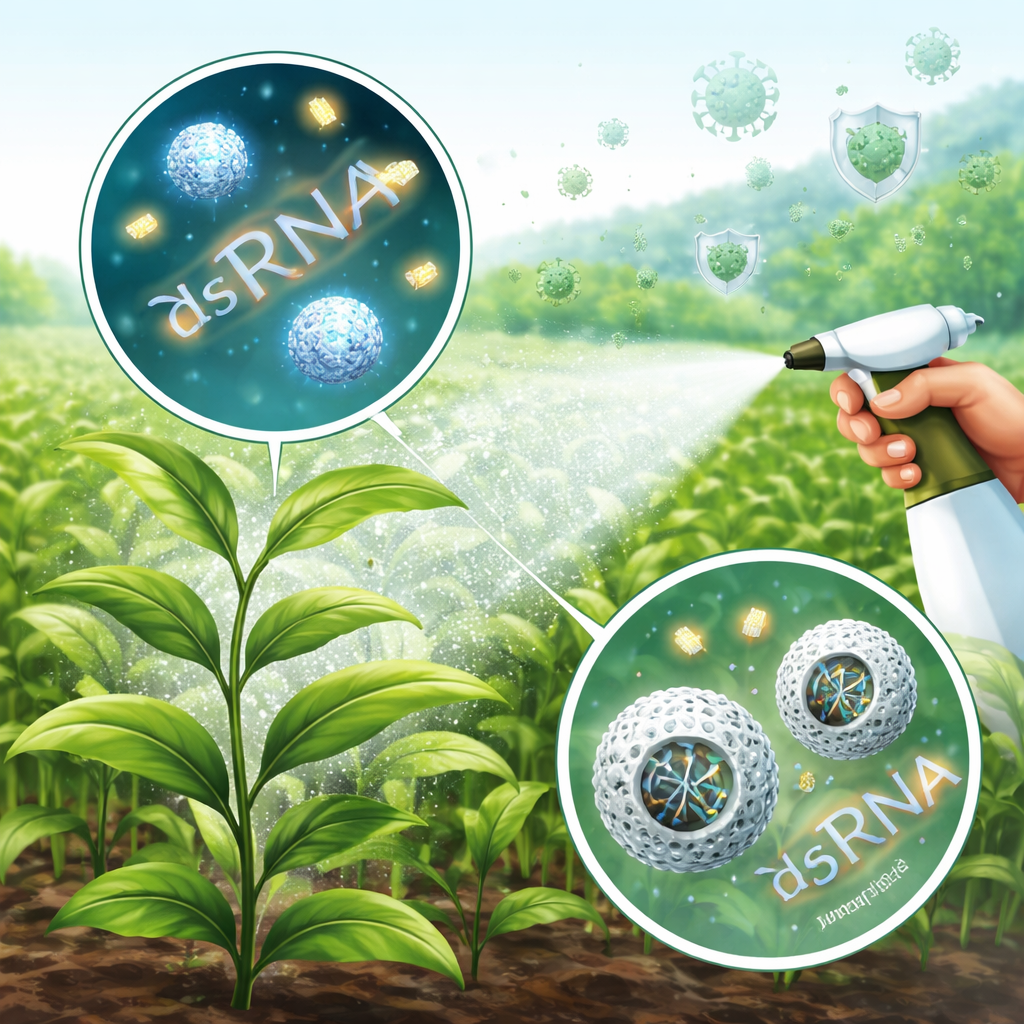
Plants already carry a natural security system that chops up suspicious genetic material into short fragments and uses them to silence invaders. Scientists can tap into this process by applying specially designed double-stranded RNA (dsRNA) that matches key genes of a virus. When the plant takes up this dsRNA, it is cut into smaller pieces that guide the plant to attack the virus. This method, called spray-induced gene silencing, avoids altering the plant’s own DNA and can, in principle, be tailored quickly to new virus strains. In practice, however, naked dsRNA sprayed on leaves is fragile, breaks down outdoors, and is taken up inefficiently, which has limited its usefulness in the field.
Helping molecules ride into the leaf
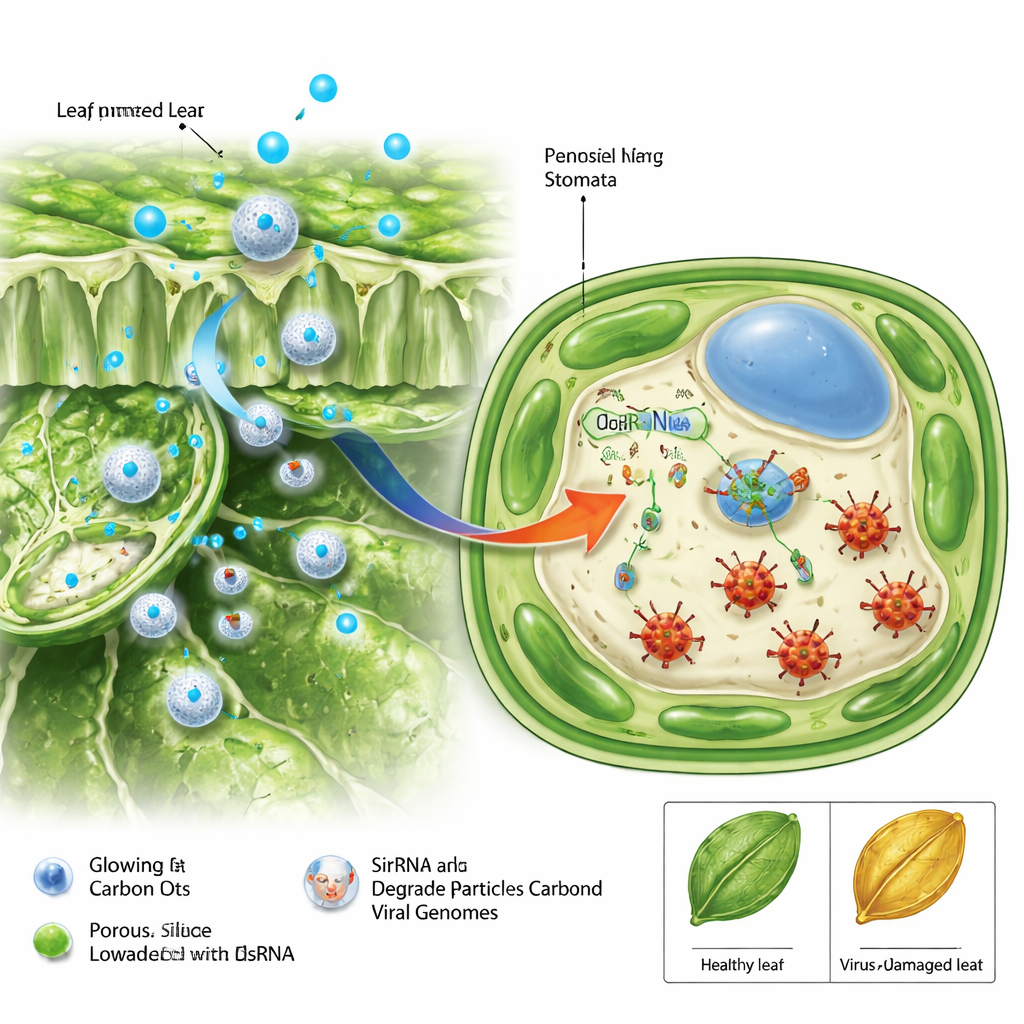
The researchers tested whether pairing dsRNA with two types of nanoparticles could solve this delivery problem. One carrier, called carbon dots, are ultra-small carbon-based particles that dissolve easily in water and are considered low in toxicity. The other, mesoporous silica nanoparticles, are sponge-like grains of silica whose surfaces were chemically modified with a positively charged polymer. Because dsRNA is negatively charged, it sticks to these positively charged particles, forming compact nanocomposites. The team carefully characterized the size, surface charge, and pore structure of these particles, then measured how much dsRNA they could hold and how tightly it was bound before being released.
Putting the nano-sprays on real plants
To see whether these carriers improved delivery, the scientists sprayed leaves of cucumber and tobacco-like Nicotiana benthamiana plants with either naked dsRNA or dsRNA bound to nanoparticles. They then measured how much dsRNA actually entered the tissue. With nanoparticle help, up to five times more dsRNA was detected inside leaves compared to naked sprays. Carbon dot formulations even allowed dsRNA to move from the sprayed area into unsprayed regions of the same leaf, something not seen with naked dsRNA. The researchers then moved to the more important test: could these formulations help plants fend off two serious crop viruses, turnip mosaic virus (an RNA virus) and beet curly top virus (a DNA virus)?
Less disease and greener leaves
When plants were challenged with turnip mosaic virus after treatment, both types of dsRNA–nanoparticle sprays sharply reduced virus levels. Compared with untreated infected plants, virus amounts were cut by 13.5-fold with the silica-based carrier and 17.3-fold with carbon dots, even more than a month after infection. Treated plants kept chlorophyll levels similar to healthy controls, meaning their leaves stayed greener and photosynthesis remained strong. Against beet curly top virus, the nanoparticle formulations delayed symptom appearance and lowered viral DNA 8- to 28-fold compared to mock-treated plants. Naked dsRNA alone could delay symptoms slightly, but it did not provide lasting protection, underscoring the importance of efficient delivery and persistence of the sprayed molecules.
What this could mean for future farming
For non-specialists, the key message is that smart packaging of genetic instructions onto tiny particles can greatly strengthen a plant’s own defenses, without permanently altering its genes or relying on conventional pesticides. This work shows that carbon dots and engineered silica nanoparticles can carry protective RNA deeper into leaves, keep it there longer, and in turn significantly curb both RNA and DNA plant viruses in experimental conditions. While questions about cost, large-scale production, environmental fate, and regulation still need answers, such nano-assisted RNA sprays offer a glimpse of a future in which farmers might protect crops with precise, biodegradable "information sprays" instead of broad-spectrum chemicals.
Citation: Zarrabi, S., Rangel, C., Martínez-Campos, E. et al. Carbon Dots and mesoporous silica nanocomposites improve spray-induced gene silencing to suppress plant RNA and DNA viruses. Sci Rep 16, 5861 (2026). https://doi.org/10.1038/s41598-026-36331-6
Keywords: plant virus control, RNA sprays, nanoparticles, crop protection, sustainable agriculture