Clear Sky Science · en
Induced tolerance to UV stress drives survival heterogeneity in isogenic E. coli cell populations
Why sunlight can be deadly for germs
Ultraviolet (UV) light from the sun and from disinfecting lamps is a powerful way to kill microbes, including the familiar gut bacterium Escherichia coli. Yet even in a genetically identical group of bacteria, some cells survive blasts of UV that wipe out their neighbors. This study asks a deceptively simple question with big implications for disinfection and infection control: are those hardy survivors born different, or do they quickly switch into a protected mode only after the damage begins?
Born tough or toughened by experience?
For years, biologists have known that small subgroups of bacteria can temporarily tolerate antibiotics without having drug-resistance mutations. One idea is that a few “primed” cells are already in a special state before the drug arrives, while the rest are vulnerable. Another possibility is that most cells react only after they are hit, turning on emergency systems that repair damage and keep them alive. The authors wanted to see which of these stories applies when E. coli is attacked not by antibiotics, but by UV light that scars the cells’ DNA.
A clever way to test hidden differences
To separate pre-existing toughness from on-the-spot responses, the researchers used a modern twist on a classic experiment known as the Luria–Delbrück fluctuation test. They grew many tiny E. coli cultures in parallel. In some, each culture started from a single cell that multiplied into a clone. In others, called noise controls, each culture started from a random mix of thousands of cells. All cultures were then exposed to carefully measured doses of UV from a 262-nanometer light-emitting diode, and the surviving cells were counted. If a rare primed state existed before UV exposure, some single-cell–derived cultures should, by chance, contain more primed cells and show much higher survival than others.
UV survivors are made, not born
Across a range of UV doses, the survival of E. coli varied, but not in the way expected if pre-primed cells were driving the outcome. At both moderate and very strong UV exposures, the distribution of survivors in single-cell clones looked much like that in the mixed-control cultures. There was no clear subpopulation of cultures with exceptionally high survival that would signal pre-armed cells. The team repeated the approach with a DNA-crosslinking chemotherapy drug, mitomycin C, which harms DNA in a different way, and again found no evidence for a stable primed group that is broadly tolerant to DNA damage.
When two smaller hits beat one big hit
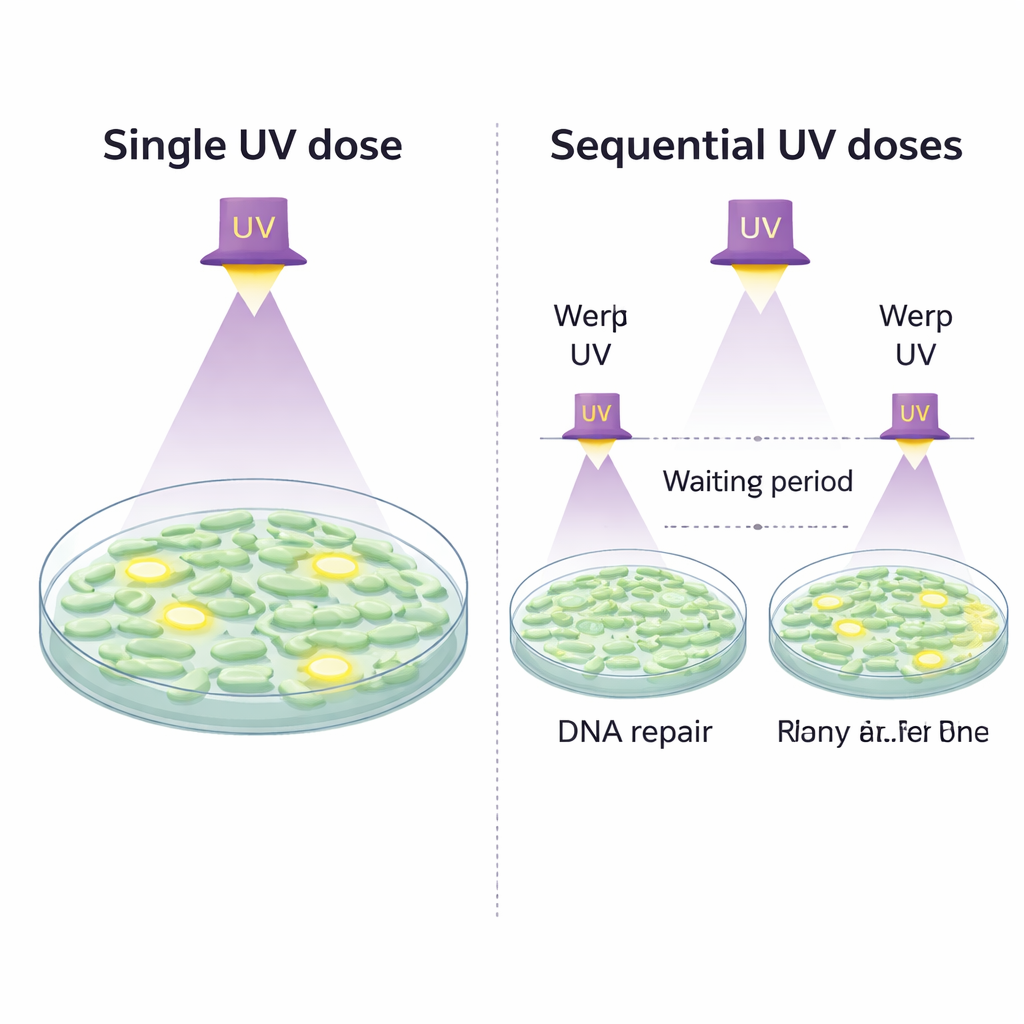
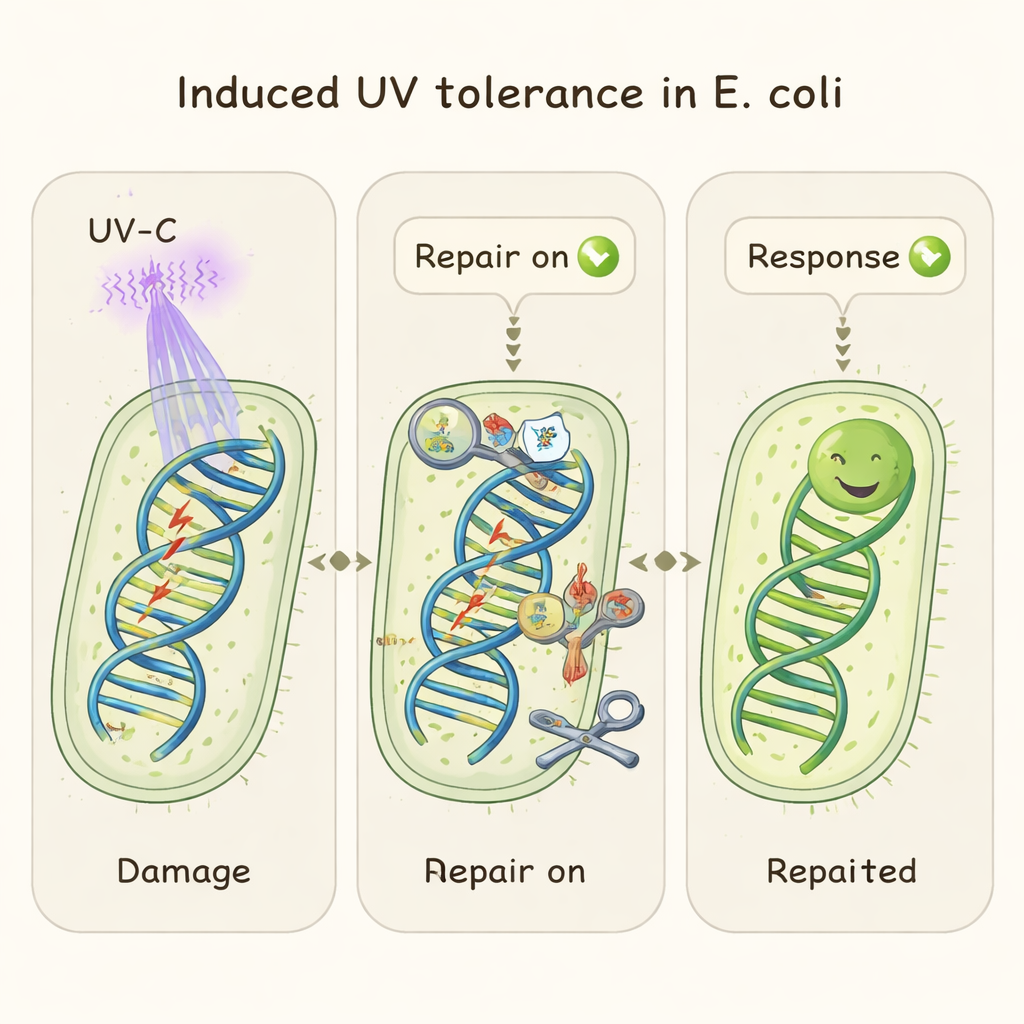
The story changed when the team split the UV dose into two parts. They first gave bacteria a modest UV “first hit,” waited 30 minutes in the dark to allow repair systems to respond, and then delivered a second UV exposure. If survival were purely a matter of chance, the fraction of cells living through both hits should equal the product of the two single-dose survival rates. Instead, the actual survival after sequential low doses was several times higher than this simple prediction, and higher than after a single, larger one-shot dose with the same total UV energy. This suggests that the first hit triggers DNA repair pathways, such as the well-known SOS response and nucleotide excision repair, that temporarily boost the cells’ ability to cope with later damage.
What this means for disinfection and survival
Put in everyday terms, this work shows that genetically identical E. coli cells are not protected from UV because some are “born” shielded; rather, most survivors rapidly toughen up after the first exposure by switching on emergency DNA repair. This induced, short-lived tolerance helps them ride out further UV stress better than expected. For technologies that rely on UV to disinfect water, surfaces, or medical equipment, it implies that dose patterns and timing matter, not just the total energy delivered. Understanding how bacteria dynamically repair their DNA under repeated stress could guide more reliable sterilization strategies and deepen our grasp of how simple organisms adapt to harsh environments without changing their genes.
Citation: Ichikawa, S., Tanoue, M., Takeuchi, J. et al. Induced tolerance to UV stress drives survival heterogeneity in isogenic E. coli cell populations. Sci Rep 16, 5931 (2026). https://doi.org/10.1038/s41598-026-36328-1
Keywords: UV stress tolerance, Escherichia coli, DNA repair, bacterial persisters, SOS response